
The biggest drain on your car budget isn’t the car itself, but the belief that you’re trapped into paying dealership prices to protect your warranty.
- The law in many regions protects your right to use certified independent garages for all routine maintenance.
- A complete service history, even from an indie shop, is your single most powerful tool for preserving resale value.
Recommendation: Stop being a passive customer. Start asking the right questions, demand justification for every line item, and you’ll cut costs without ever cutting corners.
That sinking feeling when the annual service bill arrives is something every car owner knows. It often feels like a choice between two evils: pay the sky-high dealership prices to keep that precious warranty stamp, or risk it with a cheaper, unknown garage and potentially void your coverage. For years, this has been the accepted wisdom, forcing owners to overpay for routine work like oil changes and brake inspections. But as a former workshop manager, I’m here to tell you that this is a false choice, a myth that costs you thousands over the life of your vehicle.
The common advice is to « shop around, » but that’s only scratching the surface. True savings don’t come from just finding a cheaper hourly rate. They come from a fundamental shift in mindset: you need to stop thinking like a customer and start thinking like a mechanic. It’s about understanding the system, speaking the language, and taking active control of your car’s health and your own wallet. It’s about knowing which parts are worth paying for, how to tell a necessary repair from a blatant upsell, and why a well-kept paper trail is worth more than any loyalty discount.
Forget the fear and uncertainty. This guide will give you the insider’s playbook. We’ll break down exactly what your rights are, how to choose the right service for your needs, and how to talk to a garage to get the work you need—and only the work you need—done right. By the end, you won’t just be saving money; you’ll be a more empowered, knowledgeable car owner who can protect your investment for years to come.
text
This article provides a clear roadmap to smarter car maintenance. We’ll cover everything from your legal rights regarding the warranty to the practical checks you can perform yourself to avoid costly surprises.
Contents: A Smart Owner’s Guide to Car Maintenance Savings
- Full or Intermediate Service: Which to Choose for an Average Driver?
- Why Paying Dealer Labor Rates Is No Longer Mandatory for the Service Book?
- A Car Without a Service Book: The Risky Gamble to Absolutely Avoid
- How to Spot ‘Upselling’ on Your Service Quote?
- When to Change the Timing Belt: The Signs That Don’t Lie
- OEM vs. Aftermarket Parts: Is There a Real Quality Difference?
- The 5 Simple Checks to Do Yourself the Day Before the Annual Inspection
- How to Double Your Engine’s Lifespan with Preventive Maintenance?
Full or Intermediate Service: Which to Choose for an Average Driver?
The first step in taking control of your maintenance costs is understanding what your car actually needs. Garages often present a single, expensive « annual service » package, but this one-size-fits-all approach rarely fits the average driver. The reality is that maintenance is based on two factors: mileage and time. Your job is to align your service schedule with your actual usage, not a generic calendar date.
A Full Service (or Major Service) is the comprehensive check-up. It typically includes an oil and filter change, air filter replacement, spark plugs, and a deep inspection of the brakes, suspension, and other critical systems. This is essential, but a car covering low annual mileage (e.g., under 8,000 miles a year) might not need this every 12 months. Conversely, a high-mileage driver might need one sooner.
An Intermediate Service (or Minor Service) is a lighter, more frequent check. This usually involves an oil and filter change and a visual inspection of key safety items like tires, lights, and fluid levels. For a city commuter, an intermediate service combined with a full service every 24 months might be far more cost-effective. While some in-depth tasks are for the pros, there are essential checks that take less than ten minutes. Staying on top of these at least once a month, like ensuring the engine always has enough oil, is a core part of this intermediate approach and keeps the vehicle in good shape between major garage visits.
Why Paying Dealer Labor Rates Is No Longer Mandatory for the Service Book?
Let’s get one thing straight: the idea that you *must* service your car at the main dealership to keep your warranty is the most expensive myth in the automotive world. For years, dealerships have used this fear to justify inflated labor rates and part prices. The truth is, consumer protection laws in many countries give you the right to choose where you have your car serviced without affecting your warranty coverage.
The key condition is that the maintenance must be performed according to the manufacturer’s specifications, using parts of an appropriate quality, and by a qualified technician. A professional, certified independent garage ticks all these boxes. As long as you keep detailed receipts and ensure your service book is stamped, you have all the proof you need. In fact, the Bureau of Automotive Repair in California makes this crystal clear:
You do not need to take your vehicle to the dealership for warranty repairs. By law, your vehicle warranty will stay in effect if you get repairs or maintenance at another auto shop.
– Bureau of Automotive Repair, California Bureau of Automotive Repair Official Guidelines
The financial incentive for making the switch is significant. Independent garages don’t have the massive overheads of a main dealer, and this is reflected in the price. In many cases, independent shops can have labor rates 30-50% lower than their dealership counterparts for the exact same job. Choosing a trusted independent specialist is not about cutting corners; it’s about paying for expertise, not for a fancy showroom.
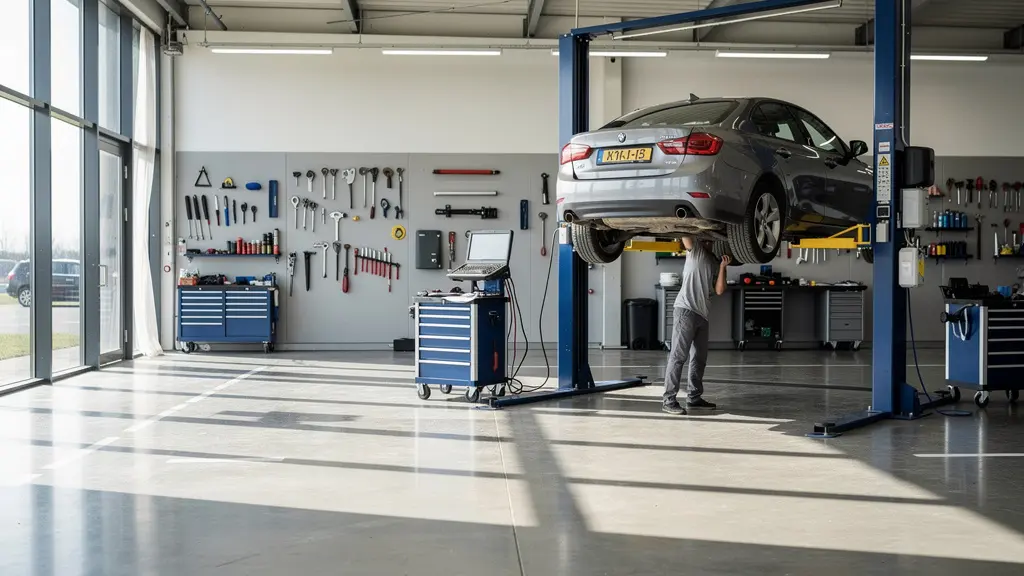
A reputable independent workshop provides the same level of care and diagnostic capability, ensuring your service record remains complete and your warranty secure. The focus is on quality work, not brand prestige, which translates directly into savings for you.
A Car Without a Service Book: The Risky Gamble to Absolutely Avoid
If choosing an independent garage is the smartest move for your wallet, then neglecting your service history is the fastest way to destroy your car’s value. A car without a complete service book is a giant red flag for any potential buyer. It screams neglect and signals a future of expensive, unknown problems. This isn’t just about trust; it has a direct and measurable impact on what your car is worth.
Think of your service history as your car’s résumé. Every stamp and every receipt is proof that the vehicle has been cared for. It demonstrates that critical tasks, from oil changes to timing belt replacements, have been done on time. Without this « paper trail imperative, » a buyer has to assume the worst. Comprehensive vehicle history data reveals this gamble can result in an average loss of over $1,700 for cars without proper service records. In many cases, especially for premium or performance vehicles, the loss can be far greater.
The difference in buyer confidence is stark, directly affecting not only the final price but also how quickly you can sell the car. As a recent comparative analysis shows, a full history is a non-negotiable asset.
| Service History Status | Average Value Retention | Buyer Confidence Level | Sale Time |
|---|---|---|---|
| Complete Digital + Paper Records | 85-90% of market value | High | 7-14 days |
| Partial Records (Major Services Only) | 75-80% of market value | Moderate | 21-30 days |
| No Service History | 65-70% of market value | Low | 45+ days |
Whether you use a dealer or a trusted independent, insist on a stamped book and keep every single invoice. This meticulous record-keeping costs you nothing but a few minutes of organization, yet it pays for itself many times over when it’s time to sell.
How to Spot ‘Upselling’ on Your Service Quote?
Once you’re at the service counter, you’ve entered a new battleground: the upsell. Service advisors are often trained and incentivized to sell you additional work that isn’t strictly necessary. Flushing fluids « just in case, » replacing parts that are only partially worn, or adding various « treatment » packages are common tactics. Your defense is to be prepared and to master the Service Counter Dialogue. You must be polite but firm, and ask the right questions.
The first red flag is a vague recommendation. If an advisor says you « need » new brake pads, your question should be, « What is the exact measurement in millimeters, and what is the legal minimum? » If they suggest a fuel system cleaning, ask them, « What specific symptom or diagnostic reading indicates this is required right now? » Put the onus on them to provide concrete data, not just opinions. A professional mechanic will respect this; a salesperson will falter.
Before you even hand over your keys, set clear boundaries. A simple script can prevent 90% of upselling attempts. Here are the key phrases you should use to control the conversation from the start:
- Before drop-off: « I’m here for the scheduled 30,000-mile service only. Please call me for authorization before performing any additional work whatsoever. »
- When reviewing the quote: « Can you please separate this quote into two parts? The items required by the manufacturer’s schedule, and the items you are recommending additionally. »
- For ‘amber’ or ‘advisory’ items: « What specific test or measurement determined this part needs attention? How long do you estimate it will last before it becomes a safety issue? »
- If pressured: « My budget today is strictly for the scheduled service. Please provide me with a written quote for the additional items so I can address them at a later date. »
This approach isn’t about being difficult; it’s about being a smart consumer. You are paying for a service, and you have the right to know exactly what you’re paying for and why it’s necessary.
When to Change the Timing Belt: The Signs That Don’t Lie
While some upselling is for minor items, there are critical components where you must never cut corners. The timing belt is chief among them. This is one area where preventive maintenance isn’t just a suggestion—it’s an absolute necessity. A timing belt failure is one of the most catastrophic (and expensive) non-accident events that can happen to an engine.
A timing belt is a reinforced rubber belt that synchronizes the rotation of the engine’s crankshaft and camshafts. This ensures the engine’s valves open and close at the correct time. If this belt snaps, the pistons can slam into the open valves, causing massive internal engine damage. The difference in cost is staggering; an automotive repair cost analysis shows a preventive replacement costs $400-$1,000, versus a $3,000-$5,000 bill for repairing the engine damage after a failure.
Unlike a tire or brake pads, a timing belt rarely gives obvious warning signs before it fails. You can’t rely on hearing a noise. Instead, you must follow two rules:
- Adhere to the Manufacturer’s Interval: Your car’s service manual will specify a replacement interval, usually between 60,000 and 100,000 miles or a certain number of years (e.g., 7-10 years), whichever comes first. This is a non-negotiable deadline.
- Visual Inspection During Other Services: When the car is in for other work, ask the mechanic to visually inspect the belt. They are looking for specific signs of wear that indicate it’s time for a change, even if you haven’t reached the mileage limit yet.

As the close-up shows, mechanics look for tiny cracks on the belt’s surface, fraying at the edges, or a glossy, hardened appearance on the teeth. These are all signs that the rubber is degrading and the belt’s integrity is compromised. When replacing the belt, it’s also standard practice to replace the water pump and tensioners at the same time, as they run on the same system and the labor is already being done.
OEM vs. Aftermarket Parts: Is There a Real Quality Difference?
Once you’ve chosen an independent garage, the next big decision is about the parts themselves. This is where a lot of confusion—and potential savings—lies. The terms OEM, OES, and Aftermarket are thrown around, but what do they actually mean for your car’s safety, performance, and value? Understanding this Parts Hierarchy is crucial.
The quality and cost can vary dramatically, and the right choice often depends on the specific part and the age of your vehicle. A brand new car under warranty has different needs than a 10-year-old daily driver. Here’s a breakdown to help you make an informed decision:
| Part Type | Quality Level | Cost vs. OEM | Warranty Impact | Best Use Case |
|---|---|---|---|---|
| OEM (Original Equipment Manufacturer) | Exact Match | 100% (baseline) | Full Protection | Critical sensors, ECUs, warranty work |
| OES (Original Equipment Supplier) | 95-100% | 70-85% | Full Protection | Most mechanical parts (brakes, suspension) |
| Premium Aftermarket | 85-95% | 50-70% | Varies by warranty | Wear items (filters, wipers), upgrades |
| Budget Aftermarket | 60-80% | 30-50% | May void warranty | Older vehicles, non-critical components |
OEM parts are identical to those your car was built with, sold in a box with the carmaker’s logo. OES parts are often the secret to smart savings; they are made by the very same company on the same production line as the OEM part, but sold in their own box without the carmaker’s markup. For most mechanical repairs, they offer identical quality for less money. Premium Aftermarket parts come from reputable brands (like Bosch, Brembo, or ZF) and are designed to meet or exceed OEM standards. Finally, Budget Aftermarket parts are the cheapest option, but their quality can be a lottery. They are best avoided for anything related to safety or engine performance.
The 5 Simple Checks to Do Yourself the Day Before the Annual Inspection
The annual inspection (often called MOT, safety inspection, or roadworthiness test) can be a source of anxiety and unexpected costs. However, a huge number of failures are for simple, easily fixable issues that you can spot yourself in 15 minutes on your driveway. In fact, some vehicle inspection data reveals that up to 73% of failures are from simple, preventable issues like blown bulbs or worn wipers. Doing a pre-inspection check doesn’t just save you the cost of a potential re-test; it saves you the time and hassle of an unnecessary failure.
Before you take your car to the garage, run through this quick and simple action plan. It covers the most common failure points and requires no special tools. This is your first line of defense against a failed test.
Your Pre-Inspection Action Plan: 5 Checks to Avoid Failure
- Test All Lights: With the engine running, walk around the car and check all exterior lights: headlights (low and high beam), turn signals, parking lights, and taillights. Ask a friend to help you check the brake lights, or simply reverse towards a wall or garage door at night and look for the reflection.
- Check the Horn: A simple but often overlooked check. Give the horn a firm press. It should produce an immediate, clear, and continuous sound. A weak or non-functional horn is an instant failure.
- Inspect Windscreen & Wipers: Check the windscreen for any cracks or large chips in the driver’s line of sight. Then, test the wipers. They should clear the screen effectively without smearing, streaking, or skipping. Lift the blades and check the rubber for tears or hardening.
- Verify Tire Tread & Condition: Check the tread depth across all tires. A common method is the « penny test, » but a proper tread depth gauge is cheap and more accurate. Look for any bulges, cuts, or uneven wear patterns, which could indicate alignment or suspension issues.
- Check All Fluid Levels: With the car on level ground and the engine cool, check the engine oil, coolant, brake fluid, and windscreen washer fluid. Ensure all reservoirs are filled between the MIN and MAX marks and look for any obvious signs of active leaks on the ground underneath the car.
By identifying and fixing these minor issues beforehand—like replacing a 50-cent bulb—you transform the official inspection from a potential expense into a simple, pass-guaranteed formality.
Key Takeaways
- Your Warranty is Protected: You have the legal right to service your car at any certified independent garage without voiding your manufacturer’s warranty.
- Documentation is Everything: A complete and detailed service history is your most valuable asset, directly preserving your car’s resale value.
- Preventive is Cheaper than Reactive: Spending money on scheduled maintenance for critical parts like the timing belt is an investment that prevents catastrophic and far more expensive failures down the line.
How to Double Your Engine’s Lifespan with Preventive Maintenance?
Everything we’ve discussed—choosing the right garage, keeping records, and making smart decisions on parts—ultimately serves one master goal: longevity. The aim isn’t just to save money on a single service bill, but to extend the life of your entire vehicle, especially its most expensive component: the engine. This requires a mindset I call Mechanical Empathy. It’s about understanding that your car is a complex system of moving parts and that proactive care is infinitely better than reactive repair.
Following the manufacturer’s service schedule is the baseline, but true longevity often comes from going slightly beyond it. This is where the wisdom of seasoned mechanics comes into play, who often recommend more frequent fluid changes than the manufacturer, whose main goal is to advertise a low cost of ownership for the first few years. As renowned independent mechanic and YouTube educator « The Car Care Nut » often emphasizes, optimal care goes beyond the book:
The Car Care Nut shares unique maintenance tips tailored to enhance vehicle longevity beyond standard manufacturer recommendations. He emphasizes the importance of regular oil changes every 5,000 miles for optimal engine performance. Coolant replacement every 50,000 miles or 5 years is crucial to prevent overheating…
– The Car Care Nut, YouTube Channel Automotive Maintenance Guide
Clean oil is the lifeblood of your engine. It lubricates, cleans, and cools. Extending oil change intervals to the absolute maximum might save a few dollars in the short term, but it allows for the buildup of sludge and increases long-term wear. The same principle applies to transmission fluid, coolant, and brake fluid. These fluids degrade over time, and replacing them proactively is a small investment that prevents the failure of transmissions, radiators, and braking systems costing thousands to repair.
Ultimately, taking control of your car’s maintenance is the most significant step you can take toward financial savings and peace of mind. Start today by reviewing your service history, finding a trusted local independent specialist, and preparing for your next service with confidence and knowledge.