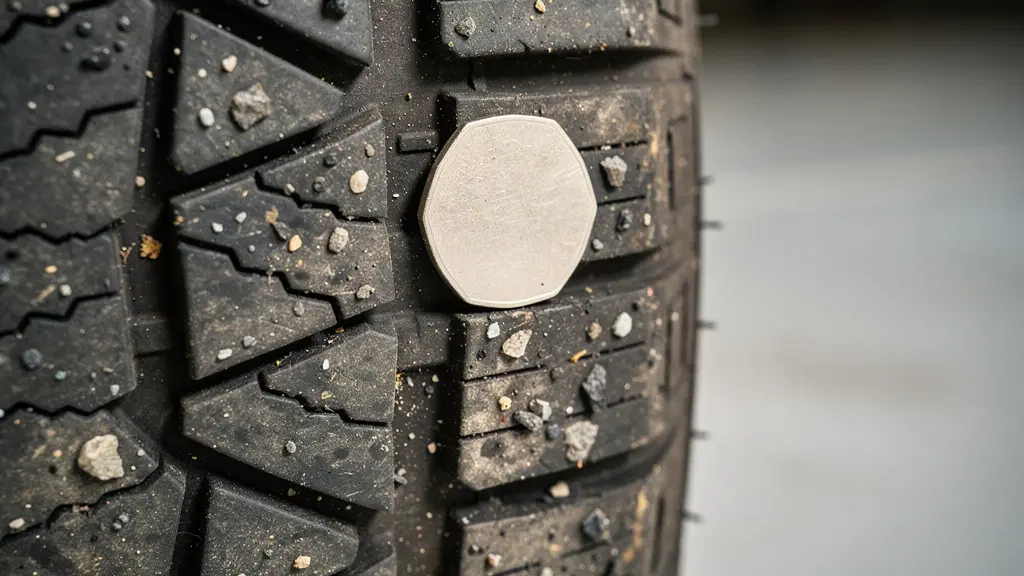
Relying on the 1.6mm legal tyre tread limit is one of the most dangerous gambles a driver can take; the safety margin has already vanished by that point.
- Braking distance in the wet can increase by 44% when tread drops from 3mm to 1.6mm.
- Fines of up to £2,500 and 3 penalty points are applied *per tyre*, not per vehicle.
Recommendation: Use the 20p coin test monthly. If the outer band is visible, your safety is already compromised and it’s time to change your tyres, regardless of the law.
As a traffic officer, I’ve seen the aftermath of countless incidents on our roads. And more often than you’d think, the root cause isn’t speed or distraction, but something far more basic: the four small patches of rubber connecting a car to the tarmac. Many drivers believe that as long as their tyre tread is above the legal minimum of 1.6mm, they’re safe. They’ve heard about the 20p test, but they see it as a simple pass-or-fail check for legal compliance.
This mindset is a critical mistake. The law is a bare minimum, not a benchmark for safety. By the time your tyres are down to 1.6mm, their ability to grip the road in wet conditions has been dangerously compromised. The difference between the legal limit and a safe 3mm of tread can be the difference between a controlled stop and a catastrophic skid. It’s a risk that could cost you far more than just a fine.
But the rules aren’t there just to catch you out. They’re based on the fundamental physics of road safety. This guide is designed to give you the perspective from my side of the windscreen—to help you understand not just the letter of the law, but the real-world reasons behind it. It’s about learning to read the language your tyres are speaking and taking action before you see blue lights in your rearview mirror, or worse.
This article will walk you through the crucial checks that keep you safe and legal. We will cover the vital difference between the legal minimum and a safe tread depth, how to diagnose problems by looking at wear patterns, and the true financial penalty of neglect. Consider this your official briefing on tyre safety.
Summary: The Officer’s Guide to Tyre Safety and Legal Compliance
- Why changing at 3mm is safer than waiting for the legal limit of 1.6mm?
- Wear on the edges or in the centre: what your tyres are telling you about your pressure
- How to spot a nail or a crack before the motorway blowout?
- Winter tyres in summer: is it illegal or just inefficient?
- Did you know the fine applies per tyre and not per vehicle?
- Why multiplying your distances by 10 on black ice isn’t an exaggeration?
- Why do low-profile tyres burst more quickly on UK roads?
- The burnt-out number plate bulb that fails 15% of cars unnecessarily
Why Changing at 3mm Is Safer Than Waiting for the Legal Limit of 1.6mm?
Let’s be clear: the 1.6mm legal limit is not a target to aim for; it’s the absolute cliff edge of safety you should never approach. The primary job of your tyre’s tread is to channel water away from the contact patch to prevent aquaplaning. As the tread depth decreases, its ability to do this job diminishes exponentially. At 3mm, your tyres are still performing effectively. Below this, you enter a critical zone where safety is significantly compromised, especially on Britain’s rain-soaked roads.
Think of it as a safety margin. Car manufacturers and safety experts agree that 3mm is the point at which you should be planning to replace your tyres. Waiting until they are at 1.6mm means you have exhausted that entire margin. Research is unequivocal on this point. Studies have found a staggering 44% increase in wet braking distance when a tyre’s tread goes from a healthy depth down to 1.6mm. In a real-world emergency stop, that is a huge difference.
Case Study: The Auto Express Emergency Stop Test
To put this into perspective, consider the findings from a test conducted by Auto Express. When performing an emergency stop from just 50mph in wet conditions, a vehicle with tyres at the 3mm mark came to a halt safely. The same vehicle, with tyres worn down to the 1.6mm legal limit, took an extra 44 metres to stop. That’s equivalent to the length of ten Ford Fiestas parked end-to-end. In a situation involving a pedestrian or a stationary queue of traffic, that extra distance is the definition of a disaster.
So, when you use the 20p test, don’t just check if the coin’s outer band is hidden. If the tread is getting close to being level with that band, your safety is already on the decline. Changing at 3mm isn’t an upsell from a garage; it’s sound advice based on the physics of grip.
Wear on the Edges or in the Centre: What Your Tyres Are Telling You About Your Pressure
Your tyres communicate with you constantly; you just need to learn their language. Uneven tread wear is a clear signal that something is wrong with your vehicle’s setup, most commonly the tyre pressure. Ignoring these signs not only accelerates wear and costs you money in fuel and premature replacements, but it also compromises handling and safety. A regular visual inspection is a crucial part of your driver’s responsibility.
The pattern of wear tells a specific story. If you see the centre of the tread wearing down faster than the edges, it’s a classic sign of over-inflation. The tyre is bulging in the middle, concentrating all the force and wear on a narrow central strip. Conversely, if both outer edges (or ‘shoulders’) are wearing faster than the middle, your tyres are under-inflated. The centre of the tread bows inwards, forcing the shoulders to take all the strain. Both conditions reduce the size of the contact patch, decreasing grip and stability.
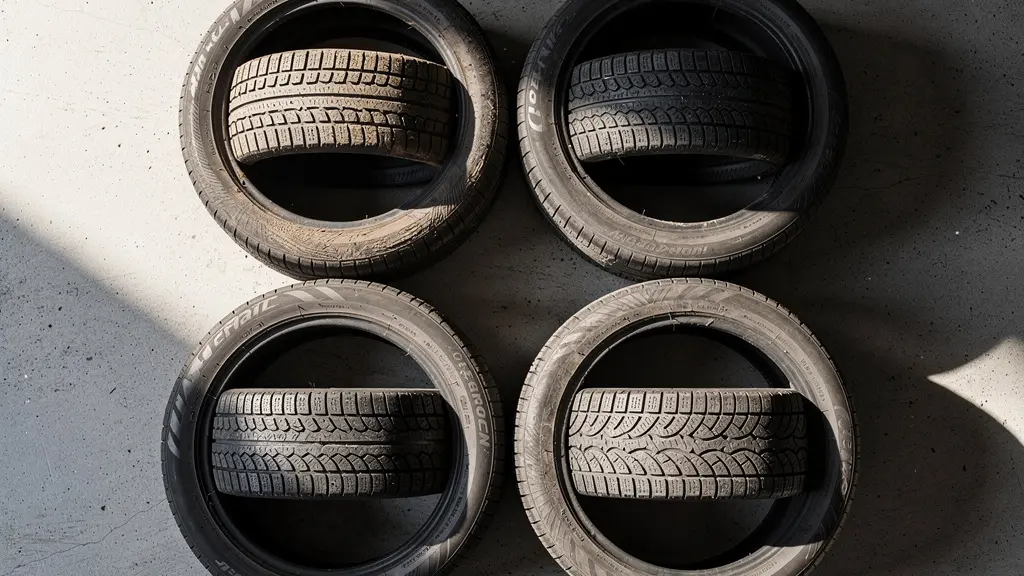
Other patterns can indicate more serious mechanical issues. Wear on just one side of the tyre often points to a wheel alignment problem, while patchy or ‘scalloped’ wear can be a symptom of worn-out suspension components. The table below serves as a basic diagnostic guide for these common issues.
| Wear Pattern | Cause | Solution |
|---|---|---|
| Centre wear (middle wearing faster) | Over-inflation | Reduce pressure to manufacturer specs |
| Edge wear (both shoulders wearing) | Under-inflation | Increase pressure to correct PSI |
| One-sided wear | Wheel alignment problems (camber/toe) | Professional alignment check needed |
| Cupping/scalloping (patchy wear) | Worn suspension components | Suspension inspection required |
How to Spot a Nail or a Crack Before the Motorway Blowout?
While gradual tread wear is the most common issue, sudden and catastrophic tyre failure is the scenario every driver dreads. A blowout at 70mph on a busy motorway is an extremely dangerous event. Fortunately, many of these failures don’t happen without warning. A regular, thorough visual and tactile inspection can help you spot the danger signs long before they escalate into a crisis.
Your weekly checks should go beyond just tread depth and pressure. Run your hands carefully over the entire surface of the tyre, including the inner and outer sidewalls. You are looking for anything out of the ordinary: small nails, screws, or shards of glass embedded in the tread. You should also check for any cuts, cracks, or splits in the rubber, particularly on the sidewall. These can be caused by ‘kerbing’ the tyre or driving over debris, and they can weaken the tyre’s structure over time.
The most critical warning sign is a lump or bulge on the sidewall. This indicates that the internal structure of the tyre—the strong ply cords that form its carcass—has been damaged, typically after hitting a pothole. According to a report on tyre legality, damaged cords produce a weakness within the tyre which is most likely to fail when under maximum stress, such as at high speed. A bulge is a blowout waiting to happen.
As the UK’s leading tyre safety charity, TyreSafe, advises, this is not a situation to ignore. Their guidance is clear and should be treated as a direct order:
Tyres with lumps or bulges must be examined by a tyre specialist since these could indicate internal damage
– TyreSafe UK, TyreSafe Tyre Condition Guide
Winter Tyres in Summer: Is It Illegal or Just Inefficient?
Fitting the correct tyres for the season isn’t just a recommendation for snowy climates; it’s a matter of fundamental vehicle dynamics. While it is not explicitly illegal to use winter tyres during the summer in the UK, doing so is both inefficient and unsafe. The two types of tyres are engineered with vastly different rubber compounds to perform in specific temperature ranges.
Winter tyres are made with a much softer compound, rich in natural rubber, which stays flexible in temperatures below 7°C. This allows them to maintain grip on cold, icy, or snowy roads. However, when you use these tyres in warm summer conditions, that soft compound becomes a major liability. The rubber becomes overly pliable, almost like chewing gum on hot pavement. This has two dangerous effects: it significantly increases braking distances and negatively affects the vehicle’s handling and stability, especially during cornering.
Furthermore, this accelerated wear will destroy a set of expensive winter tyres in a single season of warm-weather driving. You are literally leaving money on the road with every mile you drive. Beyond the financial and safety implications, there’s a contractual one to consider. In the event of an accident, your insurance company could argue that your vehicle was not in a roadworthy condition due to the use of inappropriate tyres for the season. This could potentially invalidate your policy, leaving you with a massive bill.
The rule of thumb is simple: when the ambient temperature is consistently above 7°C, you should be on summer or all-season tyres. Sticking with winter tyres all year round is a false economy that compromises your safety.
Did You Know the Fine Applies Per Tyre and Not Per Vehicle?
This is a point of law that catches many drivers by surprise and turns a costly mistake into a financially crippling one. The penalty for driving with illegal tyres is not a single, flat fine for the vehicle. The law is applied on a per-tyre basis. This means if you are stopped and found to have all four tyres below the 1.6mm legal limit, you are facing four separate offences. The potential consequences are severe and cumulative.
The problem is alarmingly common. Data gathered from tyre retailers and garages suggests that over 6 million tyres in the UK are found with illegal tread depth every year. Many of these drivers are completely unaware of the risk they are running, both in terms of safety and their driving licence.
The £10,000 Worst-Case Scenario
Let’s break down the maths. As detailed in legal guidance from the RAC, the maximum penalty for a single defective tyre is a fine of up to £2,500 and three penalty points on your licence. If all four of your car’s tyres are found to be illegal, you could face a staggering total fine of £10,000 and 12 penalty points. Twelve points mean an automatic driving disqualification. This isn’t a theoretical scare tactic; it’s the maximum sentence available to the courts, and it demonstrates how seriously this offence is treated. Even for a single illegal tyre, the potential for a £2,500 fine and 3 points is a significant deterrent.
This « cumulative risk » is why a quick check is so important. What might seem like a minor oversight can quickly escalate into the loss of your licence and a fine that could have bought you a new car. The cost of a new set of premium tyres pales in comparison to the potential legal and financial fallout of neglect.
Why Multiplying Your Distances by 10 on Black Ice Isn’t an Exaggeration?
Of all road conditions, black ice is the most treacherous because it’s often invisible. It forms on cold, damp surfaces and creates a near-frictionless layer between your tyres and the road. In these conditions, the concept of normal braking distance becomes almost irrelevant. The widely-cited advice to increase your following distance by a factor of ten is not an overstatement; it’s a stark reflection of the laws of physics.
The ability of a tyre to grip the road is measured by its coefficient of friction. The higher the number, the more grip you have. On a dry road, this coefficient is high. On a wet road, it’s lower. On snow, it’s lower still. On black ice, it is catastrophically low, approaching the level of lubricated steel on steel. The data makes this terrifyingly clear.
As this comparative analysis of friction shows, the reduction in grip is dramatic. A car that can stop in a certain distance on a dry road will require nearly ten times that distance to stop on an icy one.
| Surface Condition | Friction Coefficient | Relative Stopping Distance |
|---|---|---|
| Dry Tarmac | 0.7-0.8 | 100% (baseline) |
| Wet Tarmac | 0.4-0.5 | 140-180% |
| Snow | 0.2-0.3 | 300-400% |
| Black Ice | 0.05-0.1 | 800-1000% |
In these situations, modern electronic aids like ABS and traction control can become almost useless. They are designed to manage wheel spin or lock-ups when there is at least some grip to work with. On black ice, there is often nothing for them to manage. As technical experts at the RAC point out, these systems are not magic.
ABS and traction control rely on having some grip to work with. On black ice, there is often no grip to manage
– RAC Technical Services, Winter Driving Safety Guide
Key Takeaways
- The legal tread limit of 1.6mm is a minimum for legality, not safety; change tyres at 3mm.
- Uneven tyre wear is a clear sign of pressure or alignment issues that compromise handling.
- Fines and penalty points are cumulative, applying to each illegal tyre individually, which can lead to a £10,000 total fine and disqualification.
Why Do Low-Profile Tyres Burst More Quickly on UK Roads?
Low-profile tyres are a popular choice for their sporty appearance and sharper handling characteristics. However, they have a significant vulnerability, particularly on the often poorly maintained surfaces of many UK roads. The « profile » of a tyre refers to the height of its sidewall. A low-profile tyre has a much shorter, stiffer sidewall than a standard tyre. While this reduces flex and improves steering response, it also removes a crucial layer of cushioning.
When a vehicle with low-profile tyres hits a sharp-edged pothole, the impact force has nowhere to go. The short sidewall is violently compressed against the wheel rim, « pinching » the tyre’s internal structure. This is known as a « pinch flat » or impact fracture. It can cause immediate deflation or, more dangerously, create an internal weakness that leads to a bulge and a subsequent blowout at high speed. Standard tyres with taller, more flexible sidewalls are much better at absorbing these impacts without sustaining damage.
This makes driving on low-profile tyres in the UK a calculated risk that requires extra vigilance. The reduced cushioning doesn’t just affect the tyre; it also transfers more impact stress to the suspension components and the alloy wheels themselves, which are expensive to repair or replace. If you drive a car with low-profile tyres, a diligent inspection routine is not optional.
Your Action Plan: Low-Profile Tyre Risk Assessment
- Assess sidewall height: Be aware that lower profiles have less ability to absorb impacts from potholes and road imperfections.
- Inspect for pinch damage: After hitting a significant pothole, always perform a visual and tactile check for any new bulges on the inner and outer sidewalls.
- Check for wheel damage: At the same time, inspect the edge of the alloy wheel for cracks or dents, as the impact force transfers directly to it.
- Monitor for suspension issues: Be alert to new noises or changes in handling, as the increased stress can accelerate wear on suspension components.
The Burnt-Out Number Plate Bulb That Fails 15% of Cars Unnecessarily
The annual MOT test feels like a final exam for your car’s health, but roadworthiness is a year-round responsibility. While this article focuses on tyres, the mindset extends to all aspects of your vehicle. A simple blown bulb for your number plate can cause an MOT fail, but an illegal tyre can get you prosecuted at any time. The statistics are stark: according to the tyre safety charity TyreSafe, dangerous and illegal tyres contribute to over 2 million MOT failures in the UK every year.
This highlights a dangerous misconception many drivers have. They assume that if their car has a valid MOT certificate, it must be legal. This is incorrect. An MOT certificate is only a snapshot confirming that your vehicle met the minimum legal standards on the day of the test. The moment you drive away, the responsibility for maintaining that standard falls back on you, the driver.
A tyre that was legal on the day of the test can easily become worn and illegal a few thousand miles later. A police officer can stop you and check your tyres at any time, and your MOT certificate will not be a defence if they are found to be below the legal limit. As one servicing expert puts it, the certificate is no shield from on-the-spot enforcement.
A valid MOT certificate is not a ‘get out of jail free’ card. Police can issue on-the-spot fines (£100) and 3 penalty points for illegal tyres at any time
– Eden Tyres & Servicing, Tyre Safety Guide
This is why regular checks of everything—lights, wipers, and especially tyres—are not just for passing the MOT, but for ensuring you are safe and legal every single day you are on the road. The 20p test is your best tool for continuous compliance.
Don’t wait for the MOT reminder or the sight of blue lights in your mirror. Go outside now, take a 20p coin, and walk around your car. Give yourself the peace of mind that comes from knowing your vehicle is safe for you, your passengers, and everyone else on the road. It’s the most important five-minute journey you’ll make all week.