
A dashcam is not just a camera; it is your only objective witness in a system designed to doubt your word.
- Footage must be clear, legally obtained, and properly handled to be admissible.
- Frame rate (60fps) often matters more than 4K resolution for capturing license plates.
Recommendation: Treat your footage like forensic evidence. Secure the file immediately, do not edit it, and declare your device to your insurer to potentially unlock specific protections.
Every day, thousands of drivers find themselves standing on the side of the road, looking at a dented bumper and a stranger who is already lying to the police. The sinking feeling isn’t just about the damage; it’s the realization that without proof, your no-claims bonus and your premiums are at the mercy of a « he said, she said » debate. In the world of insurance claims, the truth is secondary to what can be proven.
While many drivers believe simply suction-cupping a device to their windshield is the ultimate shield, the reality of forensic video analysis is far more complex. It is not just about having a recording; it is about the chain of custody, the technical quality of the capture, and the legality of the surveillance itself. From determining liability in a split-second brake check to disputing a staged accident, the difference between a rejected claim and a payout lies in the details.
But what if the key to protection wasn’t just the hardware, but how you manage the data it creates? Effective defense against « Cash for Crash » schemes requires thinking less like a driver and more like an investigator. We will examine how to transform raw video files into irrefutable evidence that cuts through the bureaucracy.
To navigate this technical landscape, we must break down the evidence lifecycle, from the moment of impact to the final settlement negotiation.
Summary: The Investigator’s Handbook
- 38.1:Comment une vidéo de 30 secondes peut accélérer votre remboursement de 3 mois ?
- 38.2:Installation « Hardwire » : comment brancher la caméra proprement sur la boîte à fusibles ?
- 38.3:Surveillance parking : votre caméra va-t-elle vider votre batterie la nuit ?
- 38.4:Filmer la route en Europe : dans quels pays votre Dashcam est-elle illégale ?
- 38.5:4K ou 1080p : quelle qualité faut-il pour lire une plaque d’immatriculation la nuit ?
- 11.3:Comment réagir face à un conducteur agressif sans escalader le conflit ?
- Rayure de clé sur le parking : déclarer ou payer de sa poche ?
- 30:Comment structurer votre police d’assurance pour ne payer que ce qui est nécessaire ?
How Can a 30-Second Video Speed Up Your Reimbursement by 3 Months?
In the aftermath of an accident, insurance adjusters are primarily looking for one thing: liability clarity. A dispute over who drifted into whose lane can drag on for months, locking up your deductible and increasing your stress. Video evidence acts as a shortcut through this administrative gridlock. By providing an objective timeline of events, you remove the ambiguity that fraudsters rely on.
The impact on processing speed is measurable. Data indicates that dashcam footage settles insurance claims 35% faster than cases relying solely on witness statements. This acceleration happens because the footage often forces the opposing party to admit fault immediately, rather than waiting for a police report or court summons.
Case Study: The Belt Parkway Staged Crash
In November 2024, a driver on New York’s Belt Parkway found themselves the target of a classic « swoop and squat » scam. A vehicle cut in front and slammed on the brakes, forcing a collision. However, the victim’s dashcam captured the fraudsters deliberately reversing into the victim’s stopped car. This footage did not just expedite the claim; it led to the arrest of Maikel Martinez for insurance fraud and reckless endangerment, converting a potential liability into a criminal conviction for the scammer.
However, sending a raw video file isn’t always enough. You must present the evidence correctly to ensure it is prioritized by the claims department.
Action Plan for Submitting Evidence
- Secure the Evidence: Immediately save and lock the incident footage on the device to prevent it from being overwritten by the loop recording cycle.
- Preserve Integrity: Retain the original video file with all metadata intact—never edit, trim, or alter the file before submission.
- Contextualize: Provide full recordings showing the minutes before and after the accident, not just the collision clip, to establish driving behavior.
- Submit Data: Send the raw footage with embedded GPS and timestamp data in your very first claim email to establish the facts immediately.
- Narrate: Include a clear written description of events that matches the video timeline to help the adjuster navigate the footage.
Once you understand the value of the footage, the next step is ensuring your camera is actually recording when it matters most.
Hardwire Installation: How to Connect the Camera Cleanly to the Fuse Box
A dashcam plugged into a cigarette lighter is a temporary solution that often fails at critical moments. The plug can vibrate loose, or you might forget to plug it in. For a « set it and forget it » reliability, hardwiring the unit directly into the vehicle’s fuse box is the professional standard. This method also frees up your 12V socket and hides unsightly cables.
The process involves using an « add-a-circuit » kit, which allows you to tap into an existing fuse slot without cutting any factory wires. You will be dealing with two types of power sources: ACC (Accessory), which powers on with the ignition, and Constant (BAT), which provides power even when the car is off—essential for parking surveillance.
Visualizing the connection is key to a safe installation. The image below illustrates the precision required when working within the fuse panel.
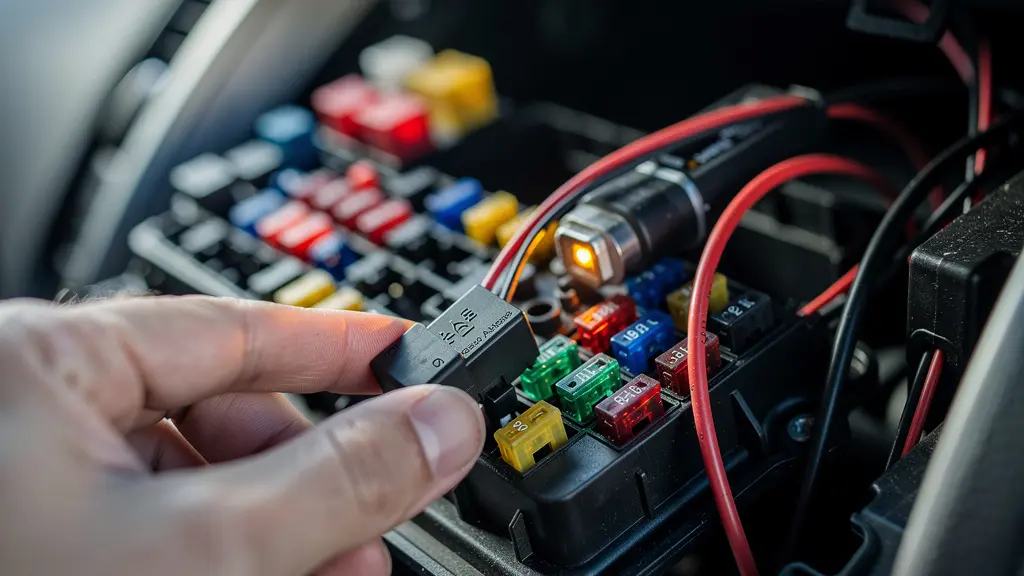
As seen in the detailed view above, the « add-a-circuit » tap (often with a red wire) replaces a standard fuse. It is crucial to orient the tap correctly to ensure the current flows through the fuse and protects your device. Always use a circuit tester to verify which side of the fuse slot is « hot » before inserting the tap.
Hardwiring provides the power, but it raises a new concern: the health of your vehicle’s battery during long surveillance sessions.
Parking Surveillance: Will Your Camera Drain Your Battery at Night?
The fear of waking up to a dead car battery is valid. A dashcam running in « Parking Mode » consumes power continuously to monitor for impacts or motion. If left unchecked, this can drain a standard lead-acid battery below the threshold required to crank the engine, leaving you stranded.
To prevent this, modern hardwire kits include a voltage cutoff feature. This acts as a safety gate: if the car battery’s voltage drops below a certain level, the camera shuts down to save the remaining power for the engine starter. Experts recommend setting this cutoff voltage between 12.2V to 12.4V to ensure reliable starting in all weather conditions.
However, relying solely on the car’s main battery isn’t the only option. Depending on your parking environment and budget, you might need a dedicated power solution.
The table below compares the three main power strategies for parking surveillance.
As outlined in this power solution comparison, a dedicated battery pack offers the highest protection but at a steeper cost.
| Solution Type | Cost Range | Recording Duration | Battery Protection |
|---|---|---|---|
| Direct Hardwire | $20-50 | 6-12 hours | Voltage cutoff only |
| LiFePO4 Battery Pack | $300-500 | 24-48 hours | Complete isolation |
| Timer Setting | $0 (built-in) | User defined | Time-based cutoff |
For those prioritizing vehicle health over continuous recording, the dedicated battery route is often the superior choice.
Adding a Dashcam in parking mode that constantly keeps the car’s batteries in a chronic deep discharge state is simply a bad idea in modern vehicles. Your best option for useful & competent parking mode is to use a LiFePO4 based dash cam specific battery pack system.
– DashCamTalk Forum Expert, DashCamTalk Technical Discussion Forum
While power management is a technical challenge, driving across borders introduces legal complexities that can render your footage useless or even illegal.
Filming the Road in Europe: In Which Countries is Your Dashcam Illegal?
Crossing a border in Europe changes more than just the speed limit; it changes your rights to record. Privacy laws, particularly GDPR, create a patchwork of regulations that can trap the unprepared driver. What is considered a prudent safety measure in the UK might be classified as illegal surveillance in Austria.
The visual landscape of legality is fragmented. The map below serves as a metaphorical guide to this complex regulatory environment.
As the image suggests, regulations overlap and diverge. In countries like Luxembourg and Austria, strict privacy laws historically made dashcam usage risky or prohibited. In contrast, France allows the recording for private use but strictly forbids publishing the footage online (social media) without blurring faces and license plates. The key is distinguishing between « personal exemption » and « systematic surveillance. »
GDPR Impact on Dashcam Usage Across EU Countries
As of February 2025, EU dashcam regulations vary dramatically: Austria and Luxembourg maintain strict prohibitions with dashcams considered illegal due to privacy laws. Germany allows usage with strict conditions – only for documenting specific incidents, not continuous surveillance. France and Belgium permit private use but prohibit public sharing without consent. Meanwhile, countries like Ireland require GDPR compliance including visible recording notices and data deletion policies.
Legality allows you to record, but only technical quality ensures that recording is useful. Resolution is often the most misunderstood specification.
4K or 1080p: What Quality Do You Need to Read a License Plate at Night?
Marketing often pushes « 4K » as the ultimate feature, but in the context of forensic analysis, resolution is not the only king. The ability to read a license plate on a moving vehicle at night depends heavily on frame rate (FPS) and the sensor’s dynamic range. A 4K image that is blurry due to low frame rate is less useful than a sharp 1080p image.
Motion blur is the enemy of evidence. Standard 30fps recording can result in a blurred plate if the relative speed between cars is high. Doubling the frame rate to 60fps captures twice as many moments per second, significantly increasing the chance of grabbing a crisp frame where the alphanumeric characters are legible.
The comparison below highlights the trade-offs between resolution, motion clarity, and storage.
As this resolution vs frame rate analysis demonstrates, higher resolution does not always equal better evidence.
| Setting | Motion Blur | Plate Readability | Storage Usage |
|---|---|---|---|
| 4K @ 30fps | High blur | Poor on moving cars | Very High |
| 1080p @ 60fps | Minimal blur | Excellent | Moderate |
| 1440p @ 30fps + High Bitrate | Moderate | Good balance | Moderate-High |
For night driving, high bitrate 1080p at 60fps is often the sweet spot for investigators.
Frame rate matters more than resolution for capturing plates on fast-moving cars. 1080p at 60fps often outperforms 4K at 30fps by reducing motion blur, which is the primary failure point in ‘Cash for Crash’ evidence.
– Technical Analysis, Insurance Thought Leadership
Technical settings capture the event, but your behavior determines the outcome. Dealing with road rage requires a specific protocol.
How to React to an Aggressive Driver Without Escalating the Conflict?
When confronted by road rage, your dashcam serves as a silent witness, but it also changes the dynamic of the confrontation. Drivers who know they are being recorded often modify their behavior. However, relying on the camera alone is not a safety strategy; you must actively de-escalate the situation to ensure the physical safety of your passengers.
The goal is to gather evidence without provoking the aggressor. Pointing explicitly at the camera or shouting « You’re on video! » can trigger a violent response. Instead, subtle actions and verbal narration are your best tools. The audio recording inside the cabin is just as valuable as the video outside.
De-escalation Protocol Under Threat
- Narrate Evidence: Calmly dictate the license plate, car model, and driver description aloud to the camera’s microphone to ensure data capture even if the video is unclear.
- Signal Recording: Point subtly to the dashcam without aggressive gestures if the other driver approaches, simply to indicate the presence of recording.
- Secure Footage: Immediately press the emergency lock button to prevent the loop recording cycle from overwriting this critical segment.
- Disengage: Avoid confrontation—exchange information if safe, otherwise stay in your locked vehicle with windows up.
- Involve Authorities: Call the police if threatened and immediately inform them you have video evidence of the aggression.
While aggression is immediate, vandalism is often discovered too late. The question then becomes financial: is it worth the claim?
Key Scratch in the Parking Lot: Declare It or Pay Out of Pocket?
Walking back to your car to find a fresh key mark along the door is infuriating. If your parking mode captured the culprit, you have a decision to make. While the instinct is to make the vandal pay, the economics of insurance claims often suggest a different path. A « not-at-fault » vandalism claim can still impact your premiums or your no-claims bonus status.
Insurers view claims frequency as a risk factor. Even if you are the victim, filing a claim for minor cosmetic damage might cost you more in long-term premium hikes than the cost of a local repair. The key variable is the « excess » or deductible and the clarity of the evidence.
Smart Repair vs Insurance Claim Cost Analysis
Progressive Insurance notes that dashcam recordings can expedite vandalism claims by providing clear evidence of intentional damage versus accidental contact. However, without footage clearly showing the perpetrator and intent, insurers may reject vandalism claims. Smart repairs for minor scratches typically cost $200-500, while filing a claim may increase premiums by $400-700 annually for up to 5 years, making out-of-pocket payment often more economical for minor damage.
This financial calculation extends to your policy itself. How can you leverage your dashcam to lower your fixed costs?
How to Structure Your Insurance Policy to Pay Only What Is Necessary?
Carriers are increasingly recognizing the value of dashcams in reducing their administrative costs. Some insurers now incentivize the installation of these devices directly. By proving you are a lower risk—or at least a driver who can prove liability—you can negotiate better terms.
The savings can be significant. Statistics show that some insurers offer annual discounts of up to 20% for drivers who install and declare a qualifying dashcam. This discount reflects the insurer’s reduced risk of paying out on fraudulent claims.
Policy Optimization Checklist
- Add Legal Expense Coverage: This is crucial for prosecuting scammers using your footage to recover uninsured losses like your deductible.
- Verify Uninsured Driver Promise: Ensure your policy protects your excess/deductible if you have video proof of a hit-and-run by an uninsured driver.
- Check Fine Print: Review dashcam discount clauses; some may void the entire policy if the camera wasn’t recording during an accident.
- Declare Installation: While not always required, formally declaring the dashcam installation may unlock hidden discounts or specific waivers.
- Review Comprehensive: Essential for vandalism claims where the dashcam captures the perpetrator; third-party only covers will not help here.
Key Takeaways
- Footage settles claims faster by removing liability ambiguity.
- Hardwiring ensures reliability and enables parking surveillance.
- Proper policy structure maximizes the financial ROI of your device.
Secure your journey today by reviewing your current policy and ensuring your hardware is installed to professional standards.
Frequently Asked Questions about Dashcam Security
Can routing cables across airbag deployment zones be dangerous?
Yes, extremely dangerous. Always route cables behind the A-pillar trim and away from airbag zones. Cables crossing airbag paths can become lethal projectiles during deployment.
What’s the difference between ACC and constant power fuses?
ACC (accessory) fuses only have power when the ignition is on, while constant fuses remain powered even when the car is off. For dashcams, connect to ACC for automatic on/off or constant for parking mode.
Why shouldn’t I wrap bare wire around a fuse leg?
This creates a serious fire hazard due to poor connection and potential arcing. Always use proper add-a-circuit fuse taps that match your fuse size (Mini, ATO, Micro2) to maintain circuit integrity.
Will insurance accept dashcam footage of vandalism?
Yes, but only if it clearly shows intentional damage by an identifiable person. Random shopping cart damage won’t qualify as vandalism.
Do I need a police report for vandalism claims?
Most insurers require a police reference number for vandalism claims. Dashcam footage helps police open a criminal damage case rather than dismiss it as a civil matter.
How does vandalism affect my no-claims bonus?
Filing any claim, including vandalism, typically reduces or resets your no-claims discount, potentially costing thousands over 5 years.