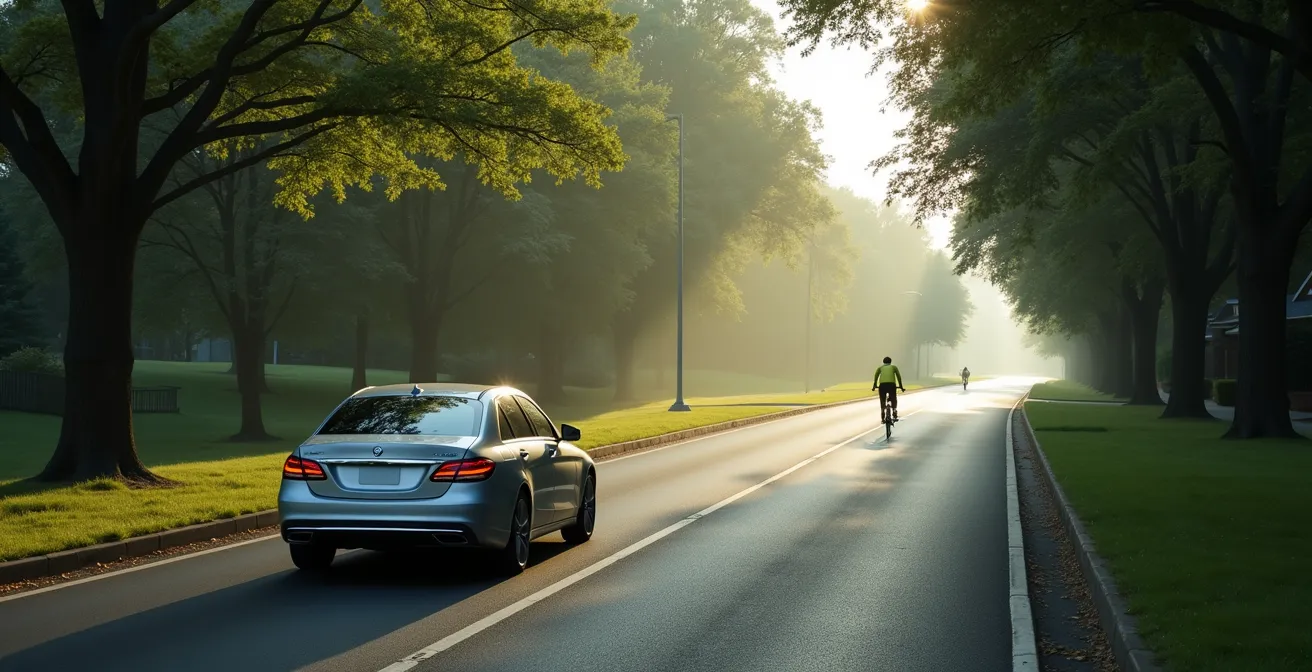
Sharing the road safely isn’t about memorising rules; it’s about understanding the unseen physics and psychology that dictate cyclist behaviour and vulnerability.
- A 1.5-metre passing distance is a physical necessity to counter air turbulence and give a cyclist reaction time, not an arbitrary number.
- At junctions, cyclists going straight have priority over turning vehicles because they are the more vulnerable road user maintaining momentum.
- New technology like e-bikes and blind spots in driver-assistance systems mean that human vigilance is more critical than ever.
Recommendation: Treat every cyclist as if they are about to swerve to avoid an invisible pothole. This single mental shift will transform you from a reactive driver into a proactive one.
That flicker of uncertainty when you see a cyclist ahead is a familiar feeling for many drivers. Are you leaving enough space? Are you aware of the latest rule changes? With the introduction of the new Highway Code, the feeling of confusion is understandable, especially with the threat of fines and penalty points looming. For years, the advice has been a vague « be careful » or « be patient, » but this guidance fails to equip drivers with the practical knowledge needed for genuine road-sharing harmony.
The common approach is to learn the new rules by rote, like a list of dos and don’ts. But what if the key to becoming a safer, more confident driver around cyclists isn’t just knowing *what* the rules are, but fundamentally understanding *why* they exist? What if you could learn to see the road through a cyclist’s eyes, anticipating their movements not because a rulebook tells you to, but because you instinctively grasp the invisible forces and risks they face every second?
This guide moves beyond simple rule-reciting. As a driving instructor focused on road cohabitation, my goal is to deconstruct the most common and confusing driver-cyclist interactions. We won’t just cover the regulations; we’ll explore the physics of a close pass, the psychology of a cyclist’s lane positioning, and the subtle cues that differentiate a regular bike from a fast-accelerating e-bike. By the end, you won’t just be a driver who avoids fines; you’ll be one who actively contributes to a safer environment for everyone.
To help you navigate these crucial concepts, we will break down the most critical scenarios you’ll encounter. The following sections will guide you through each point, transforming abstract rules into concrete driving skills.
Summary: A Driver’s Guide to Cohabiting with Cyclists
- Why 1.5 metres is the vital minimum even at low speed?
- Turning left: why must you wait for the cyclist going straight?
- E-bike or undeclared moped: how to tell the difference on the road?
- The « Dutch Reach »: the simple gesture to avoid dooring a cyclist
- Why do cyclists ride in the middle of the lane and not on the edge?
- How much space should you leave when overtaking a bike at 30 mph?
- Does your system see lane-splitting motorcycles in traffic jams?
- What are the new Highway Code rules that could get you fined?
Why 1.5 metres is the vital minimum even at low speed?
The 1.5-metre rule isn’t an arbitrary number plucked from thin air; it’s a minimum buffer zone grounded in physics and human reaction time. While many countries have adopted this standard, with some like Germany even requiring 2 metres outside of towns, its importance is often underestimated, especially at lower speeds. To a driver, 1.5 metres can feel like a generous amount of space, but for the person on the bike, it’s a non-negotiable zone of survival.
There are four invisible dynamics at play. First, the aerodynamic pressure from any vehicle, even a small car at 30 mph, creates a wall of air that can physically push a cyclist, causing instability. For larger vehicles like SUVs and vans, this effect is magnified. Second, this creates air turbulence in your wake. A pass that feels smooth inside your car can leave a cyclist fighting to control their bike in a vortex of disturbed air. At 30 mph, you are travelling at 13.4 metres per second, giving the cyclist less than 0.2 seconds to react to this sudden force.
Third, cyclists operate within a ‘cone of instability’. They must have the freedom to move laterally to avoid hazards you can’t see from your driver’s seat, such as potholes, drain covers, oil slicks, or broken glass. Boxing them in against the kerb removes their only escape route. Finally, there’s the crucial element of psychological space. A close pass triggers an instinctive fear response, which can lead to panic, wobbling, or sudden braking—ironically increasing the very danger the driver was trying to avoid.
Turning left: why must you wait for the cyclist going straight?
This scenario is one of the most common causes of collisions and a key focus of the new Highway Code. You’re at a junction, indicating to turn left. A cyclist is on your inside, continuing straight ahead. The old mindset might tempt you to « nip in front » before they reach the junction. However, the new hierarchy of road users makes it clear: you must wait. The responsibility lies with the vehicle capable of causing the most harm.
The official Highway Code, under Rule H3, is unambiguous. As stated in the 2022 Highway Code changes, you should not cut across cyclists going ahead when you are turning. This principle applies just as you would not turn across the path of another motor vehicle. The logic is to treat the cyclist’s path as a protected lane. Their momentum is forward, and your action of turning creates a direct conflict.
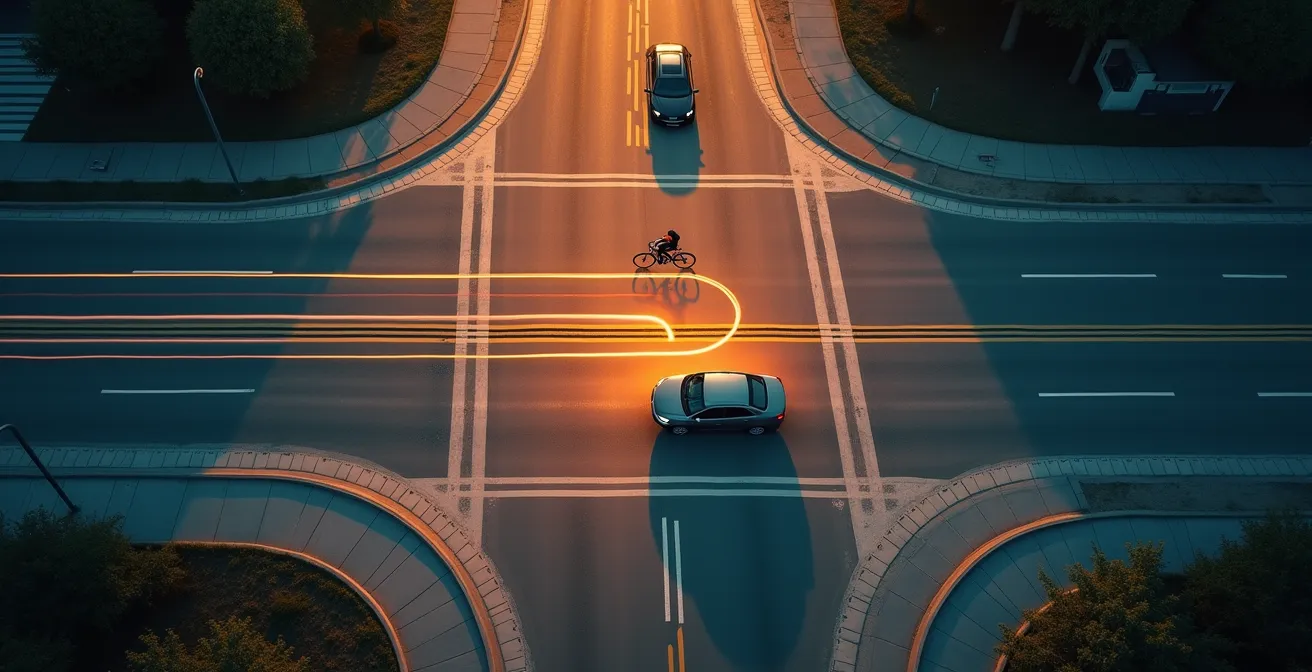
As the image above illustrates, the cyclist’s trajectory continues in a straight line, while the turning car must cross it. By waiting, you eliminate the risk entirely. Forcing the cyclist to brake suddenly or swerve puts them in immense danger. They may not have the stopping power or stability to avoid a collision if you misjudge their speed. The safest and most legally compliant action is always to hold your position and let the vulnerable road user proceed unhindered.
E-bike or undeclared moped: how to tell the difference on the road?
A significant new challenge for drivers is the rise of electric bikes (e-bikes). From a distance, they look identical to standard bicycles, yet their performance is vastly different. Drivers often pull out from junctions assuming a cyclist will accelerate slowly, but this assumption is dangerously outdated. E-bikes create an « acceleration surprise, » as they can reach 15 mph almost instantly from a standstill. This closes gaps far more quickly than drivers anticipate, leading to high-risk situations.
Your brain is calibrated to the gentle, effort-based acceleration of a traditional cyclist. An e-bike shatters that mental model. This is where your observation skills as a driver become critical. You need to look for visual and behavioural cues to distinguish a standard bike from a faster, more unpredictable e-bike. The key is to watch for a mismatch between perceived effort and actual speed. Is the rider gliding up a hill with no effort? Are they maintaining speed without pedalling? These are red flags.
To help you identify these risks proactively, here is a breakdown of the key behavioural differences. Learning to spot these cues can give you the vital extra second of decision-time needed to prevent a misjudgement.
| Behavioral Cue | Standard Bike | E-bike/Moped Risk |
|---|---|---|
| Acceleration from stop | Gradual, requires pedaling effort | Instant, reaches 15+ mph quickly |
| Hill climbing | Slows significantly, visible effort | Maintains speed without effort |
| Speed without pedaling | Immediately starts slowing | Maintains 15-25 mph coasting |
| Overall speed predictability | Consistent with visible effort | Unpredictable, can surge suddenly |
The « Dutch Reach »: the simple gesture to avoid dooring a cyclist
Opening your car door without looking is one of the most carelessly dangerous actions a driver or passenger can take in an urban environment. A suddenly opened door becomes a solid steel wall in a cyclist’s path, leaving them no time to react. The consequences are severe; over 700 cyclists are injured and 2 are killed by car doors each year in the UK, according to government statistics. This is not a freak accident; it’s a preventable and common collision.
The solution is remarkably simple and has been adopted into the UK Highway Code: the « Dutch Reach. » Instead of opening the door with the hand closest to it (e.g., your right hand for the driver’s side), you reach across your body and use your far hand (your left hand). Why does this simple switch make such a difference? Because it’s a mechanical trick that forces a good habit. The act of reaching across your body naturally pivots your torso and head, forcing you to look over your shoulder and into your blind spot.
This action turns an unconscious, risky habit into a conscious, deliberate safety check. It forces you to look back along the side of your car, directly into the path of an approaching cyclist. It should be taught to and used by everyone in the car, not just the driver. It costs nothing, takes no extra time, and is one of the most effective ways to prevent « dooring » incidents. Make it a habit for yourself and your passengers every time you exit the vehicle.
Why do cyclists ride in the middle of the lane and not on the edge?
For many drivers, seeing a cyclist in the middle of the lane—a position known as the ‘primary position’ or ‘taking the lane’—can be a source of frustration. It can seem assertive or obstructive. However, this is rarely about being difficult; it is a defensive driving strategy taught to cyclists for their own safety. Understanding their reasoning is key to reducing road tension.
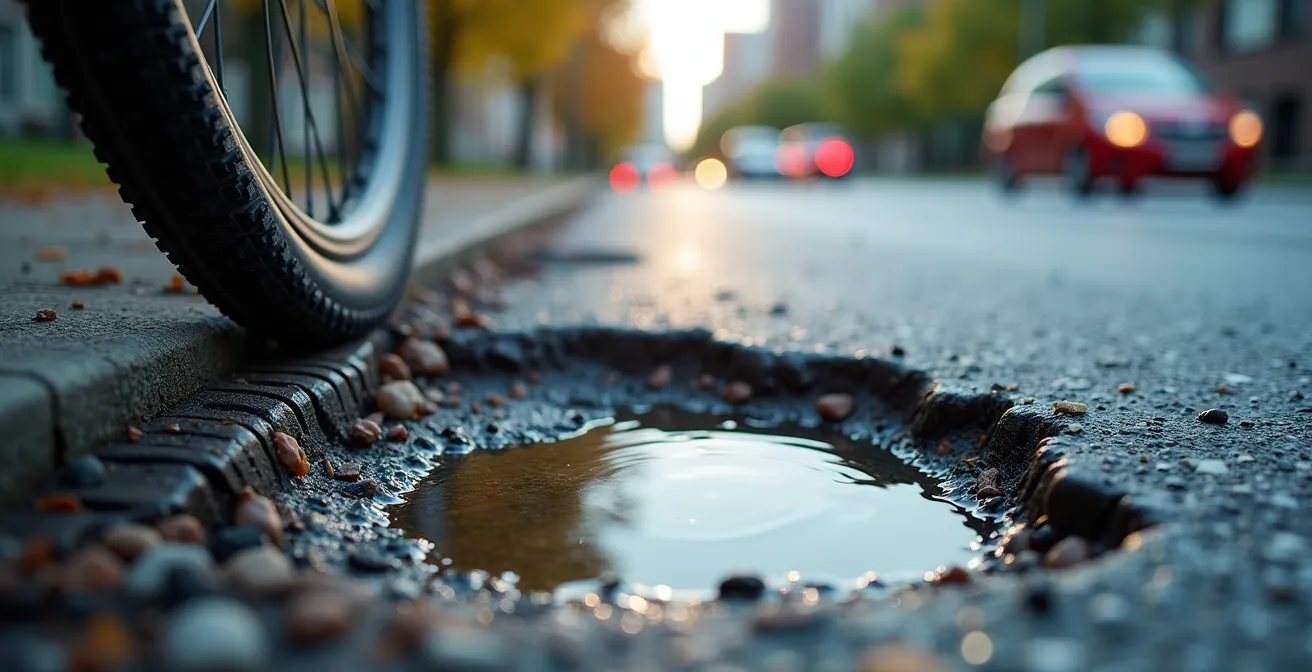
Riding close to the kerb is extremely hazardous. The edge of the road is where debris like broken glass and gravel accumulates. It’s also where you find the most dangerous road defects like potholes and drain covers, which can easily cause a cyclist to lose control. A cyclist needs to maintain a position at least an arm’s length from the kerb simply to have a safe surface to ride on. At pinch points, where the road narrows, taking the centre of the lane is even more critical. It makes the cyclist far more visible and, crucially, prevents a driver from attempting an unsafe overtaking manoeuvre where there isn’t enough space.
Furthermore, in slow-moving traffic, this central position discourages cars from passing too closely and increases the cyclist’s visibility to drivers at upcoming junctions. While the Highway Code suggests cyclists use cycle lanes where available, they are not compulsory, especially if they are poorly maintained or unsafe. Similarly, while cyclists can ride two abreast, it is often safer for them to do so as it makes the group more visible and shorter to overtake. The core principle is visibility and safety: they are positioning themselves to be seen and to avoid dangers you cannot see.
How much space should you leave when overtaking a bike at 30 mph?
We’ve established the 1.5-metre minimum, but it’s crucial to understand that this is not a fixed number—it’s the absolute baseline that increases with speed. The Highway Code specifies you should leave at least 1.5 metres of space when overtaking a cyclist at speeds up to 30 mph, and give them even more room at higher speeds. This isn’t just a recommendation; it’s a rule designed to counter the increased forces at play.
At 30 mph (approximately 50 km/h), your vehicle covers 13.4 metres every second. A 1.5-metre gap provides a minuscule fraction of a second of reaction time for the cyclist to deal with the turbulence and pressure wave your car creates. As your speed increases, so does the intensity of this invisible force. Overtaking at 50 or 60 mph with only 1.5 metres of space can be enough to literally blow a cyclist off course.
This is why many safety experts and instructors advocate for a simpler, more binary rule. As one cycling safety expert from DMV Bicycle Safety Guidelines puts it: « If you can’t fully change lanes, you can’t pass. » This removes the guesswork. Instead of trying to estimate metres while moving, the decision becomes simple: is there a completely clear adjacent lane for you to move into? If yes, you can pass safely. If no—because of oncoming traffic or a solid white line—then you must hold back and wait. This approach guarantees you will always leave more than enough space.
Does your system see lane-splitting motorcycles in traffic jams?
As cars become more technologically advanced, there’s a growing tendency to rely on Advanced Driver-Assistance Systems (ADAS) like blind-spot monitoring and automatic emergency braking. While these systems are fantastic aids, it’s critically dangerous to assume they are infallible, especially when it comes to detecting thin, fast-moving objects like cyclists and motorcycles. The logic applies equally to a cyclist filtering through slow traffic as it does to a lane-splitting motorcycle.
Advanced systems face significant challenges in detecting cyclists due to their thin profiles, non-metallic frames (which are less reflective to radar), and sometimes erratic movements. A cyclist emerging from behind a bus or a group of riders being misread as a single, slow-moving object are common failure scenarios. A recumbent cyclist might be too low for the system’s sensors to even register. Relying solely on a beep or a light in your wing mirror is a recipe for disaster. The ultimate safety system is still the one between your ears, connected to your eyes.
You must treat your ADAS as a co-pilot, not the pilot. It’s there to catch something you might have missed, not to do the looking for you. Before any manoeuvre—changing lanes, turning, or pulling away from the kerb—a manual head check (the « lifesaver » glance over your shoulder) is non-negotiable. Technology can fail, but a thorough visual scan will not.
Your Pre-Manoeuvre Mental Checklist: ADAS Blind Spots
- Emerging Objects: Have I checked for a cyclist or motorcyclist emerging from behind a large, stationary vehicle like a bus or lorry?
- Group Misinterpretation: Could this group of cyclists be confusing my car’s radar? I must treat them as multiple, unpredictable individuals.
- Unusual Profiles: Am I in an area where I might encounter low-profile vehicles like recumbent bikes that my sensors might miss?
- Blind Spot Confirmation: Even if my blind-spot monitor is clear, have I performed a physical head check to confirm nothing is there?
- Final Action: I will only proceed with my manoeuvre after a manual head check, regardless of what my ADAS indicates.
Key Takeaways
- The 1.5-metre passing rule is a physical necessity based on aerodynamics and reaction time, not just a guideline.
- The « Hierarchy of Road Users » places the greatest responsibility on those who can cause the most harm; at junctions, this means turning vehicles must yield to cyclists going straight.
- Technology is not a replacement for human vigilance; ADAS has known blind spots for cyclists, and manual head checks remain essential.
What are the new Highway Code rules that could get you fined?
The 2022 changes to the Highway Code were not just a minor update; they represented a fundamental shift in philosophy towards protecting the most vulnerable. This is underlined by sobering statistics: 38% of road casualties in 2023 were vulnerable road users. The new rules are designed to mitigate this risk by establishing a clear « Hierarchy of Road Users. »
This hierarchy is not about giving cyclists or pedestrians a « right » to behave recklessly. It’s a principle of responsibility. It dictates that road users with the potential to cause the greatest harm (i.e., those in charge of larger, heavier vehicles) have the greatest responsibility to reduce the danger they pose. It’s a formal acknowledgement that a collision between a truck and a pedestrian has very different consequences than one between two pedestrians.
Understanding where you fit in this hierarchy is the key to avoiding fines and, more importantly, causing harm. The following table, based on the principles outlined by organisations like the TTC Group, clarifies these new levels of responsibility.
| Road User Type | Hierarchy Position | Key Responsibilities |
|---|---|---|
| Pedestrians | Highest Priority | Most vulnerable, have priority at junctions |
| Cyclists | Second Priority | Vulnerable, must give way to pedestrians |
| Horse Riders | Third Priority | Vulnerable, similar status to cyclists |
| Cars/Vans | Lower Priority | Greater responsibility to protect vulnerable users |
| Buses/Lorries | Lowest Priority | Greatest responsibility due to potential harm |
Those in charge of vehicles that can cause the greatest harm in the event of a collision bear the greatest responsibility to take care and reduce the danger they pose to others.
– Highway Code Rule H1
Ultimately, all the specific rules about passing distances, junction priority, and the Dutch Reach stem from this single, core principle. Embracing this philosophy of heightened responsibility is the most effective way to navigate the roads safely and confidently.
The next time you’re on the road, don’t just follow the rules—understand their purpose. This shift in mindset is the difference between simply avoiding a fine and actively preventing a tragedy. Start practicing these principles on every journey to become a safer, more aware, and more confident driver.