The key to saving fuel isn’t a secret list of tricks; it’s mastering the physics of drag, weight, and inertia that silently cost you money on every single drive.
- Aerodynamic drag from roof racks and even open windows is a major, often underestimated, fuel penalty that acts like a constant tax on your speed.
- Every pound of unnecessary weight in your car and every minute of idling directly translates to measurable, wasted fuel and money.
Recommendation: Focus on maintaining momentum and reducing physical resistance to transform your existing car into a significantly more efficient machine.
Watching the numbers spin at the gas pump can feel helpless, a weekly reminder of a cost you can’t control. Most advice on saving fuel boils down to the same tired refrains: check your tires, drive slower, and perform regular maintenance. While true, these tips barely scratch the surface. They are the « what » without the « why, » leaving you with a checklist but no real understanding or control over your vehicle’s thirst for fuel.
This approach misses the fundamental point. Your car is in a constant battle with physics. Every time you accelerate, you’re fighting inertia. Every moment on the highway, you’re fighting aerodynamic drag. Every climb up a hill, you’re fighting gravity and weight. These aren’t abstract concepts; they are invisible forces actively draining your fuel tank and your wallet. The common tips are just symptoms of a deeper issue.
But what if the key to saving 15% or more on fuel wasn’t about a longer checklist, but about a smarter mindset? What if you could learn to see these invisible forces and make small, precise decisions to outsmart them? This guide isn’t about generic advice. It’s a coaching session designed to help you understand the core principles of « energy management » for your car. We will dissect the real-world fuel cost of common habits and accessories, backed by data, to empower you to make informed choices that have a real impact on your MPG.
By understanding the physics at play, you stop being a passive consumer of fuel and become an active manager of your car’s efficiency. The following sections will break down exactly where your money is going and how to get it back, one mile at a time.
For those who prefer a visual and auditory walkthrough, the following video from an experienced mechanic offers a great practical overview, complementing the deep-dive principles we are about to explore. It’s a fantastic summary of what really works and what’s just a myth.
To navigate this deep dive into fuel efficiency, we’ve structured this guide around the most common questions and overlooked factors that have the biggest impact on your daily consumption. Each section tackles a specific scenario, providing you with the data and the reasoning to become a smarter, more economical driver.
Table of contents: A driver’s guide to beating high fuel costs
- Roof box and bars: how much do they really cost you in fuel on the highway?
- AC or windows open: which is more economical at 50 mph?
- Why emptying your trunk is the simplest way to save?
- When does cruise control make you consume more (mountains/hills)?
- Are ‘Eco’ tires worth their extra cost in real fuel savings?
- Why does idling cost you more than turning off the engine?
- How much does leaving empty bars on all year cost you?
- How to charge your electric car for less than £5 per full charge?
Roof box and bars: how much do they really cost you in fuel on the highway?
Think of a rooftop cargo box as a parachute you’ve strapped to your car. While incredibly useful for family vacations, it imposes a severe « aerodynamic tax » on your fuel efficiency, especially at highway speeds. Your vehicle was designed in a wind tunnel to be as slippery as possible, but adding a large, blunt object to the roof completely disrupts that careful engineering. The engine now has to work significantly harder just to push the car through the air.
The numbers are more dramatic than most drivers realize. Rigorous testing reveals the true cost. For example, research from the Lawrence Berkeley National Laboratory found that on a typical sedan, fuel consumption increased by up to 20.8% on the highway with a rooftop cargo box attached. Even a larger SUV, which is already less aerodynamic, saw a 6.2% penalty. Other tests, like those from Consumer Reports, show an average MPG loss of around 19% at 65 mph.
This isn’t a small rounding error; it’s a massive fuel penalty. If your car normally gets 30 MPG on the highway, a rooftop box could drop that to just 24 MPG. Over a 500-mile road trip, that’s nearly 4 extra gallons of gas. The lesson is clear: the roof box should be treated as a temporary tool. Install it right before your trip and, just as importantly, remove it the moment you get back. Every day you leave it on is a day you’re paying an unnecessary tax to the laws of physics.
Ultimately, the convenience of extra storage comes at a direct and substantial cost at the pump. Being mindful of this trade-off is the first step toward a more efficient driving strategy.
AC or windows open: which is more economical at 50 mph?
It’s one of the oldest debates in driving: on a hot day, is it cheaper to roll down the windows or turn on the air conditioning? The answer isn’t a simple « yes » or « no »—it’s a fascinating tug-of-war between two different physical forces: engine load and aerodynamic drag. The winner depends almost entirely on your speed.
At lower speeds, typically below 45-50 mph, your car’s engine isn’t working very hard to overcome wind resistance. In this scenario, the biggest energy thief is the A/C compressor. It’s a mechanical pump run by your engine’s accessory belt, and engaging it adds a noticeable load, forcing the engine to burn more fuel just to keep everything running. At these city speeds, opening your windows is the more economical choice. The added aerodynamic drag is minimal and costs less fuel than running the A/C.
However, the tables turn dramatically as you accelerate onto the highway. Aerodynamic drag increases exponentially with speed. When you open your windows at 50, 60, or 70 mph, you disrupt the smooth airflow your car was designed for, creating massive turbulence and drag. Your car is no longer a sleek shape but a chaotic bucket catching the wind. The engine must burn significantly more fuel to fight this self-imposed resistance.
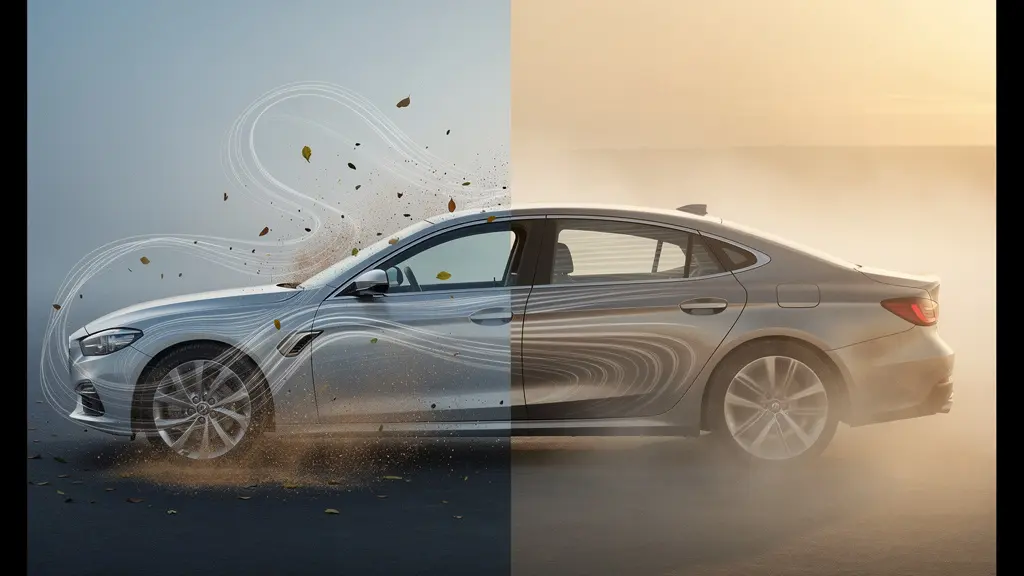
As the illustration above visualizes, a car with closed windows allows air to flow smoothly around its body. With open windows, the air tumbles into the cabin, creating a high-pressure zone that acts like an anchor. At these higher speeds, the consistent, predictable load of the A/C compressor is far more efficient than the chaotic, powerful drag from open windows. Therefore, once you’re cruising at highway speeds (generally above 50 mph), you will save fuel by closing the windows and turning on the A/C.
The smart driver adapts their strategy based on the environment: windows down in the city, A/C on the open road. It’s a simple switch that respects the laws of physics to your financial benefit.
Why emptying your trunk is the simplest way to save?
While aerodynamics dominate fuel consumption on the highway, a different force dictates your efficiency in city driving: weight. Every time you accelerate from a stoplight, you are fighting inertia. The heavier your car is, the more energy—and therefore fuel—it takes to get it moving. While you can’t change the base weight of your vehicle, you can control the unnecessary junk you carry around every day.
That clutter in your trunk, the forgotten sports equipment, the box of old books destined for donation, the extra child seat—it all adds up. It may not feel like much, but it creates a constant, low-level drain on your fuel budget. According to official guidance from government agencies and automotive clubs, the impact is measurable. Research shows that for the average car, every 100 pounds of extra weight can reduce your fuel efficiency by about 1%.
A 1% reduction sounds small, but it’s a permanent penalty you pay every single day. If you’re carrying an extra 200 pounds of non-essential items, you’ve effectively reduced your car’s MPG by 2% for free. Over a year of driving, this « weight tax » can easily add up to a full tank of gas or more. Unlike complex hypermiling techniques, reducing weight is the lowest-hanging fruit in the quest for better MPG. It requires no change in driving style, just a one-time decision to clean out your car.
Your 5-minute trunk audit checklist: Items to remove now
- Seasonal gear: Take out snow chains in the summer and beach chairs in the winter. Don’t haul what you don’t need.
- Unused child seats: If you’re not traveling with children on your daily commute, a heavy car seat is just dead weight.
- Sports equipment: Make it a habit to unload golf clubs, hockey bags, or gym gear after each use rather than using your car for permanent storage.
- Non-essential tools or extras: That heavy aftermarket subwoofer or massive box of tools you rarely use is costing you at the pump.
- Keep only essentials: Your emergency kit should be lean—a spare tire, jack, and a basic first-aid kit are all you truly need for daily driving.
By treating your car as a mode of transport, not a mobile storage unit, you instantly make it more efficient without spending a dime or changing a single habit on the road.
When does cruise control make you consume more (mountains/hills)?
Cruise control is often touted as a fuel-saving feature, and on flat, open highways, it absolutely is. By maintaining a perfectly steady speed, it avoids the subtle, inefficient micro-accelerations that human drivers make. However, in hilly or mountainous terrain, this « smart » feature becomes remarkably dumb, and can actually cause you to burn *more* fuel than a mindful driver.
The problem is that cruise control has only one objective: maintain the set speed at all costs. It lacks the most crucial tool a human driver has: foresight. You can see a hill coming and adjust your strategy. Your cruise control can only react once it’s already on the incline and the car starts to slow down. As one automotive expert from the Family Handyman Gas Mileage Guide noted, this is where the system’s logic fails:
The car does not know if you are going uphill—it only knows you want to do X speed, so it will apply more and more throttle to maintain that speed.
– Pyle (Automotive Expert), Family Handyman Gas Mileage Guide
This « more and more throttle » approach is incredibly wasteful. The system will often aggressively downshift and open the throttle wide to fight gravity and maintain, for example, exactly 65 mph on a steep grade. This is the equivalent of flooring it uphill. A smart human driver, on the other hand, would allow their speed to naturally drop a few miles per hour (say, from 65 to 60 mph) on the way up, easing the load on the engine. Then, on the subsequent downhill, they would use gravity to effortlessly regain that lost speed, often without touching the accelerator at all. This technique is about managing momentum, not rigidly holding a number.
Practical tests have confirmed this. Allowing for a 5 mph speed variation on inclines and declines can save a measurable amount of fuel on every single hill compared to letting cruise control wage a losing battle against physics. In rolling terrain, your foot is a far more intelligent—and economical—tool than your cruise control button.
So, the next time you see hills on the horizon, do your wallet a favor: switch off the cruise control and take command of your car’s momentum yourself.
Are ‘Eco’ tires worth their extra cost in real fuel savings?
The world of tires is filled with marketing buzzwords, and « Eco » or « Low Rolling Resistance » (LRR) are among the most common. The promise is simple: pay a little more upfront for these special tires and save money on gas over their lifespan. But is this a genuine engineering benefit or just clever marketing? The answer, according to extensive testing, is that the savings are real, but whether they’re « worth it » depends on your driving habits and timeline.
Rolling resistance is the energy your car loses from the simple act of your tires deforming as they roll against the road surface. Think of it as a constant, sticky friction. LRR tires are made with advanced rubber compounds and tread designs that deform less, thereby reducing this energy loss. This means your engine doesn’t have to work quite as hard to keep the car moving at a constant speed. The effect is small on any given trip, but it compounds over tens of thousands of miles.
Independent analysis provides clear numbers. For instance, Consumer Reports testing found that switching to LRR tires could save up to $360 in fuel costs over the 62,000-mile life of the tires compared to standard all-seasons. This more than covers the typical price premium for these tires. The key is understanding the payback period. If a set of LRR tires costs an extra $80, and they save you $40 per year in fuel, they will have paid for themselves in two years. For the rest of their lifespan, the savings are pure profit.
However, it’s not a one-size-fits-all solution. The best LRR tires may have slightly less grip in wet or snowy conditions compared to premium performance tires. For most daily drivers in moderate climates, this trade-off is negligible, but it’s a factor to consider. The decision comes down to a simple calculation: if you plan to keep your car for at least 2-3 more years and do a fair amount of highway driving, the investment in quality LRR tires almost always pays for itself and then some.
For the long-term-oriented driver, choosing the right rubber is a savvy financial move that provides a slow but steady return with every mile driven.
Why does idling cost you more than turning off the engine?
There’s a persistent myth, held over from the era of carbureted engines, that restarting your car uses more gas than letting it idle for a minute or two. For any modern, fuel-injected vehicle (basically any car made in the last 30 years), this is unequivocally false. Letting your engine run while parked is the equivalent of opening your wallet and lighting money on fire. You are getting zero miles per gallon.
When your engine is idling, it is still burning fuel just to keep its internal components moving, power the electronics, and maintain operating temperature. While the consumption rate is low, it is constant and adds up quickly. Research shows engines consume between 0.25 to 0.5 gallons of fuel per hour while idling, depending on the engine size and A/C usage. That’s a gallon of gas wasted every 2-4 hours of going nowhere. In contrast, restarting a warm engine uses a tiny squirt of fuel, equivalent to only a few seconds of idling.
The break-even point is surprisingly short. The widely accepted rule for modern cars is: if you are going to be stopped for more than 10 seconds, you will save fuel by turning off the engine and restarting it when you’re ready to move. This applies to numerous daily situations: waiting for a long train, stuck in a complete standstill traffic jam, or waiting in the school pickup line. Don’t worry about starter wear, either. Modern starters and batteries are designed to handle tens of thousands of start-stop cycles, a technology now standard in many new cars for this very reason.
Another common mistake is « warming up » the car by letting it idle on a cold morning. This is not only wasteful but also less effective than the modern method: start the car, wait about 30 seconds for oil to circulate, and then begin driving gently. The engine warms up much faster under a light load than it does at idle, making the whole system reach its optimal, efficient operating temperature sooner.
The next time you’re stopped with no prospect of moving for more than ten seconds, turn the key. It’s one of the simplest and most effective fuel-saving actions you can take.
Key takeaways
- Your car’s biggest enemies are aerodynamic drag at high speed and weight/inertia at low speed.
- Small, consistent habits like removing roof racks, cleaning out your trunk, and turning off the engine when stopped for more than 10 seconds yield significant cumulative savings.
- The smartest driver is an active one, using foresight to manage momentum on hills rather than relying blindly on cruise control.
How much does leaving empty bars on all year cost you?
We’ve already established the significant fuel penalty of a fully loaded rooftop cargo box. But what about the crossbars themselves? Many drivers leave their empty roof racks mounted year-round for convenience, assuming their impact is negligible without the bulky box. This is a costly mistake. Those two simple bars, slicing through the air, create constant turbulence and drag that you pay for every single time you drive.
The effect is less dramatic than a full cargo box, but it is relentless. Research shows that even sleek, aerodynamic crossbars can reduce fuel efficiency by 1% to 6%, depending on the vehicle and speed. Bulky, square-shaped bars are even worse. While a few percentage points may not sound like much, this penalty is applied every mile of every trip, all year long. It’s a slow, steady leak from your fuel budget. Extrapolated across millions of drivers, research estimates that this habit wastes over 100 million gallons of fuel annually in the U.S. alone.
Let’s translate this into real-world dollars. Based on average driving distances and fuel prices, leaving a set of aerodynamic bars on your car can cost you an extra $120 to $180 per year in fuel. If you have older, less efficient square bars, that figure can jump to a staggering $200 to $300 annually. Over the five-year life of a vehicle, you could be spending over $1,000 extra on gasoline simply for the convenience of not removing the bars when they aren’t in use.
Compare that to the alternative: the annual fuel cost of only mounting the rack when needed is typically just $20 to $40. The one-time hassle of installing and removing the rack a few times a year yields a significant return on investment. If you are not actively carrying a kayak, skis, or a cargo box, those bars have no business being on your roof. They are serving no purpose other than to make your engine work harder and your wallet lighter.
Treating your roof rack like a specialized tool—used only when needed—rather than a permanent accessory is a simple change that delivers guaranteed annual savings.
How to charge your electric car for less than £5 per full charge?
While the ultimate long-term saving might come from switching to electric—where savvy off-peak charging can feel almost free—mastering your current car’s efficiency is the most powerful financial move you can make today. The principles of conserving energy are universal, and they turn you, the driver, into the most important efficiency component. These are the advanced techniques that separate casual drivers from true masters of economy, often called « hypermiling. »
Starting from a stop absolutely destroys your gas economy and miles per gallon.
– Drive-Safely.net Editorial Team, Top 24 Tips to Get Better Gas Mileage
This single idea is the core of all advanced techniques: momentum is your most valuable asset. Creating it costs a lot of fuel; preserving it is the key to saving. Instead of thinking about your trips as a series of starts and stops, think of them as managing a continuous flow of energy. Here are the core techniques to cultivate this mindset:
- Pulse and Glide: This is the cornerstone of hypermiling. Instead of holding a steady throttle, you « pulse » by accelerating gently to a target speed (e.g., 55 mph), and then « glide » by taking your foot off the gas and coasting in gear, letting the car’s momentum carry you as your speed slowly drops (e.g., to 45 mph), then repeating the cycle. This keeps the engine in its most efficient power band during the pulse and uses zero fuel during the glide.
- Anticipate Stops 30 Seconds Ahead: Look far down the road. See a red light, a stop sign, or slowing traffic? Take your foot off the accelerator immediately. The goal is to coast for as long as possible, letting the car slow down naturally rather than converting your precious momentum into useless heat through the brakes. The best drivers pride themselves on how little they have to use their brake pedal.
- Time Traffic Lights: As you approach an intersection, learn to read the light patterns. If a light is stale green (it’s been green for a while), anticipate it will turn red and ease off the throttle early. By doing this, you can often arrive just as it turns green again, allowing you to roll through without ever coming to a complete, fuel-guzzling stop.
- Chain Your Trips: A warm engine is an efficient engine. A cold engine uses a rich fuel mixture and suffers from higher internal friction. Whenever possible, combine your errands into one longer trip rather than making multiple short trips throughout the day with long cool-down periods in between.
Start by incorporating just one of these techniques into your daily commute. Focus on anticipating one red light each day. Once that becomes second nature, you’ll find yourself naturally adopting a smoother, more efficient—and far cheaper—driving style.