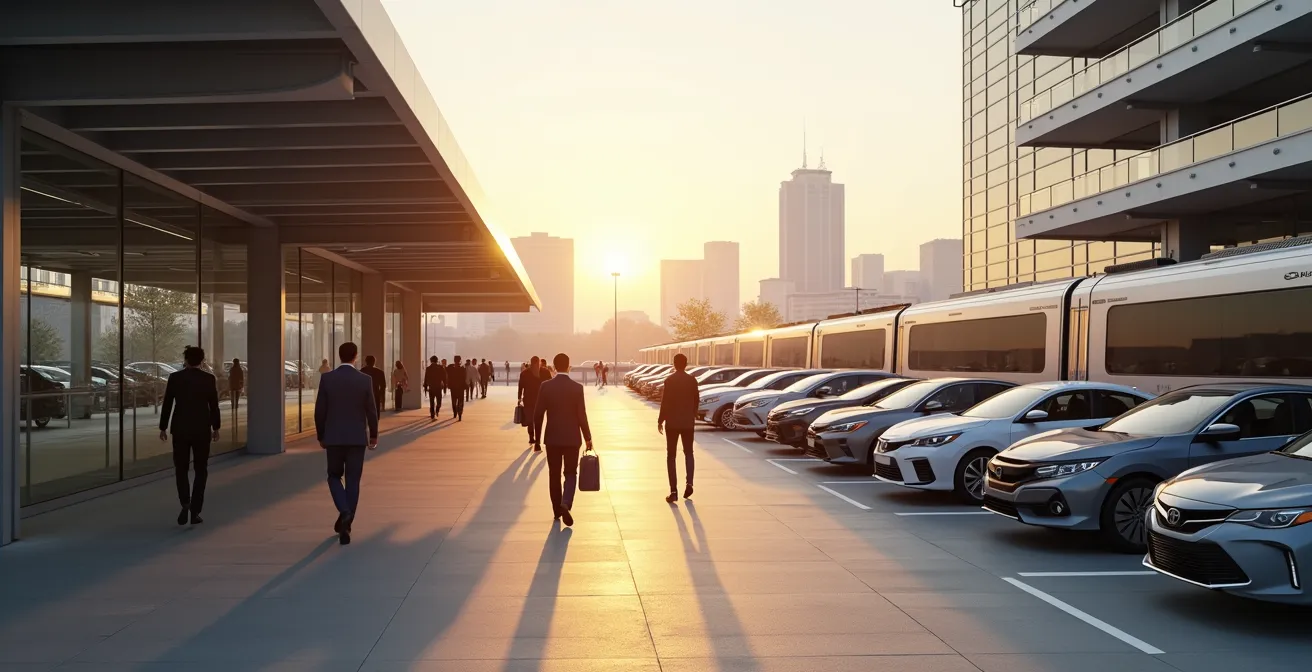
Switching to a Park and Ride (P&R) system consistently cuts commute times not just by avoiding traffic, but by optimizing the entire journey’s hidden inefficiencies.
- It transforms passive, stressful time spent in traffic jams into predictable, potentially productive time on public transport.
- It completely eliminates the 10-15 minute « hunt for parking » and the exorbitant cost of downtown lots.
- Modern integrated apps and last-mile solutions like folding bikes remove the daily friction points, creating a seamless door-to-desk journey.
Recommendation: Start by identifying one peripheral P&R lot on your commute axis and test the full journey for one week to quantify your personal time and cost savings.
For any commuter who has watched their GPS estimate tick upwards while stuck in the final few miles of a city-bound crawl, the frustration is universal. You’re so close, yet your journey grinds to a halt. The common advice—leave earlier, try a different route—often just shifts the time of the traffic jam rather than solving the core problem. The inefficiency is baked into the model of one person, one car, heading to a densely populated central business district.
Park and Ride is often presented as a simple alternative, but it’s rarely analyzed for what it truly is: a complete system of commute optimization. The conversation usually stops at « it’s greener » or « it reduces stress. » But what if the real power of Park and Ride lies in a concept of time arbitrage? This is the strategic exchange of low-value, unpredictable time (sitting in a traffic jam, circling for a parking spot) for high-value, predictable time (reading on a train, catching up on emails). The 30% time saving isn’t magic; it’s the calculated result of eliminating the biggest time sinks in a traditional commute.
This analysis moves beyond the surface-level benefits. We will dissect the Park and Ride model as a traffic flow analyst would, examining each component part—from security and last-mile logistics to financial models and digital integration. By understanding the system as a whole, you can unlock a faster, cheaper, and fundamentally more efficient way to navigate your daily journey from your driveway to your desk.
To fully grasp how these time savings are achieved, this article breaks down the essential components of a successful Park and Ride strategy. The following sections will guide you through optimizing security, finances, technology, and contingency planning, turning your commute from a daily battle into a streamlined process.
Summary: A Systemic Approach to a Faster Commute
- How to reduce your home-to-work commute time by 20 minutes in the city?
- Leaving your car at the station: are the risks of theft real?
- Where to park on the outskirts to finish the trip by metro without paying the price fort?
- How does the « Trunk + Folding Bike » combo eliminate parking fees?
- Train pass + parking vs. Gas + wear & tear: the real financial winner
- Which single app to use to pay for parking, charging, and train at the same time?
- A single app for the parking and the bus: how to simplify your tickets?
- What to do if you miss the last train to get your car?
How to reduce your home-to-work commute time by 20 minutes in the city?
Reducing your daily commute by 20 minutes or more is achieved by strategically shifting from inefficient solo driving in congested zones to a faster, more predictable multimodal system. The core of this strategy is Park and Ride, which allows you to bypass the most time-consuming and stressful part of the urban journey: the « last mile » approach and the search for parking.
The fundamental principle is bottleneck avoidance. Instead of being part of the problem—the traffic jam—you exit the main flow of cars at a peripheral hub and switch to a mode of transport with its own dedicated right-of-way, like a train or a metro. This isn’t a theoretical concept; cities worldwide have proven its effectiveness. For example, the introduction of Stockholm’s congestion tax led to a significant increase in Park and Ride usage, as commuters quickly realized it was the most efficient way to enter the city.
The time savings aren’t just about moving faster. They also come from increased predictability. A train scheduled for 8:15 AM will arrive at its destination far more reliably than a car navigating unpredictable downtown traffic. This reliability allows for tighter scheduling and less « buffer time » built into your morning. Advanced systems, like those in Prague, even offer all-day tickets that include both parking and public transport fares, demonstrating how integrated ticketing can further reduce complexity and time spent at transaction points, making the entire process seamless.
Leaving your car at the station: are the risks of theft real?
One of the most significant psychological barriers to adopting Park and Ride is the fear of leaving a vehicle unattended for eight to ten hours a day. This concern is not unfounded; research shows that parking facilities can be vulnerable. In fact, a comprehensive analysis by ASU’s Center for Problem-Oriented Policing found that about 40% of vehicle thefts occur in parking facilities, making security a valid consideration for any commuter.
However, it’s crucial to contextualize this risk. Many modern Park and Ride lots are specifically designed with crime prevention in mind, incorporating features like high-visibility lighting, regular patrols, and extensive CCTV coverage. The effectiveness of these measures is well-documented. For instance, a case study on a large lot in suburban Vancouver showed that introducing a well-publicized private security bike patrol led to a substantial drop in vehicle theft. This demonstrates that a visible security presence serves as a powerful and effective deterrent.
Ultimately, while the risk is not zero, it can be significantly mitigated through a combination of facility design and personal vigilance. By choosing lots with good security infrastructure and adopting smart habits, commuters can dramatically reduce their vehicle’s vulnerability. Taking proactive steps transforms the act of parking from a source of anxiety into a calculated part of a secure and efficient commute system.
Your Park & Ride Security Checklist
- Location Selection: Always pick well-lit spots close to station entrances, shuttle stops, or visible security cameras.
- Valuables Concealment: Lock all doors and store any valuables, bags, or electronics completely out of sight in the trunk before you arrive at the lot.
- Situational Awareness: Avoid parking in secluded corners, near overgrown vegetation, or close to exits that offer a quick escape for thieves.
- Identity Protection: Remove garage door openers, work IDs, and any documents with your home address from the vehicle.
- Natural Surveillance: Whenever possible, park in higher-traffic areas where other commuters and staff are frequently present.
Where to park on the outskirts to finish the trip by metro without paying the price fort?
The key to maximizing both time and cost savings with Park and Ride is selecting the right peripheral hub. The goal is to find a lot that is far enough from the city center to avoid congestion and high fees, but well-connected enough to provide a fast and frequent link to your final destination. These lots are the strategic interchanges in your optimized commute system.
Cities often design their Park and Ride networks to encourage this behavior. Amsterdam’s P+R system is a masterclass in strategic pricing: lots offer parking for as little as €1 for 24 hours if you arrive after 10 AM, while charging a higher rate of €8 before 10 AM. This incentivizes a staggered flow of traffic and rewards commuters who can shift their schedules slightly. By researching your local P&R’s pricing structure, you can identify lots that offer deep discounts for off-peak entry or combined transit tickets, significantly lowering your overall cost.
The scale of these networks can be vast, offering plenty of options. The city of Oxford, for example, operates one of the UK’s largest urban Park & Ride networks with over 5,031 car parking spaces distributed across multiple entry points to the city. When choosing, look for lots directly serviced by a single, high-frequency metro or train line that goes to or near your office. This avoids the need for a second transfer, which adds complexity and time to your journey. An ideal lot is one where you can park, walk to the platform, and board a direct service into the city core.
How does the « Trunk + Folding Bike » combo eliminate parking fees?
The « Trunk + Folding Bike » combination is the key to unlocking maximum financial savings by solving the « last-mile problem. » While Park and Ride eliminates the stress of driving downtown, you still need to get from the city-center train or metro station to your office. This last leg of the journey can introduce new costs (taxis, rideshares, bikeshare rentals) or time delays (walking). A folding bike stored in your car’s trunk creates a personal, cost-free solution.
This strategy effectively eliminates the need for any parking at your final destination. You are no longer paying exorbitant daily or monthly rates for a downtown garage. Instead, your only parking cost is the significantly lower fee at the peripheral Park and Ride lot. The folding bike transforms you from a captive user of last-mile transport services into a self-sufficient commuter with full control over your schedule and expenses.
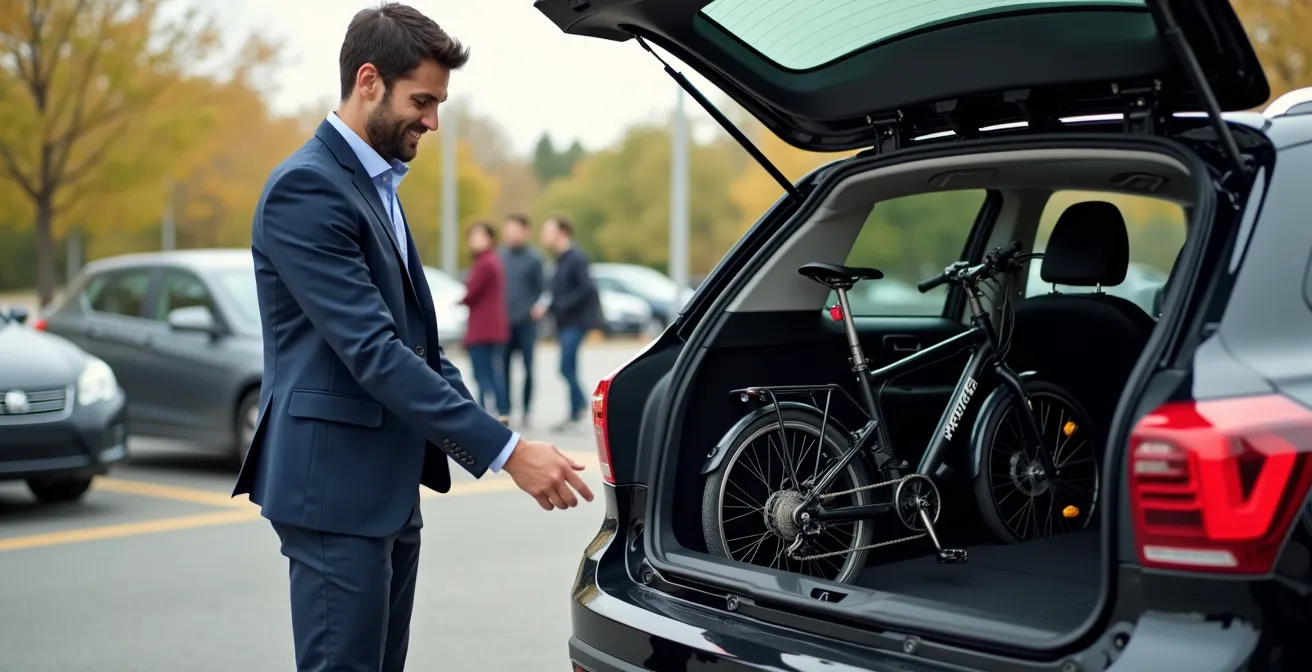
As the image demonstrates, modern folding bikes are engineered for this exact purpose. They are lightweight, often weighing between 12-15kg, and can be folded or unfolded in as little as 20-30 seconds. This efficiency means the transition from train platform to cycling is nearly instantaneous. You bypass the queues for taxis and the search for available rideshare vehicles, gaining back precious minutes every single day. This personal mobility provides a critical boost to your « last-mile velocity, » making the entire commute system faster and more resilient.
Train pass + parking vs. Gas + wear & tear: the real financial winner
When analyzing the financial case for Park and Ride, it’s easy to focus only on the direct costs of a transit pass versus a tank of gas. However, a true cost-benefit analysis reveals a much wider gap. The total cost of driving includes not just fuel, but also insurance, maintenance, depreciation, and the often-staggering cost of downtown parking. When all factors are considered, the financial winner becomes clear.
The American Public Transportation Association (APTA) conducts regular analysis on this topic, and their findings are compelling. According to their research, riders can save over $13,000 annually on average by using public transit instead of driving. This figure accounts for the comprehensive costs of car ownership, which are often underestimated in day-to-day budgeting. The slow, creeping costs of oil changes, tire replacements, and brake jobs—all accelerated by stop-and-go traffic—add up to thousands per year.
Beyond these direct savings, there are often hidden financial benefits. Many employers offer tax-advantaged commuter benefits that allow you to pay for your transit pass and parking with pre-tax dollars. For an employee in a 25% tax bracket spending $200 per month on transit, this can translate to an additional annual saving of $600 to $840. The IRS limits for these benefits are substantial, allowing for significant pre-tax deductions for both transit and associated parking fees, further tipping the financial scales in favor of a multimodal commute.
Which single app to use to pay for parking, charging, and train at the same time?
In an ideal world, a single « super-app » would manage every aspect of a multimodal commute. While the industry is moving in that direction, the current reality for most commuters is that the optimal solution is not one app, but a strategically chosen « app stack. » This involves using a small number of best-in-class applications that work together to create a seamless digital ecosystem for your journey.
The core of your app stack should include:
- A Transit Planning App: Apps like Citymapper or the Transit app provide real-time tracking, multi-modal route planning, and service disruption alerts. This is your command center for the public transport leg of your journey.
- A Parking Payment App: Services like ParkMobile or SpotHero allow you to find, reserve, and pay for your parking spot at the P&R lot in advance, eliminating the need to use a physical payment kiosk.
- An EV Charging App (if applicable): For electric vehicle owners, an app like PlugShare or A Better Routeplanner is essential. It allows you to filter P&R lots by charger availability and type, ensuring you can secure a charge while you work.
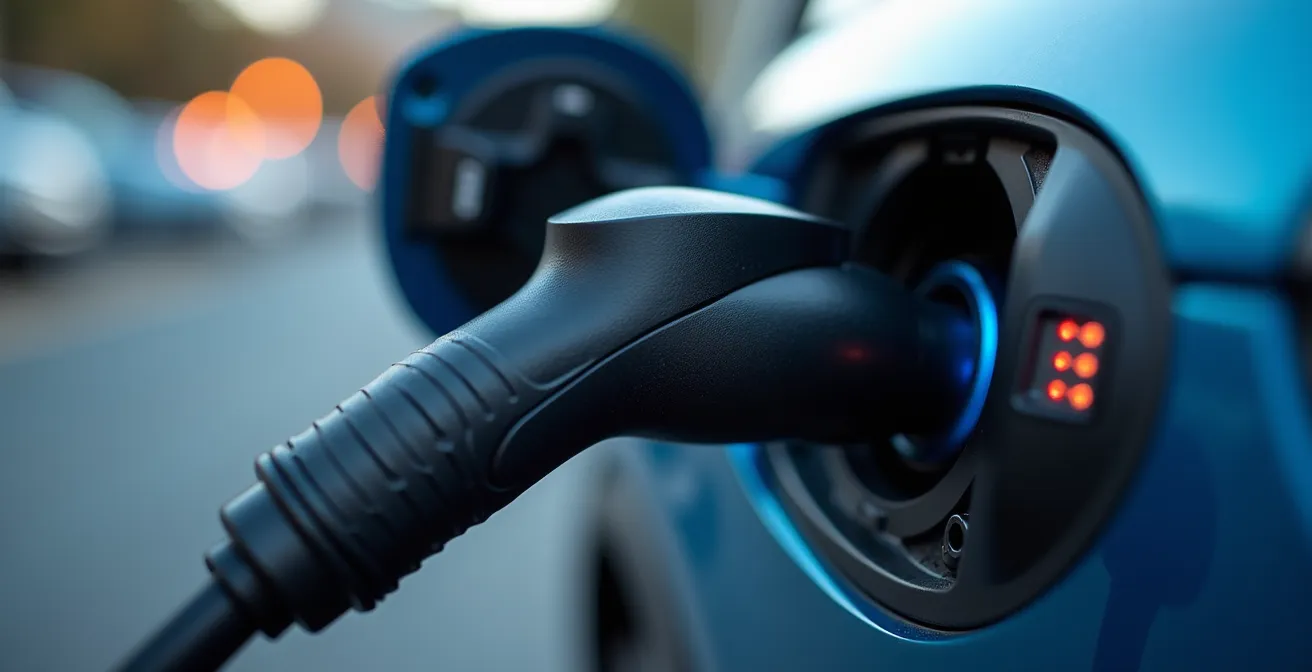
The key is to configure these apps for maximum efficiency. Setting up auto-reload on your transit card, linking your payment methods, and enabling notifications for your regular train line reduces daily mental overhead. As facilities become more advanced, with integrated EV charging and real-time space availability, this digital layer becomes even more critical for a frictionless commute experience. The goal is to make the entire process—from leaving your house to arriving at your desk—as automated and thought-free as possible.
A single app for the parking and the bus: how to simplify your tickets?
While a single, all-encompassing app remains the holy grail, simplifying your digital ticket and payment process is achievable today by focusing on integration and automation. The goal is to create a frictionless experience that removes the need to fumble with your phone at critical moments, such as when entering a parking lot or boarding a train. This not only saves time but also enhances safety.
The danger of digital distraction is real, especially in the chaotic environment of a busy parking facility. A poll from the National Safety Council revealed that an alarming 66% of drivers make phone calls while driving through parking lots. Trying to find the right app, enter payment details, or confirm a booking while maneuvering a vehicle is a recipe for a low-speed collision or worse. A streamlined digital system minimizes this risk by preparing everything in advance.
Creating this simplified system involves a few key actions:
- Enable Tap-to-Pay: Set up your phone’s NFC (Near Field Communication) capabilities for your primary credit card or transit card. This allows for instantaneous payment at compatible readers without opening an app.
- Use Auto-Reload: Configure your transit card or account to automatically add funds when the balance drops below a certain threshold. This eliminates the risk of a declined payment during the morning rush.
- Link Your Accounts: Where possible, link your parking app to your transit app. Some platforms can pull data from each other, allowing for more integrated trip planning and a consolidated view of your commute.
By front-loading the setup, you turn daily transactions into a single tap or a fully automated background process. This is a core principle of commute system optimization: identifying and eliminating small points of friction that, when aggregated, represent significant time sinks and sources of stress.
Key Takeaways
- System Over Steps: True time savings come from optimizing the entire commute as a single, integrated system, not just avoiding one traffic jam.
- The Last Mile Is Crucial: Your commute doesn’t end at the train station. A personal mobility solution like a folding bike is key to bypassing final destination costs and delays.
- Plan for Failure: A robust contingency plan for a missed train or other emergency transforms a potential crisis into a minor, manageable inconvenience, making the system resilient.
What to do if you miss the last train to get your car?
The ultimate test of any system is how it performs under pressure. For a Park and Ride commuter, the nightmare scenario is missing the last train back to their car, leaving them stranded miles from their vehicle late at night. A truly optimized commute strategy anticipates this possibility and has a robust contingency plan in place. This transforms a potential crisis into a manageable inconvenience.
The first step is proactive research. Before you ever need it, you should know your primary P&R lot’s policy on overnight parking. Many facilities permit it, but some may have specific rules or additional fees. Knowing this in advance removes one layer of uncertainty. Next, build a « bail-out » list on your phone containing the numbers of local taxi firms, a few colleagues who live in a similar direction, and a pre-calculated cost estimate for a rideshare journey home.
Case Study: The Guaranteed Ride Home Program
Many regional transit and commuter resource agencies offer a powerful but often underutilized safety net: a Guaranteed Ride Home (GRH) program. As detailed by organizations like Virginia’s VDOT, these services provide registered commuters who use ridesharing or public transit with a free or low-cost emergency ride home (via taxi, rental car, or rideshare) in the event of a personal emergency or unexpected overtime. Registering for your local GRH program is often free and acts as the ultimate insurance policy for your multimodal commute.
Building a commute buddy system with a colleague who uses a similar P&R route provides another layer of resilience. This mutual support network can be invaluable. By developing a clear contingency protocol, you remove the fear of the unknown. This preparation is the final step in creating a truly resilient and stress-free commute system, ensuring that even on the worst days, you have a clear and calm path forward.
The next logical step is to analyze your own route and build your personalized Commute System. Start today by researching your local Park and Ride options, digital tools, and contingency programs to reclaim your time and transform your daily journey.