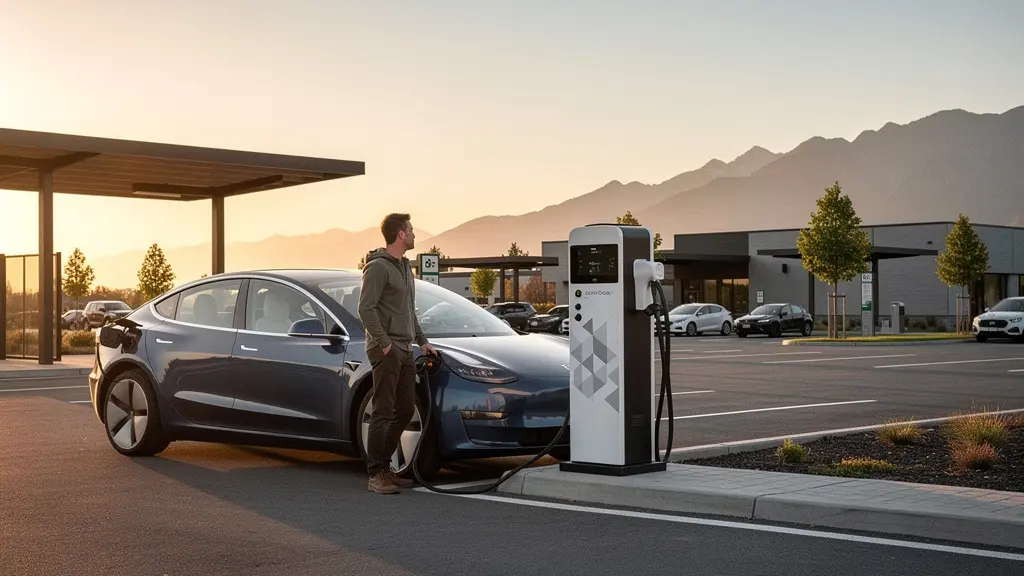
A successful long-distance EV trip isn’t about finding chargers; it’s about building a resilient system of options that makes failure nearly impossible.
- Develop a multi-layered contingency plan (Plan A, B, and C) for every charging stop to eliminate surprises.
- Mastering the ‘80% rule’ on fast chargers saves you significant time and protects your battery health in the long run.
Recommendation: Shift your mindset from just ‘planning a route’ to ‘designing a journey with built-in resilience’. This guide provides the expert framework to do just that.
The thought of a 300-mile journey in a new electric vehicle can feel like a final exam you haven’t studied for. The questions loom large: What if the chargers are all taken? What if one is broken? What if I run out of power in the middle of nowhere? This feeling, known as ‘range anxiety’, is the single biggest barrier for new EV owners. Many will tell you to just « use a good app » or « plan your stops », but this advice barely scratches the surface of what it takes to travel with true confidence.
The real secret, the one seasoned EV drivers and professional planners know, isn’t about finding the single perfect charger. It’s about understanding the system and building a web of options so robust that any single point of failure becomes an inconvenience, not a catastrophe. This guide is not just a list of tips; it’s a transfer of an expert mindset. We will move beyond simple route planning and into the strategy of ‘charging resilience’. We will explore the technical details that matter, the contingency plans that save you, the economic realities of public charging, and the best practices that turn a stressful journey into a smooth, predictable, and even enjoyable experience.
This article provides a complete framework for your first long-distance trip. It breaks down every critical decision point, from the cables you use to the hotel you choose, giving you the knowledge to handle any situation with confidence.
Contents: A Stress-Free EV Road Trip Blueprint
- CCS or Type 2: Which cable to use to charge 80% in 30 minutes?
- What to do if the only rapid charger at the service station is faulty?
- Why is never charging to 100% on a rapid charger a golden rule?
- How to choose a hotel with charging to start the next day full?
- How to reduce the installation cost of your Wallbox by £350?
- Why does rapid charging on the motorway cost 3 times more than at home?
- Over-the-air update: should you do it right away or wait for feedback?
- How to recharge your electric car for less than £5 per ‘full tank’?
CCS or Type 2: Which Cable to Use to Charge 80% in 30 Minutes?
Understanding charging connectors is the first step in removing a major source of anxiety. It’s simpler than it looks. For the kind of fast charging you need on a long journey—getting to 80% in about 30 minutes—you will almost always be using a DC (Direct Current) rapid charger. The good news is that these stations always have the cable attached, or ‘tethered’. You don’t need to bring your own heavy-duty cable.
Your car will have one of two main DC inlets in Europe: CCS (Combined Charging System) or, for older models, CHAdeMO. CCS is the dominant standard and is essentially a Type 2 connector with two extra large pins below it. When you arrive at a rapid charging station, you simply select the CCS connector from the charger, plug it into your car, and follow the on-screen or app instructions to begin. The idea of « bringing the right cable » is primarily for AC (Alternating Current) charging at home or at destinations like shopping centres, where you’d use your own Type 2 cable.
The public DC fast-charging network is constantly growing, with a 7.4% quarterly increase in DC fast charging ports according to recent infrastructure data. This expansion is key to enabling seamless long-distance travel. Before your trip, simply use an app like PlugShare or Zap-Map to filter for chargers compatible with your car’s CCS or CHAdeMO port. This ensures you are only routed to stations you can actually use.
What to Do if the Only Rapid Charger at the Service Station Is Faulty?
This is the scenario that keeps new EV owners up at night. You arrive at your planned stop with 15% battery, only to find the charger is out of order. This is where the mindset of ‘charging resilience’ moves from theory to critical practice. A plan that relies on a single, unverified charger is not a plan; it’s a gamble. A true expert planner builds a three-tiered contingency strategy for every stop.

The first step is always to verify the charger’s status before you even set off. Apps like PlugShare are invaluable, as its two-million-strong community provides the fastest real-time updates on whether a unit is online. Look for recent check-ins and comments; a string of « failed to charge » reports is a clear red flag. However, even a charger reported as working can fail. This is why you need a backup.
Your ABC Contingency Plan for Every Stop
- Plan A (Primary Charger): This is your ideal, planned fast-charging stop. Before committing, check its real-time status and recent user comments on multiple apps (e.g., Zap-Map, PlugShare).
- Plan B (Backup Fast Charger): Identify an alternative rapid charger within a 10-15 mile radius of Plan A. This is your immediate pivot if Plan A is occupied, out of order, or has a long queue.
- Plan C (Graceful Failure Option): Locate a slower Level 2 (7-22kW) charger near an amenity like a supermarket or restaurant. This isn’t for a full charge, but a « graceful failure » option to add 20-30 miles of range in an hour while you grab a coffee, giving you enough buffer to reach the next viable fast charger.
- Safety Margin Rule: Always plan to use the charger *before* the penultimate one on your route. This means you always have at least one more charging opportunity within your car’s remaining range.
- Pattern Recognition: When checking recent comments, look for patterns. A comment like « Charger #2 is always broken » is a crucial piece of intelligence that an app’s simple ‘online’ status won’t tell you.
Why Is Never Charging to 100% on a Rapid Charger a Golden Rule?
It feels counter-intuitive. You’re on a long trip, and the instinct is to fill the battery to the brim at every stop. However, pushing a rapid charge from 80% to 100% is one of the biggest mistakes a new EV driver can make. It’s inefficient, time-consuming, and puts unnecessary strain on your battery. The reason lies in the ‘charging curve’. Your car’s Battery Management System (BMS) controls the charging speed to protect the battery. It will accept the fastest speeds when the battery is at a low state of charge and will dramatically slow down as it gets full.
This isn’t just a minor slowdown; it’s a cliff edge. Going from 80% to 100% can often take as long as it took to go from 10% to 80%. You and other drivers are left waiting for a diminishing return of just a few extra miles. The ‘80% sweet spot’ is the core principle here: charge just enough to comfortably reach your next planned stop with a healthy buffer (around 20-25%). This strategy minimizes your time at the charger and maximizes the overall efficiency of your journey. You’ll have more frequent but much shorter stops, which is often faster overall and less stressful than waiting endlessly for that last 5%.
The following table, based on typical DC fast-charging performance, clearly illustrates why that last 20% is known as the « zone of inefficiency. » As the data from a recent global EV analysis shows, both time and cost efficiency plummet after the 80% mark.
| Charge Range | Time Required | Speed (kW) | Cost Efficiency |
|---|---|---|---|
| 0-50% | 15 minutes | 150kW average | Most efficient |
| 50-80% | 15 minutes | 75kW average | Good efficiency |
| 80-95% | 25 minutes | 25kW average | Poor efficiency |
| 95-100% | 20 minutes | 10kW average | Least efficient |
How to Choose a Hotel With Charging to Start the Next Day Full?
Arriving at your destination and plugging in for a slow, overnight charge is the holy grail of EV road trips. It’s convenient, usually cheaper, and means you start the next leg of your journey with a 100% battery, achieved without any battery-straining rapid charging. However, simply filtering for « hotels with EV charging » is not enough. The quality and availability of these chargers can vary wildly.
As experts at Podenergy point out in their journey planning guide:
If you can avoid an en route charger and charge at a destination, particularly overnight, that is always a more convenient (and often cheaper) experience. Picking a hotel/long stay destination with a 7kW-22KW charger is always a great win.
– Podenergy, EV Journey Planner Guide
To secure this « great win, » you need to become a savvy auditor before you book. A single, slow charger shared between 200 rooms is not a reliable plan. You need to call the hotel and ask specific questions to understand their ‘charger-to-room’ ratio and policies. Is the charging free for guests, or is there a per-kWh fee? Can a charging spot be reserved, or is it a first-come, first-served free-for-all? A hotel with four dedicated 7kW chargers for 50 rooms is a much safer bet than one with a single charger for 300.
Always have a backup plan. Use PlugShare to identify public chargers near the hotel. You might be able to get a substantial charge while you’re out for dinner, even if the hotel’s chargers are occupied when you arrive. A proactive ‘destination charging’ strategy is just as important as planning your en-route stops.
How to Reduce the Installation Cost of Your Wallbox by £350?
While on-the-road charging strategy is crucial for long trips, the foundation of affordable and stress-free EV ownership is a reliable home charging setup. Securing a full ‘tank’ overnight at a hotel is a great travel tactic, but making it a nightly routine at home is a game-changer. It’s the key to unlocking the lowest possible running costs. However, the upfront expense of installation can be a hurdle for many.
The cost of getting a dedicated home charger, or ‘wallbox’, installed can be significant. According to industry analysis, the average home charger installation cost in the UK is around £1,000. While this seems steep, it’s an investment in convenience and long-term savings, especially considering that the vast majority of EV charging happens at home. The good news is that there are several strategies to significantly reduce this initial outlay, often by £350 or more in the UK through schemes like the EV Chargepoint Grant for people who live in flats or rented properties.
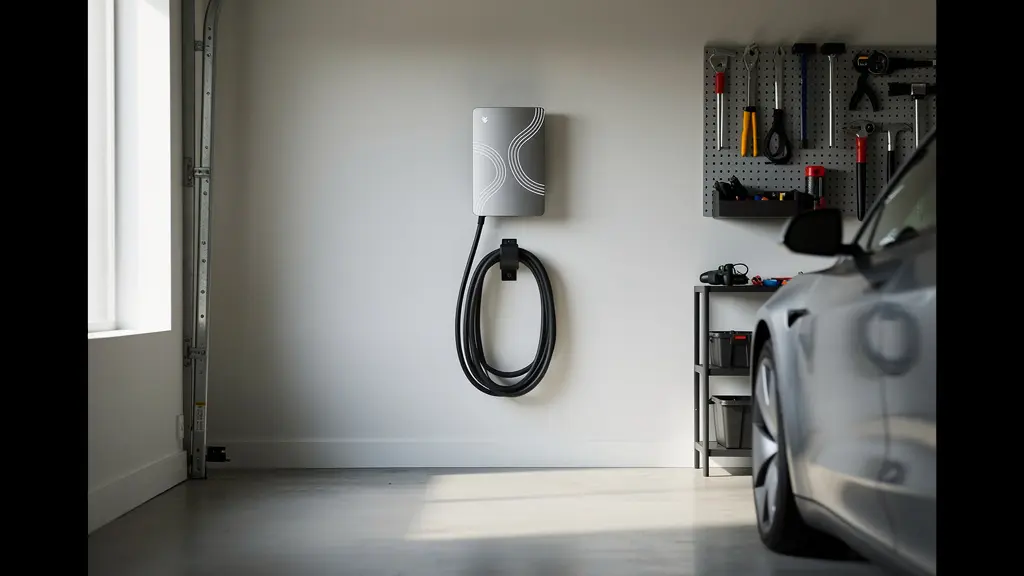
Beyond direct grants, the most impactful way to save is by researching all available incentives and making smart choices about the hardware itself. Many utility providers offer their own rebates or special programs. Furthermore, federal and state tax credits can sometimes reduce the net cost by 30-50%. It’s crucial to search for programs specific to your location, such as « [Your Country/State] EV charger rebate », to ensure you don’t leave money on the table. Comparing the return on investment of a ‘smart’ charger, which allows for scheduled off-peak charging, against a simpler, less expensive installation is also a key calculation.
Why Does Rapid Charging on the Motorway Cost 3 Times More Than at Home?
The price shock can be real. You’ve been enjoying charging your car at home for a few pence per kilowatt-hour (kWh), and suddenly a motorway rapid charger is asking for a price that feels closer to petrol. It’s not a mistake; there are fundamental economic reasons why public rapid charging carries a significant premium. In essence, you are not just paying for electricity; you are paying for convenience, speed, and massive infrastructure costs.
First, the hardware for a 150kW+ DC rapid charger is exponentially more expensive than a simple 7kW home wallbox. We’re talking tens of thousands of pounds versus a few hundred. Second, these chargers require incredibly powerful grid connections, which the charging network operator has to pay to install and maintain, often involving dedicated substations. Third, a significant portion of the cost comes from ‘demand charges’—fees levied by utility companies based on the highest peak power draw. A bank of rapid chargers all firing at once creates a massive power spike, which is very costly for the operator.
Finally, there’s the cost of real estate and maintenance at prime locations like motorway service areas. A recent UK charging cost analysis reveals the stark difference, with some rapid chargers hitting 81p per kWh compared to as little as 7p/kWh on an overnight home tariff. Understanding this cost structure is key. The motorway charger is a tool for long-distance travel, and you pay a premium for the convenience of a 30-minute ‘refill’. Home charging is for your daily ‘grazing’, and it’s where the real cost savings of EV ownership are found.
Over-the-Air Update: Should You Do It Right Away or Wait for Feedback?
Your car’s software is now as important as its mechanical parts. Over-the-air (OTA) updates can bring exciting new features, improved efficiency, or a refreshed user interface. However, they can also, in rare cases, introduce bugs or unforeseen issues. The question of when to install an update becomes a critical risk-management decision, especially before a long trip. The golden rule among seasoned EV drivers is simple: never install a major software update immediately before a long journey.
A car that was working perfectly yesterday could develop a new, frustrating quirk after an update. This could range from a minor annoyance, like the infotainment system lagging, to a more serious problem with charging or battery management. The most prudent strategy is to establish a ‘Pre-Trip Update Lock’. We recommend a 72-hour rule: do not install any non-critical updates within three days of a major trip. This gives you a buffer to ensure your car remains in a stable, known state for your journey.
For any update, it’s wise to let the bravest members of the community go first. Monitor owner forums for your specific vehicle model (like Tesla Motors Club or Rivian Forums). These communities are incredibly quick to report any issues with a new software version. Differentiating between update types is also key. A simple user interface (UI) tweak is low-risk. An update to the core Battery Management System (BMS), however, carries a higher potential risk and warrants extra caution. A patient, informed approach to OTA updates is another layer in your web of resilience.
Key Takeaways
- Building a multi-tiered contingency plan (A, B, and C) for each charging stop is the cornerstone of stress-free travel.
- The ‘80% sweet spot’ on rapid chargers is a critical time-saving strategy, not a limitation.
- The high cost of motorway rapid charging is a fee for convenience and infrastructure; home charging is where true savings are realised.
How to Recharge Your Electric Car for Less Than £5 per ‘Full Tank’?
After discussing the high costs of on-the-road charging, it’s time to focus on the ultimate prize of EV ownership: the remarkably low cost of ‘filling up’ at home. This isn’t a myth or an exaggeration; with the right strategy, charging your car with around 250-300 miles of range can genuinely cost less than a fancy cup of coffee. The entire system is built upon one principle: charging at off-peak rates overnight.
The first and most important step is to switch your home electricity to a ‘Time-of-Use’ tariff. These plans, offered by most utility providers, have incredibly low rates during overnight hours when electricity demand is lowest—sometimes as low as 7p/kWh. A typical 60kWh EV battery, which provides substantial range, would cost just £4.20 to charge from empty on such a tariff. This is the economic foundation of smart EV ownership. According to the IEA Global EV Outlook, a staggering 93% of UK EV owners have access to home charging, making this strategy accessible to the vast majority.
Even if you can’t charge at home, the sub-£5 ‘tank’ is still within reach. It requires a strategy of ‘graze charging’. This involves using free Level 2 chargers often found at supermarkets, shopping centres, and retail parks. While you’re shopping for an hour, you can easily add 20-30 miles of range for free. Many employers also offer free or heavily subsidised workplace charging as a perk. By combining strategic use of free public chargers with an off-peak home tariff, you can drive the average cost of your electricity down to almost negligible levels, making the promise of ultra-low running costs a daily reality.
Your next step is to take this expert mindset and apply it to a test run. Plan a 100-mile round trip using these principles, from building an ABC contingency plan to identifying free destination chargers. This practice is what builds the confidence to make your first 300-mile adventure a success.