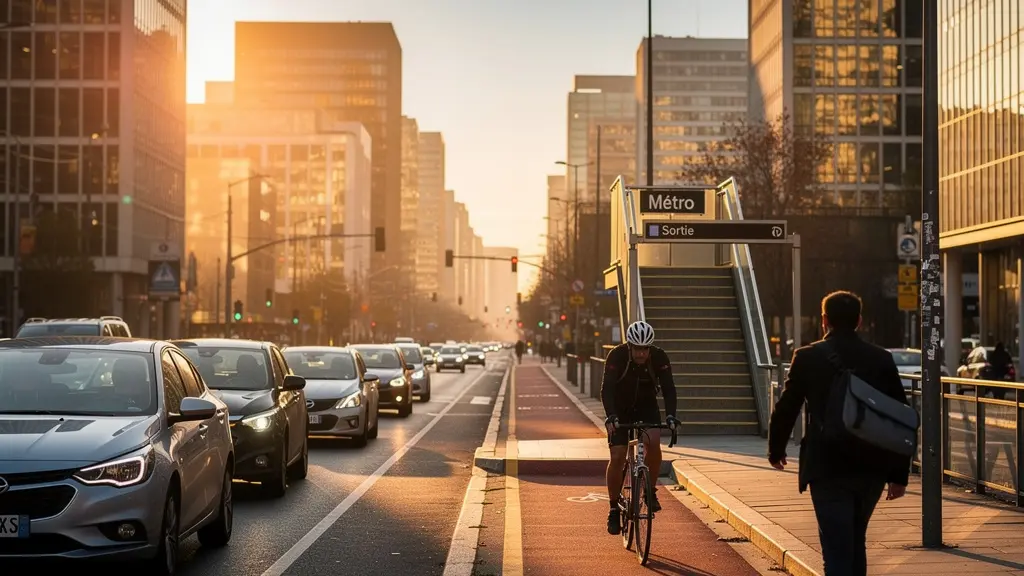
Reclaiming 20 minutes from your daily commute isn’t about one magic trick; it’s about making a series of smarter, data-backed decisions.
- Idling for over 10 seconds costs more fuel than restarting your engine, a small change with compounding savings.
- The right vehicle choice—prioritising a smaller turning radius and visibility over size—drastically reduces parking time and stress.
- A ‘Park and Ride’ strategy combined with a metro leg is demonstrably faster and cheaper than hunting for city-centre parking.
Recommendation: The key is to stop enduring your journey and start treating your commute as an integrated system you can actively optimise.
There’s a familiar sinking feeling that every urban commuter knows. It’s the sight of red tail lights stretching into the distance as the clock on your dashboard ticks past another minute you’ll never get back. You’re stuck in traffic again. For the tired commuter in London or Manchester, this daily battle against congestion feels like an unwinnable war. The common advice—leave earlier, check Google Maps, take the train—often feels like applying a plaster to a gaping wound. These tips are not wrong, but they are incomplete.
They fail to address the core issue: most of us approach our commute passively, as something to be endured. But what if the solution isn’t one single, drastic change? What if the secret to reclaiming those precious 20 minutes lies in a series of small, calculated optimisations? This is the mindset of an efficiency consultant. It’s about seeing your journey not as a straight line, but as a system with distinct phases—engine start, vehicle choice, route navigation, and final parking—each with its own potential for « marginal gains ». This guide will dissect each of these phases, providing you with the data and strategic frameworks to transform your daily grind into a masterclass in urban mobility.
This article breaks down the core decisions you face every day. By analysing each component of your journey, you can build a faster, cheaper, and less stressful commuting system. The following sections provide a clear roadmap to achieving that 20-minute saving.
Summary: How to cut 20 minutes from your city commute?
- Why staying on idle costs you more than switching off the engine
- City car or compact SUV: which is truly king of the urban jungle?
- Waze vs Google Maps: which best predicts morning traffic jams?
- The manual gearbox in town: the ergonomic mistake that tires your left leg
- Where to park on the outskirts to finish the journey by metro without paying the high price?
- Which single app can you use to pay for parking, charging and the train all at once?
- Pay the £12.50 daily fee or change your car: what’s the break-even point?
- Why is ‘Park and Ride’ 30% faster than town-centre parking?
Why staying on idle costs you more than switching off the engine
The first marginal gain in optimising your commute happens before you’ve even moved an inch. It’s a common dilemma at a red light or in a gridlock queue: is it better to keep the engine running or to switch it off? The data provides a clear and surprising answer. The old myth that restarting your engine consumes a lot of fuel is outdated. For modern vehicles, the break-even point is incredibly short. In fact, research shows that idling for more than 10 seconds uses more fuel than restarting the engine. Considering the number of stops longer than 10 seconds in a typical city drive—traffic lights, junctions, pedestrian crossings—the accumulated waste is significant.
This isn’t just about fuel cost; it’s about time perception and environmental impact. An idling car is the definition of inefficiency: 0% progress for 100% of the cost. Adopting the « 10-second rule » is a mental shift. It turns passive waiting time into an active moment of optimisation. Over a week, a month, or a year, these small acts of efficiency compound into noticeable savings in fuel and a reduction in your vehicle’s emissions. It’s the first and easiest step in treating your commute as a system you control, not one that controls you.
Your Idling Reduction Action Plan
- Identify Stop Points: For one week, make a mental note of every stop on your commute that lasts longer than 10 seconds (lights, junctions, school zones).
- Implement the 10-Second Rule: Actively turn off your engine for any stop you’ve identified as typically being a long wait.
- Avoid Drive-Thrus: Park and walk inside for your morning coffee. Drive-thru queues are a major source of unnecessary idling.
- Track Your Idle Time: Use your car’s trip computer or a simple timer to measure your total idle time on a typical day. Awareness is the first step to reduction.
- Calculate Your Cost: Multiply your daily idle hours by a conservative estimate of 0.3 gallons/hour. Seeing the financial cost in pounds and pence reinforces the new habit.
City car or compact SUV: which is truly king of the urban jungle?
Your choice of vehicle is the single biggest hardware decision affecting your commute’s efficiency. The debate between a nimble city car and a versatile compact SUV is a classic one, but for the urban efficiency consultant, the metrics are clear. While a compact SUV offers a commanding view of the road and more cargo space, these advantages often come at the cost of the two most critical factors in city driving: manoeuvrability and parking ease. Data shows that compact SUVs typically have a 34-38 feet turning radius, compared to sub-34 feet for many city cars, a difference that becomes stark when executing a three-point turn on a narrow street or navigating a tight multi-storey car park.
The true « king » of the urban jungle is the one that minimises the time spent on the most stressful part of the journey: finding and fitting into a parking space. A city car’s smaller footprint directly translates into more available parking options and less time circling the block. While modern compact SUVs mitigate this with 360-degree cameras, they cannot create a parking space where one doesn’t physically exist. The following table breaks down the key trade-offs.
This comparative analysis from Consumer Reports puts the practical differences into perspective for urban drivers.
| Feature | City Car | Compact SUV |
|---|---|---|
| Average Length | 160-170 inches | 170-180 inches |
| City MPG | 35-40 | 28-32 |
| Parking Ease | Excellent | Good with 360° cameras |
| Visibility | Lower position | Higher command view |
| Cargo Space | 12-15 cu ft | 20-25 cu ft |
This visual comparison highlights the fundamental trade-off. The city car’s inherent size advantage often outweighs the technological aids of a larger vehicle in the dense urban environment.
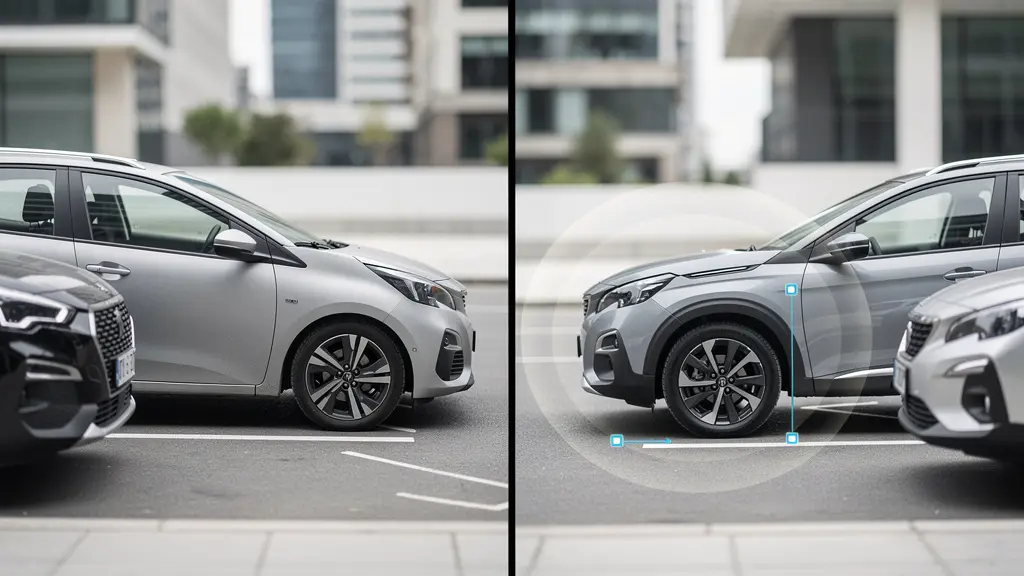
Ultimately, the choice depends on your entire lifestyle, but for a commuter focused purely on optimising the daily journey, the city car’s agility and parking efficiency make it the superior tool for the job. The time saved by not having to pass up a tight parking space is a tangible daily win.
Waze vs Google Maps: which best predicts morning traffic jams?
In the digital age, your navigation app is your co-pilot. The two dominant players, Google Maps and Waze, seem to offer the same service, but the obsessive optimiser knows they operate on different philosophies. Google Maps is the master planner; its strength lies in its vast historical data, allowing it to predict traffic based on typical patterns for that specific time and day. It’s excellent for getting a reliable baseline estimate before you even leave the house.
Waze, on the other hand, is the real-time tactician. Its power comes from its crowdsourced community, reporting accidents, broken-down vehicles, and police presence the moment they happen. It excels at reacting to the unexpected—the sudden lane closure or fender-bender that Google’s historical model couldn’t have predicted. The key insight for the efficient commuter is that it’s not a question of « which is better? » but « how do I use both? »
The optimal approach is a dual-app strategy. Use Google Maps 15-20 minutes before your departure to get a strategic overview and a reliable ETA. Then, when you get in the car, run Waze for the actual turn-by-turn navigation. This « strategic stacking » gives you the best of both worlds: Google’s long-term prediction and Waze’s immediate, on-the-ground intelligence. This approach turns navigation from a passive act of following directions into an active strategy of leveraging different data sources for the most efficient outcome, effectively creating your own personalised traffic intelligence system.
The manual gearbox in town: the ergonomic mistake that tires your left leg
For decades, the manual gearbox was championed by driving purists for its engagement and perceived control. In the context of a congested city commute, however, it represents a fundamental ergonomic mistake. Every traffic jam, every stop-and-go queue, becomes a physical chore. The constant clutch-in, clutch-out motion is not just a minor inconvenience; it’s a repetitive strain that leads to physical fatigue in your left leg and ankle, and mental fatigue from the constant micro-management of the drivetrain. This is the « ergonomic cost » of a manual in the city.
An automatic transmission, particularly a modern Continuously Variable Transmission (CVT), eliminates this entire layer of work. It transforms the experience of driving in traffic from a laborious task into a simple, two-pedal operation. This isn’t about being lazy; it’s about preserving your physical and mental energy for more important things than coordinating your left foot and right hand. The driver who arrives at work less physically taxed and mentally drained is the more effective one.
The benefits extend beyond comfort. While driving purists once claimed manuals were more fuel-efficient, modern technology has flipped that script. In the specific context of urban driving, advanced automatic transmissions are often superior. Data shows that modern CVT transmissions can provide 20-30% better fuel economy in urban stop-and-go conditions compared to a traditional manual being worked through the gears. So, the switch to an automatic is not just a vote for comfort; it’s a data-backed decision for both ergonomic and fuel efficiency.
Where to park on the outskirts to finish the journey by metro without paying the high price?
The most committed efficiency expert knows that sometimes the best way to win the game is to change the rules. For the urban commuter, this means questioning the assumption that you must drive all the way to your final destination. The « Park and Ride » strategy is the ultimate system-level optimisation. It involves driving to a strategically chosen car park on the city’s periphery and completing the final, most congested leg of the journey via a faster, more reliable mode of transport like the Tube or a tram.
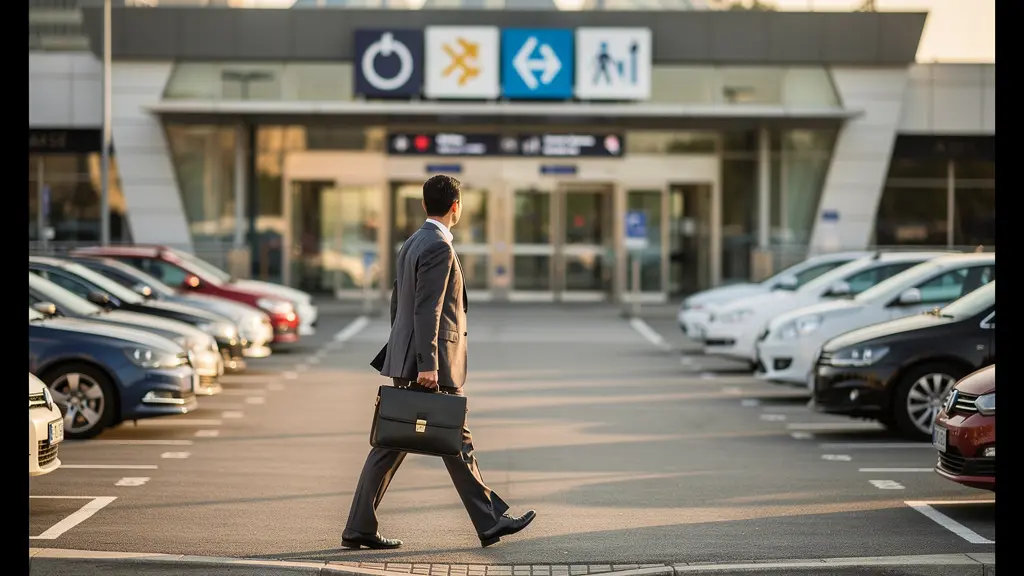
The goal is to identify the « sweet spot »: a station with ample, affordable parking that is far enough out to avoid the worst city-centre traffic but close enough to offer a quick train ride in. In London, this could mean looking at stations near the end of the Metropolitan or Central lines. In Manchester, it could be a Metrolink stop with a large dedicated car park like East Didsbury or Radcliffe. These facilities are designed for this exact purpose, offering a seamless transition from car to train.
The financial and time savings are significant. A comprehensive analysis of Park and Ride effectiveness shows that users not only save an average of £100-200 per month on expensive city-centre parking fees but also reclaim valuable time. The break-even point is clear: if your daily downtown parking costs exceed the price of a return train ticket plus the Park and Ride fee, the system is a net win. It’s a strategic trade-off: a few extra minutes on a train in exchange for avoiding the stress and uncertainty of the final-mile gridlock and parking hunt.
Which single app can you use to pay for parking, charging and the train all at once?
The optimised commute isn’t just about movement; it’s about minimising friction at every step, especially payments. Juggling separate apps for parking (RingGo, PayByPhone), train tickets (Trainline, Citymapper Pass), and EV charging (Zap-Map, Pod Point) creates a digital clutter that costs time and adds mental load. The holy grail is a single, unified payment system, often referred to as Mobility as a Service (MaaS). While a true all-in-one app that covers every provider is still rare in the UK, the principle can be applied by creating your own « unified payment ecosystem« .
This involves consolidating your most-used services and making them as accessible as possible. It starts with downloading your city’s core transit app (like TfL Go in London) and linking it with a primary payment method. Then, you add the dominant parking app for your most frequented zones and your preferred EV charging network app. The key is not just having the apps, but organising them for one-tap access.
By creating a dedicated folder or home screen widget group for « Mobility, » and using NFC or mobile wallet integrations for contactless payments, you can dramatically speed up every transaction. This proactive organisation turns a series of fumbling, time-consuming interactions into a smooth, near-instantaneous process. It’s another marginal gain that, when stacked with others, contributes to a less stressful, more efficient journey.
Building Your Unified Payment Ecosystem: A 5-Step Guide
- Foundation First: Download your city’s official transit app (e.g., TfL Go) and ensure your travel card (Oyster/contactless) is registered. This is your system’s core.
- Consolidate Parking: Identify the 1-2 parking apps that cover the majority of your potential parking zones (e.g., RingGo, PayByPhone) and delete the rest.
- Integrate Charging (if applicable): Add your primary EV charging network apps and link them to your main payment card.
- Leverage Your Wallet: Add your transit and payment cards to your phone’s digital wallet (Apple Wallet/Google Pay) for tap-to-pay functionality at barriers and terminals.
- Organise for Speed: Create a « Commute » or « Mobility » folder on your phone’s home screen and place these core apps inside for instant access.
Key takeaways
- Every second of idling over 10 seconds is a measurable loss; treating your engine switch as a tactical tool is your first win.
- Vehicle choice is strategy: a smaller turning circle and footprint are more valuable in the city than a high driving position or extra cargo space.
- The smartest strategies are hybrid: combine Park and Ride with the metro, or use Google Maps for planning and Waze for real-time execution.
Pay the £12.50 daily fee or change your car: what’s the break-even point?
For commuters in London, the Ultra Low Emission Zone (ULEZ) presents a stark financial decision. Paying the £12.50 daily charge for a non-compliant vehicle feels like a tax on your commute. The question is, at what point does it become more economical to invest in a compliant vehicle rather than continuing to « rent » access to the zone? This is a classic break-even analysis. The daily fee, while painful, is a known quantity. Over a standard working year of 220 days, it amounts to a staggering £2,750. This figure is the benchmark against which all other options must be measured.
The alternatives range from retrofitting your current vehicle to upgrading to a used compliant car or even exploring car-sharing options. Each has a different upfront cost and a corresponding timeline to break even against the £2,750 annual charge. A modest investment in an LPG conversion could pay for itself in under a year, while upgrading to a newer vehicle is a larger capital outlay that takes longer to recoup but offers other benefits like improved reliability and efficiency.
The following table provides a clear cost analysis, allowing you to identify the break-even point for your specific situation. This data-driven approach removes emotion from the decision, turning it into a simple financial calculation.
This ULEZ compliance cost analysis provides a clear framework for making the most financially sound decision.
| Option | Annual Cost | Break-even Timeline |
|---|---|---|
| Daily ULEZ Fee (220 workdays) | £2,750 | Immediate cost |
| Upgrade to Compliant Used Car | £8,000-12,000 one-time | 3-4 years |
| Retrofit to LPG | £1,500-2,500 | 8-11 months |
| Car-sharing (3 days/week) | £1,560 | Saves £1,190/year |
The data shows that continuing to pay the daily fee is, in most long-term scenarios, the least financially efficient option. Calculating your own break-even point is the critical step to stopping the financial leak and optimising your largest commuting expense.
Why is ‘Park and Ride’ 30% faster than town-centre parking?
The claim that adding a train journey can make your commute faster seems counter-intuitive, but the data proves it. The « 30% faster » figure for Park and Ride isn’t magic; it’s the result of a strategic trade-off that eliminates the most time-consuming and unpredictable parts of an urban car journey. The time saving doesn’t come from the driving portion, but from what you *avoid* at the end of it. An analysis of the strategy reveals a clear breakdown of where the minutes are saved.
The biggest gain comes from eliminating the « parking hunt« . Studies show that drivers in congested city centres can spend an average of 15 minutes simply searching for an available parking space. Park and Ride facilities are designed with ample capacity, reducing this search time to virtually zero. The second major gain comes from avoiding city-centre gridlock. The last mile of any journey into a city core is invariably the slowest. By switching to a train, you bypass this entire bottleneck, saving another 10 minutes on average.
Of course, you have to account for the train itself. This includes the walk to the platform and the average wait time, which adds about 5 minutes to the journey. But the net result is a clear win. The calculation is simple: -15 minutes (parking search) -10 minutes (traffic) +5 minutes (train wait) = a net saving of 20 minutes. This 20-minute saving on a typical 60-minute final approach represents a time reduction of approximately 30%. It’s a powerful demonstration of how optimising the whole system, rather than just one part, yields the greatest results.
Frequently Asked Questions about Optimizing Your Urban Commute
Can one app really handle all urban mobility payments?
While no single app covers everything universally in the UK, MaaS (Mobility as a Service) platforms are emerging. For now, the best strategy is to build a « digital commute wallet » by configuring mobile wallet apps with your transit cards, main parking payment app, and EV charging memberships, then creating home screen shortcuts for one-tap access.
How do I set up a digital commute wallet?
Start by adding your primary contactless payment card and any digital transit cards (like a digital Railcard) to your phone’s wallet (Apple/Google Pay). Then, download the essential apps for your route (e.g., TfL Go, RingGo) and group them in a folder on your home screen for quick access. The goal is to minimise the time spent searching for and opening apps.
Which cities offer the best integrated payment systems?
Globally, European cities like Amsterdam, Copenhagen, and Berlin are leaders in integrated mobility payments. In the UK, London’s system with Oyster and contactless payment across tubes, buses, and some rail services is one of the most advanced, though full integration with parking and third-party services is still developing.