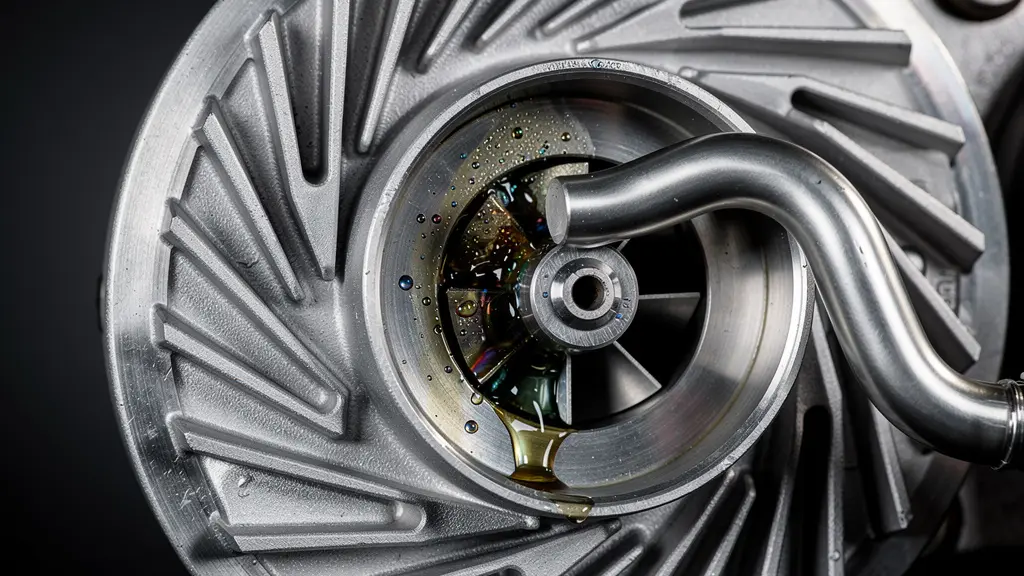
Turbochargers have a reputation for being fragile and expensive to replace, but their failure is rarely a matter of luck. The key to making a turbo last is not just following a maintenance checklist, but truly understanding the physics behind why they fail. By grasping the critical roles of heat management and oil quality, you can adapt your driving habits to prevent the specific conditions—like oil coking and bearing starvation—that destroy turbos from the inside out.
The dreaded high-pitched whine, a sudden loss of power, and a plume of blue smoke from the exhaust. For any owner of a modern turbocharged car, these are the signs of a nightmare scenario: a failed turbocharger. The subsequent repair bill, often running into thousands of dollars, has cemented the idea that turbos are fragile, ticking time bombs destined to fail. You’ve likely heard the standard advice: let the engine idle after a long drive, use good synthetic oil, and don’t push the engine when it’s cold.
While this advice is sound, it’s merely a list of rules. It treats the symptom, not the cause. It’s like being told not to touch a hot stove without ever understanding the concept of heat transfer. This approach leaves you vulnerable because you don’t know *why* you’re doing what you’re doing. What if the real key to turbo longevity isn’t just following a checklist, but fundamentally changing your mindset? What if you could visualize the extreme environment inside that small metal snail and learn to drive in a way that actively protects it?
This is where we move beyond the platitudes. A turbocharger operates at speeds up to 250,000 RPM and can glow red hot under load—it’s a marvel of engineering existing at the very edge of physical limits. Its survival depends entirely on a microscopic film of oil and your ability to manage extreme temperatures. This guide will deconstruct the common failure modes, explaining the physics at play. We will explore why a cool-down period is non-negotiable, how city driving slowly strangles a diesel turbo, and why even something as benign as cruise control can be a silent killer in the wrong situation.
text
This article breaks down the essential knowledge needed to ensure your turbocharger’s longevity. Below is a summary of the key areas we will cover, providing a clear roadmap to understanding and protecting this critical component of your engine.
Summary: The Definitive Guide to Turbocharger Longevity
- Why shutting down the engine immediately after the highway kills your turbo
- Whistling or police siren: when should you worry about your turbo’s noise?
- Why does city driving clog up your diesel turbo’s vanes?
- Reconditioned or new turbo: which option to choose for an old car?
- Why is a delayed oil change fatal for the turbo’s bearing?
- Belt or chain: why is rupture the most expensive failure to avoid?
- Does ‘High Mileage’ oil really help reduce leaks and consumption?
- When does cruise control make you consume more (mountains/inclines)?
Why shutting down the engine immediately after the highway kills your turbo
After a long, spirited drive on the highway, your turbocharger’s turbine housing can reach temperatures exceeding 900°C (1650°F). It glows a dull cherry red, a testament to the immense energy it has been converting. The central rotating assembly, spinning at over 200,000 RPM, is kept alive by a constant flow of engine oil that serves two purposes: lubrication and cooling. When you pull into a rest stop and immediately turn off the ignition, the oil pump stops. The flow of life-giving, cooling oil ceases instantly. However, the turbo itself is still scorching hot.
This is where a process called « oil coking » occurs. The stagnant oil trapped in the bearing housing essentially gets baked onto the components. It carbonizes, turning into a hard, abrasive sludge that clogs the tiny oil passages and coats the bearings. The next time you start your car, the turbo spins up with restricted or contaminated lubrication. This accelerates wear exponentially, leading to premature bearing failure. In fact, it is estimated that over 90% of turbocharger failures are oil-related, with coking from improper shutdown being a primary culprit.
To prevent this, you must give the turbo a chance to cool down. An idle period of 30 to 60 seconds is all it takes. During this time, the engine continues to circulate fresh oil through the bearing housing, carrying away the immense residual heat and allowing the turbo’s temperature to drop to a safe level before the oil flow stops. It’s the single most important habit you can adopt.
The proper procedure after high-speed driving is simple but crucial for long-term health:
- Drive at a reduced, moderate speed for the last few minutes of your journey to begin the cooling process while still in motion.
- Once parked, let the engine idle for at least 30 to 60 seconds. You can use this time to gather your belongings.
- Never rev the engine right before shutting it down, as this spins the turbo up to high speed just before you cut its oil supply.
Think of it as a cool-down lap for an athlete. You wouldn’t ask a marathon runner to sprint across the finish line and immediately lie down. The same respect for thermal management will make your turbo last.
Whistling or police siren: when should you worry about your turbo’s noise?
A healthy turbocharger makes a faint, smooth whistling sound as it spools up, a noise many enthusiasts enjoy. This is the normal sound of air being compressed at high speed. However, when this whistle changes in character and becomes a loud, high-pitched « police siren » shriek or a grinding, metallic noise, it’s a critical warning sign that should never be ignored. These sounds are the audible symptoms of a turbo in distress.
A loud siren-like whine that rises and falls with engine RPM is the classic sign of bearing failure. The shaft, which is supposed to float on a stable film of oil, is now physically contacting the bearing surfaces. This creates a high-frequency vibration that you hear as a shriek. Another possibility is an imbalance caused by a damaged compressor or turbine wheel. A small chip from ingesting debris can throw the assembly off-balance, causing it to wobble at extreme speeds and produce a siren noise just before catastrophic failure.
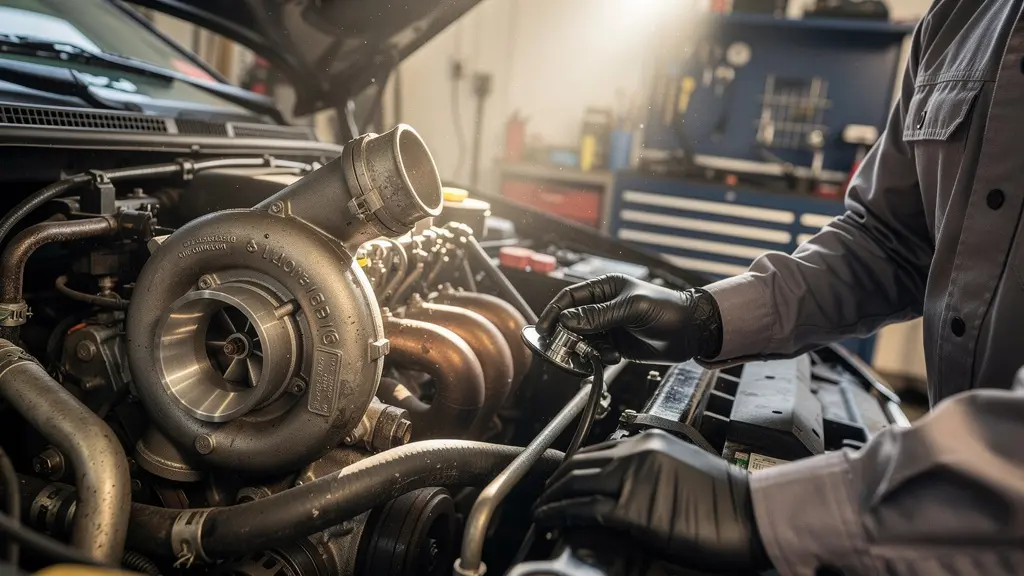
Diagnosing these sounds requires a trained ear and often specialized tools like a mechanic’s stethoscope to pinpoint the source of the noise. Ignoring it is a gamble. If the bearing fails completely, the turbine and compressor wheels can collide with their housings, shattering and sending metal fragments directly into your engine’s cylinders and intercooler. This turns a turbo replacement into a full engine rebuild.
Diagnostic Case Study: Early Intervention
A 2019 SUV with 78,000 miles was brought to a workshop with reports of occasional power loss. During a test drive, technicians noted a distinct high-pitched whine that intensified with engine speed. Using a stethoscope and smoke analysis, they confirmed advanced wear in the turbo’s main bearing. By replacing the turbo immediately, they prevented a complete failure that could have sent metal debris through the engine, saving the owner a potential repair bill of over $8,000.
In short, learn to distinguish between the healthy whistle of your turbo and the siren song of its impending doom. The difference is subtle at first but represents the boundary between a simple repair and a financial disaster.
Why does city driving clog up your diesel turbo’s vanes?
For owners of modern diesel vehicles, frequent short trips and low-speed city driving can be a silent killer for the turbocharger. This is especially true for engines equipped with a Variable Geometry Turbo (VGT). A VGT uses a set of small, adjustable vanes inside the turbine housing to change the turbo’s characteristics on the fly, providing quick response at low RPM and high efficiency at high RPM. It’s a brilliant piece of technology, but it has an Achilles’ heel: soot.
As one automotive expert aptly put it in the Blue Ridge Automotive Service Guide, « Variable Geometry Turbos (VGT) are like an athlete’s muscles; without the full range of motion provided by highway driving, they get stiff and stuck with soot from short, low-EGT trips. » Diesel exhaust is naturally rich in soot. During highway driving, high Exhaust Gas Temperatures (EGTs) and strong exhaust flow keep these vanes moving through their full range and burn off any carbon deposits. In city driving, however, the engine rarely reaches optimal temperature. Low EGTs and gentle exhaust flow allow soot to build up on the delicate VGT mechanism, acting like a thick, sticky glue.
Eventually, the vanes become seized. The turbo is then stuck in one position—often a low-boost setting—leading to significant performance loss, « limp mode » activation, and fault codes. To combat this, mechanics have long prescribed a simple but effective remedy known as the « Italian Tune-Up. » This involves driving the car at higher RPMs on a highway for a sustained period to raise EGTs and blow the carbon deposits out of the turbo and exhaust system.
Action Plan: Performing a VGT Cleaning Cycle (The « Italian Tune-Up »)
- Ensure the engine is fully warmed up by driving for at least 10-15 minutes.
- Find a safe and legal stretch of open highway where you can maintain a steady speed.
- Select a lower gear (e.g., 3rd or 4th in an automatic or manual) to bring the engine RPM up to the 3,000-3,500 range.
- Maintain this higher RPM and steady speed for approximately 15-20 minutes. This will significantly increase EGTs.
- After the run, resume normal driving and remember to perform the standard cool-down idle before shutting off the engine.
If your diesel vehicle spends most of its life in the city, scheduling a regular highway run is not an indulgence; it’s essential preventative maintenance.
Reconditioned or new turbo: which option to choose for an old car?
When a turbo fails on an older, high-mileage vehicle, the owner faces a difficult financial decision. A brand-new OEM (Original Equipment Manufacturer) turbo can cost thousands, sometimes exceeding the value of the car itself. This makes the market for cheaper reconditioned or remanufactured turbos very appealing. However, this is a domain where « you get what you pay for » has severe consequences. The critical distinction lies between a properly « remanufactured » unit and a cheap « reconditioned » or « rebuilt » one.
A true OEM remanufactured turbo is rebuilt by the original manufacturer (like Garrett or BorgWarner) or a certified specialist. It’s completely disassembled, cleaned, and inspected. All wear components—bearings, seals, and thrust collars—are replaced with new parts that meet original specifications. The rotating assembly is then re-balanced to extremely tight tolerances, often exceeding 150,000 RPM. This process restores the turbo to as-new condition and performance.
In contrast, a cheap « reconditioned » unit from an unknown source is a massive gamble. These are often just cleaned externally, fitted with a cheap « repair kit » of questionable origin, and never properly balanced. A poorly balanced turbo will self-destruct from vibration in a matter of weeks or even days, and you’re back to square one, but now you’ve also paid for labor twice. As a Garrett Motion analysis reveals, less than 1% of turbos fail due to manufacturing defects. The overwhelming majority fail due to external factors like poor lubrication, contamination, or, in this case, a shoddy rebuild.
| Option | Initial Cost | Expected Lifespan | 5-Year Total Cost (Example) | Risk Level |
|---|---|---|---|---|
| Cheap Reconditioned | $400 | < 1 year | $5,400+ (incl. multiple replacements + labor) | High |
| OEM Remanufactured | $800 | 5+ years | $800 | Low |
| New OEM | $2,500 | 8+ years | $2,500 | Lowest |
For an older car you plan to keep, a quality remanufactured turbo from a reputable brand offers the best balance of cost and reliability, providing peace of mind that a cheap alternative can never deliver.
Why is a delayed oil change fatal for the turbo’s bearing?
The heart of a turbocharger is its bearing system, and the lifeblood of that system is engine oil. The turbine shaft doesn’t ride on ball bearings like a wheel; it floats on a microscopic, high-pressure film of oil known as a hydrodynamic wedge. This oil film is all that prevents the shaft, spinning at incredible speeds, from making metal-to-metal contact with the bearing housing. This system demands a constant supply of clean, high-quality oil. A delayed oil change is a death sentence for this delicate arrangement for two reasons: contamination and degradation.
First, as oil ages, it accumulates contaminants: microscopic metal particles from engine wear, unburnt fuel, and soot (especially in diesels). These particles turn the oil into a liquid abrasive. When this contaminated oil is forced into the turbo’s tight tolerances, it acts like sandpaper, scouring the bearings and shaft, and destroying the precise clearances needed for the hydrodynamic wedge to form. The damage is swift and irreversible.
Second, heat and mechanical stress cause the oil to degrade. The long-chain molecules that give the oil its viscosity and lubricity break down. The additives that prevent corrosion and neutralize acids are consumed. The oil loses its ability to form a strong, stable film under pressure. At the extreme temperatures inside a turbo, this degraded oil can no longer provide adequate protection. The oil film collapses, leading to direct metal-to-metal contact and immediate, catastrophic bearing failure. The speed at which this happens is terrifying; research from specialists demonstrates that running a turbo for just 5 seconds without oil can cause as much wear as 500,000 miles of normal operation.
Following the manufacturer’s oil change interval is the bare minimum. For a turbocharged engine, especially one that sees frequent hard use or city driving, cutting that interval in half is the cheapest insurance policy you can buy.
Belt or chain: why is rupture the most expensive failure to avoid?
While this guide focuses on the turbo, a holistic approach to engine longevity requires acknowledging other potential points of catastrophic failure. Among the most feared is the failure of the timing system—either a timing belt or a timing chain. The turbocharger’s health is intrinsically linked to the overall health of the engine it’s attached to. A major internal engine failure will almost certainly damage the turbo through oil contamination or starvation. The timing system is the conductor of the engine’s mechanical orchestra, ensuring the pistons and valves move in perfect, harmonious synchrony.
When a timing belt snaps or a timing chain breaks or jumps a tooth, that synchrony is instantly lost. In an « interference » engine—which includes the vast majority of modern engines—the result is immediate and devastating. The pistons, no longer timed correctly, will slam into the valves that have been left open in their path. The impact bends valves, shatters pistons, and can even crack the cylinder head. The engine effectively self-destructs in a fraction of a second. This isn’t just a repair; it’s an engine replacement or a complete, costly rebuild.
The cost of replacing a timing belt at its scheduled interval (typically 60,000 to 100,000 miles) might seem high, but it pales in comparison to the five-figure cost of the engine replacement it prevents. Timing chains are designed to last the life of the engine, but they are not infallible. They rely on oil pressure for their tensioners and guides. Poor oil quality or low oil levels can cause premature wear, leading to stretching and noise (a « rattling » sound on startup) that signals impending failure. Just as with the turbo, clean oil is the chain’s best friend. This highlights the interconnectedness of engine systems, where a single point of failure can have cascading, destructive effects.
Adhering strictly to timing belt replacement intervals and listening for any chain noise are non-negotiable aspects of preserving your entire powertrain, turbo included.
Does ‘High Mileage’ oil really help reduce leaks and consumption?
Choosing the correct engine oil is the most direct and impactful decision you can make for your turbo’s health. With a dizzying array of options on the shelf—conventional, synthetic blend, full synthetic, high mileage—it’s easy to get confused. For a turbocharged engine, the choice is simple: full synthetic oil is not a luxury, it’s a requirement. The extreme heat generated by the turbo will cause conventional oil to break down and « coke » almost immediately. Full synthetic oils are engineered to have a much higher thermal stability, resisting breakdown and maintaining their protective properties at temperatures where conventional oils fail.
What about « High Mileage » oils? These are typically full synthetic or synthetic blend oils formulated with additional additives. Their primary feature is a set of « seal conditioners » designed to swell and soften old, hardened rubber seals, helping to reduce minor oil leaks and consumption in older engines. While they can be effective for this purpose, their primary benefit is for the main engine seals (crankshaft, valve stems), not necessarily the turbo itself. A turbo that is leaking oil is usually a sign of a more serious internal problem (like bearing wear or a clogged oil return line) that no additive can fix.
Therefore, for a turbocharged engine of any age, the priority should always be on quality and specification over a « high mileage » label. A high-quality full synthetic that meets the manufacturer’s exact specifications is the best choice. Using the wrong viscosity or a low-quality oil to save a few dollars is a catastrophic mistake that will cost you a turbo.
To ensure you’re using the right lifeblood for your engine, follow these guidelines:
- Use the manufacturer-specified viscosity: Whether it’s 0W-20, 5W-30, or another grade, do not deviate. This is engineered for the engine’s specific clearances.
- Choose full synthetic oil: Its resistance to heat and shear is essential for turbo protection.
- Look for modern API certifications: The « API SN Plus » or newer « API SP » ratings include specific tests to prevent Low-Speed Pre-Ignition (LSPI), a destructive phenomenon in modern, small-displacement turbo engines.
- Reduce your change interval: For turbocharged engines, changing the oil every 3,000-5,000 miles is a wise investment, regardless of the manufacturer’s « extended » interval.
Don’t be swayed by marketing. Focus on the specifications in your owner’s manual—they are there for a reason.
Key Takeaways
- The primary killers of turbochargers are extreme heat and contaminated or degraded oil; managing these two factors is paramount.
- A 30-60 second cool-down idle after hard driving is non-negotiable to prevent oil « coking » and bearing failure.
- For any turbocharged engine, using a high-quality full synthetic oil that meets the manufacturer’s exact viscosity and API specifications is a requirement, not an option.
When does cruise control make you consume more (mountains/inclines)?
Cruise control is a fantastic tool for relaxed, efficient highway driving on flat terrain. However, in hilly or mountainous regions, it can transform from a convenience into a mechanism of extreme stress for your turbocharger. This is a subtle but critical point that separates a knowledgeable driver from an average one. A human driver, seeing an upcoming incline, will naturally build momentum before the hill and ease off near the crest. Cruise control does the opposite.
An electronic system is purely reactive. It only knows one thing: maintain the set speed. As the car begins to climb a grade and slow down, the cruise control system responds by aggressively opening the throttle and demanding maximum power from the engine to regain that lost speed. This forces the turbo to operate at maximum boost and temperature for a sustained period. This condition of prolonged, high-load operation is the single most stressful scenario for a turbocharger. Exhaust Gas Temperatures (EGTs) skyrocket, putting immense thermal strain on the turbine wheel and bearing housing.
According to stress analysis, manual throttle modulation can reduce turbo stress by 30-40% on mountain grades compared to using cruise control. By manually easing the throttle near the crest of a hill, you allow the turbo to cool slightly and reduce boost, giving it a brief but vital respite. Cruise control, by holding maximum boost all the way to the top and then abruptly cutting power on the descent, creates a cycle of intense thermal shocks that accelerates wear and tear. It’s the difference between a variable workout and holding a maximum-weight lift until failure.
The lesson is clear: in hilly terrain, turn off the cruise control. Your right foot is a far more intelligent and sympathetic controller than any computer, and your turbocharger’s lifespan will be the direct beneficiary of your active engagement.