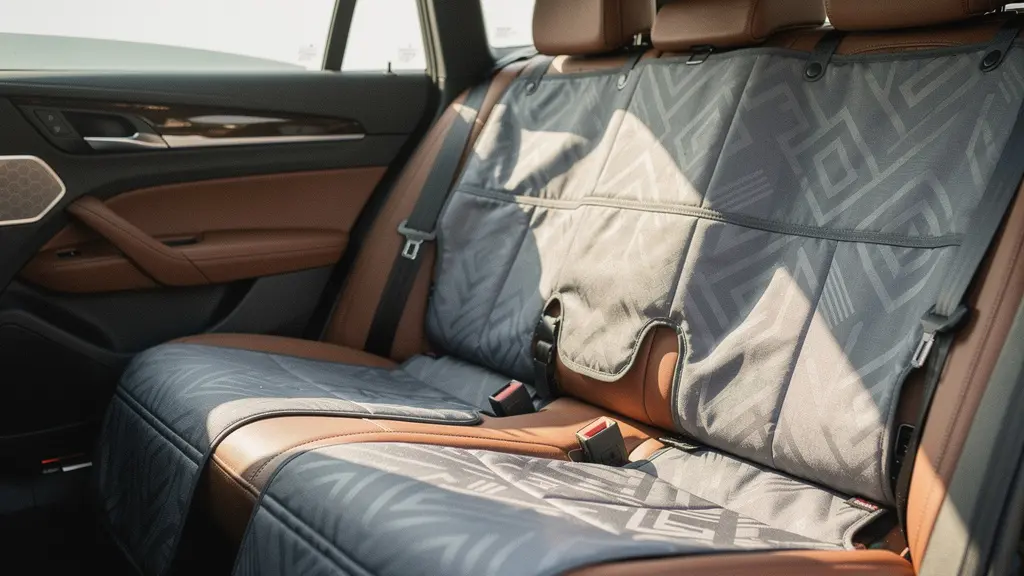
True interior protection isn’t about buying a cover; it’s about installing a system that preserves your vehicle’s original safety, function, and aesthetic value.
- Safety is paramount: Non-certified covers can interfere with airbags and fail flammability tests, creating serious hazards.
- Aesthetics come from fit: Achieving a « factory look » depends entirely on professional installation techniques, not just the product itself.
- Functionality means balance: The best materials offer a compromise between waterproofing, breathability for comfort, and durability.
Recommendation: Prioritize covers with documented safety certifications (airbag and flammability) and invest time in a meticulous installation for a result that protects your car and its value.
As a professional upholsterer, I see the conflict every day: the love for your pristine car interior versus the reality of life with dogs and children. The scratches, the spills, the lingering odors. The immediate instinct for many is to grab a generic, one-size-fits-all seat cover from a big-box store. While seemingly a quick fix, this often leads to a saggy, constantly shifting piece of fabric that cheapens your interior and, more alarmingly, can compromise the very safety systems designed to protect your family.
The common approach focuses on simply covering a problem. But a true solution goes deeper. It requires thinking like a craftsman, considering the material science, the engineering of your car’s safety features, and the techniques needed to achieve a flawless integration. What if you could have robust protection that looks and feels like it was installed at the factory? This is not about finding a better cover; it’s about adopting a better system—one that respects the integrity of your vehicle’s design.
This guide will walk you through that professional mindset. We will explore why safety certifications are non-negotiable, how to choose materials that balance protection with comfort, the secrets to an installation that mimics original upholstery, and how to maintain full functionality, from child seat access to resale value. It’s time to move beyond temporary fixes and towards a lasting, beautiful, and safe solution for your car’s interior.
To navigate this comprehensive approach, the following sections will break down each critical aspect of choosing and fitting the perfect protection system for your vehicle.
Table of Contents: A Professional Guide to Flawless Seat Protection
- Why can a non-certified cover turn your seat into a piège mortel ?
- What material to choose for a driver who transpires or comes back from sports?
- The mounting trick to make your covers look like a sellerie d’origine
- How to protect the banquette arrière while keeping access to baby seats?
- Entretien des housses : les erreurs de lavage qui les rendent impossibles à remettre
- Filet ou grille métallique : what to choose to prevent the chien from jumping in front?
- Sécurité enfant : why the overall 5-star score sometimes hides lacunes à l’arrière
- What couleur and finition to choose to resell your car 15% plus cher in 3 years?
Why a non-certified cover turn your seat into a death trap?
A seat cover seems innocuous, but an uncertified one introduces two potentially lethal risks into your vehicle: flammability and airbag interference. Automotive manufacturers must adhere to strict safety standards for every component, and a cheap aftermarket cover can negate these engineered protections in an instant. The materials used in your car’s interior are treated to be fire-retardant. According to federal motor vehicle safety standards, materials must not have a burn rate exceeding 4 inches per minute. An untested cover made from generic polyester or nylon can act like a wick in a fire, accelerating the spread of flames.
Even more critical is the issue of airbag compatibility. Modern car seats contain side-impact airbags that deploy from the seat’s bolster with explosive force. A proper seat cover has specially designed breakaway seams or panels that are rigorously tested to tear open without impeding the airbag’s path. A non-certified cover, however, can act like a net, either delaying the airbag’s deployment or, worse, redirecting it away from the occupant or towards them at an unsafe angle. This turns a life-saving device into a dangerous projectile. The same applies to Occupant Classification System (OCS) sensors in the passenger seat, which can be thrown off by a poorly designed cover, potentially disabling the airbag for a lighter passenger.
Your Safety Audit Checklist: Certified Seat Covers
- Flammability Compliance: Look for an explicit « FMVSS 302 Compliant » statement on the product label or documentation. Do not assume compliance.
- Airbag Compatibility: Demand proof of testing. The manufacturer should provide documentation or certification that their product is compatible with side-impact airbags.
- Sensor Compatibility: Verify with the manufacturer that the cover is designed not to interfere with OCS sensors. This is crucial for front passenger seat safety.
- Breakaway Stitching: Visually inspect the sides of the seat cover for designated breakaway stitching or panels. These areas should look different from the rest of the seams.
- Crash-Test Certification: The highest level of assurance comes from third-party crash-test certification from recognized safety organizations. Prioritize products that have undergone this level of scrutiny.
What material to choose for a driver who sweats or comes back from sports?
For an active driver, the immediate thought is « waterproof. » While materials like neoprene are excellent at blocking moisture, they create a significant comfort problem: they don’t breathe. This traps sweat and heat against your body, leading to a swampy, uncomfortable ride and eventually, unpleasant odors. The professional solution is to prioritize materials that offer a balance of water resistance and breathability. You want a fabric that can repel a spill but also allow moisture vapor from sweat to escape.
High-tech fabrics like 3D Air Mesh, CORDURA®, or materials with a breathable membrane are engineered for this purpose. They have a microscopic structure that is tight enough to prevent water droplets from passing through but open enough to let smaller water vapor molecules out. Another excellent feature to look for is odor control, often achieved by infusing materials with natural antimicrobials like bamboo charcoal. This prevents the growth of bacteria that cause lingering gym-bag smells in your car’s upholstery. The right choice depends on balancing your need for absolute waterproofing against your desire for daily driving comfort.
This table breaks down the performance of common materials to help you make an informed decision based on your specific lifestyle needs.
| Material | Breathability | Waterproof | Odor Control | Maintenance |
|---|---|---|---|---|
| 3D Air Mesh | Excellent | Limited | Good | Machine washable |
| Bamboo Charcoal | Very Good | Moderate | Excellent | Easy care |
| CORDURA® Fabric | Good | Water-resistant | Moderate | Highly durable |
| Neoprene | Poor | Excellent | Poor | Quick wipe-down |
| Breathable Membrane | Good | Very Good | Good | Professional clean |
The mounting trick to make your covers look like original upholstery
The difference between a cheap-looking seat cover and one that appears to be a factory upgrade has almost nothing to do with the price of the cover and everything to do with the installation. The secret is tension and anchoring. A professional upholsterer aims to eliminate all sagging, bunching, and shifting. This is achieved not with flimsy elastic straps, but with a systematic process that integrates the cover with the seat’s structure.
Forget a 5-minute installation. A proper job takes time and the right tools—simple plastic trim removal tools are your best friend here. The goal is to tuck all excess material deep into the plastic seams and crevices of the seat, just as the original upholstery is. Padded tubes or anchor flaps must be pushed firmly into the gap between the seat back and bottom cushion to create a fixed point. Underneath the seat, using the provided S-hooks to connect straps directly to the seat’s metal spring structure provides a level of tension that simple friction can never match. This creates the taught, drum-tight surface that screams « custom » instead of « afterthought. »
Here is the step-by-step process a professional would follow to achieve that coveted factory finish:
- Prepare the Canvas: Start by thoroughly vacuuming and cleaning the original seats. Any debris left underneath will create lumps and wear points.
- Increase Flexibility: If the material is stiff, gently pre-warm it with a fabric steamer or hairdryer on low heat. This makes it more pliable and easier to stretch into place.
- Start with the Anchor: The most important step is to push the seat anchors (padded tubes) firmly and deeply into the crevice where the seat back and bottom meet. Use a trim tool to wedge it in securely.
- Secure the Top: Adjust headrest straps for an even, snug fit, eliminating any sagging from the top.
- Tuck the Edges: Use plastic trim removal tools to carefully tuck all excess fabric and seams into the plastic trim surrounding the seat. This is the key to a seamless, integrated look.
- Create Invisible Tension: Route the bottom straps underneath the seat and use the S-hooks to connect them to the metal seat springs or frame. Pull them tight to remove all slack from the seat cushion.
- Final Touches: Use a hairdryer on a low setting and gently go over any remaining wrinkles. The slight heat will help the fabric conform perfectly to the seat’s contours.
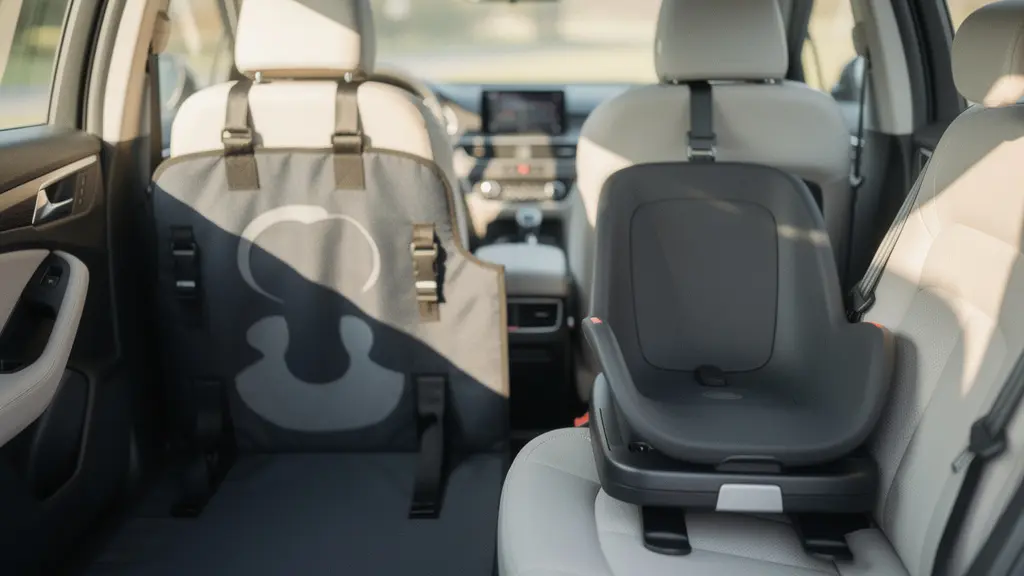
How to protect the banquette arrière while keeping access to baby seats?
Protecting a back seat used by both pets and children presents a unique challenge: you need comprehensive coverage for pet hair and dirt, but also non-negotiable, direct access to the car’s LATCH/ISOFIX anchor points for child seats. Standard « hammock » or bench covers often obstruct these critical safety anchors, forcing a dangerous compromise where parents either install the car seat over the cover (preventing a secure fit) or cut holes in the cover (destroying its integrity and warranty).
The professional solution is a modular or split-design system. Instead of a single, solid cover, these systems are designed to protect only a portion of the seat, such as a 60/40 or 50/50 split. This allows you to have a protected zone for your dog on one side while leaving the other side’s upholstery and, most importantly, its LATCH anchors completely exposed and accessible for a rock-solid child seat installation. The best designs feature zippered or Velcro openings specifically designed and positioned for anchor access, ensuring no fabric gets bunched up between the child seat base and the vehicle’s seat.
Case Study: 4Knines Modular Protection Strategy
The company 4Knines tackled this exact problem by developing a split-design rear seat cover. Their solution allows a family to use one side of the bench for their pet, with full waterproof and scratch-proof protection, while the other side remains free for a child seat. Their testing found that by using separate, single-seat-sized covers with reinforced, zippered openings for the anchors, they could maintain 100% child seat security according to safety installation standards. The key innovation was ensuring the access panels were precisely sized for LATCH connectors, which prevented fabric bunching—a common issue that can compromise the tightness of a child restraint installation.
Entretien des housses : les erreurs de lavage qui les rendent impossibles à remettre
You’ve invested in a quality, well-fitting seat cover. The last thing you want is to ruin it in the wash. The most common and costly mistake is using hot water and high-heat drying. This can cause significant fabric shrinkage, especially in cotton or canvas blends, making it physically impossible to reinstall the cover. The result is a cover that is too small, putting immense stress on the seams and straps, leading to premature failure. This loss of dimensional stability is often irreversible.
Another critical error is using fabric softener. While it seems like a good idea for softness, fabric softeners leave behind a residue that clogs the pores of breathable fabrics and, more importantly, destroys the Durable Water Repellent (DWR) coating on water-resistant materials. That factory-applied coating is what makes water bead up and roll off; fabric softener breaks it down, allowing moisture to soak in. Following a strict care protocol is essential to preserving the fit, function, and longevity of your investment.
- Always use cold water: Wash on a gentle cycle with a maximum temperature of 30°C (86°F) to prevent any risk of shrinkage.
- Fasten all straps and zippers: Secure all Velcro to itself and close all zippers before washing to prevent them from snagging or damaging the fabric.
- Never use fabric softener or bleach: These chemicals will destroy water-repellent coatings and can degrade the fabric’s strength. Use a mild detergent only.
- Air dry is best: Hang the cover to air dry. For a perfect, taut fit, reinstall it on the seat when it is about 80% dry. The slight dampness will allow it to stretch and conform perfectly as it finishes drying.
- Reactivate DWR if needed: For waterproof covers, you can often reactivate the DWR coating by tumbling it in a dryer on a low heat setting for about 20 minutes *after* it is fully dry.
- Check the care label: Above all, always defer to the manufacturer’s specific care instructions, as some materials may be hand-wash only.
Filet ou grille métallique : what to choose to prevent the chien from jumping in front?
Keeping your dog safely in the back seat isn’t just a matter of convenience; it’s a critical safety issue to prevent distracted driving. The two primary solutions are flexible net barriers and rigid metal grids. The choice between them depends less on the car and more on the dog’s temperament, size, and determination to escape. A net barrier is often less intimidating for anxious dogs and is generally easier to install and remove. It’s a great solution for calmer dogs who just need a visual reminder to stay in the back.
A metal grid, however, offers a much more robust and secure solution for larger, more persistent, or highly energetic dogs. These are often anchored more securely to the headrest posts or the vehicle’s structure and can withstand more force. While they can sometimes create slight rattles or vibrations and may have a greater impact on rear-view visibility, they provide the highest level of security against a determined dog. For many, the peace of mind that comes with a physically impassable barrier is worth the trade-offs. Crash-test certification (such as from TÜV) is more common with metal barriers, offering an additional layer of safety assurance.
The following table provides a direct comparison to help you weigh the pros and cons based on your specific situation.
| Feature | Flexible Net Barrier | Metal Grid Barrier |
|---|---|---|
| Crash Test Rating | Variable (check TÜV certification) | Often TÜV certified |
| Noise Level | Silent operation | Can rattle/vibrate |
| Visibility Impact | Minimal obstruction | Moderate obstruction |
| Dog Psychology | Less confrontational | Can increase anxiety |
| Escape Prevention | Risk of chewing through | More secure if properly anchored |
| Installation | Easy, flexible mounting | Requires precise fit |
| Price Range | $30-80 | $60-200 |
Sécurité enfant : why the overall 5-star score sometimes hides lacunes à l’arrière
A vehicle’s 5-star safety rating is a testament to its structural integrity and built-in safety systems. However, this rating can be rendered meaningless by aftermarket additions that interfere with those systems, particularly in the back seat. While we’ve discussed LATCH/ISOFIX access, another hidden danger lies with side curtain airbags. Many « hammock » style pet covers that stretch between the front and rear headrests create a wall of fabric that can block the deployment path of side curtain airbags designed to protect rear passengers’ heads in a side-impact collision.
This is especially concerning because rear-seat safety standards can have gaps. For instance, according to current regulations, mandatory child restraint side impact testing only covers children up to 40 pounds (18.1 kg). This means the interaction between airbags and older children or adults in the back seat is less rigorously defined, making it even more critical not to obstruct these systems. A seat cover should never run along the « roofline » of the side windows where these airbags are housed.
Safety authorities are clear about this risk. As a formal assessment from the National Highway Traffic Safety Administration (NHTSA) points out, the danger is real and often overlooked by well-intentioned pet owners:
Hammock style covers that stretch between front and rear headrests can obstruct the deployment path of side curtain airbags designed to protect rear passengers’ heads.
– NHTSA Safety Analysis, Federal Motor Vehicle Safety Standards Assessment
Key Takeaways
- Safety First, Always: Certification is non-negotiable. Your seat cover must be proven compatible with your vehicle’s airbags and meet flammability standards.
- Balance Protection and Comfort: The best material isn’t just waterproof; it’s a breathable fabric that resists moisture while preventing discomfort and odors on long drives.
- Fit is Everything: A premium, factory-grade aesthetic is achieved through meticulous, tension-based installation, not by buying a more expensive cover.
What couleur and finition to choose to resell your car 15% plus cher in 3 years?
Protecting your car’s interior is fundamentally about preserving its value. A cabin free from rips, stains, and odors is one of the single most significant factors in securing a higher resale or trade-in price. The cost of fixing a damaged interior far outweighs the cost of protecting it from day one. For context, professional reupholstering can cost around $2,500 on average for a complete interior, a cost that comes directly off your car’s value. A quality seat protection system is an investment that pays for itself many times over.
When choosing that system with resale in mind, the goal is not necessarily to perfectly match the original color. In fact, choosing a sophisticated, contrasting color can often look more intentional and luxurious. Think charcoal grey covers on black seats, or a rich tan on a beige interior. The key is to choose colors that are timeless and widely appealing—stick to blacks, greys, and tans. Even more important than color is the finish. A matte finish will always outperform a glossy or shiny one over time. It hides micro-scratches and wear far better and maintains a premium, understated appearance that doesn’t scream « aftermarket. »
Study: The Impact of Interior Protection on Resale Value
A 2025 analysis by Austin Automotive Restoration provided clear data on this topic. They found that vehicles with professionally protected interiors retained 12-18% more of their value at a 3-year trade-in compared to similar, unprotected vehicles. The study highlighted that the most successful protection strategies involved sophisticated contrasts rather than perfect color matching. Furthermore, it noted that matte finishes consistently maintained a more premium look over time. The ultimate value preservation came from solutions that were so well-integrated they were nearly invisible, preserving the original factory aesthetic while preventing damage.
By applying these professional principles, you’re not just buying a product; you’re investing in the longevity, safety, and value of your vehicle. The next logical step is to assess your specific needs and choose a protection system that meets these high standards of both safety and aesthetic integration.