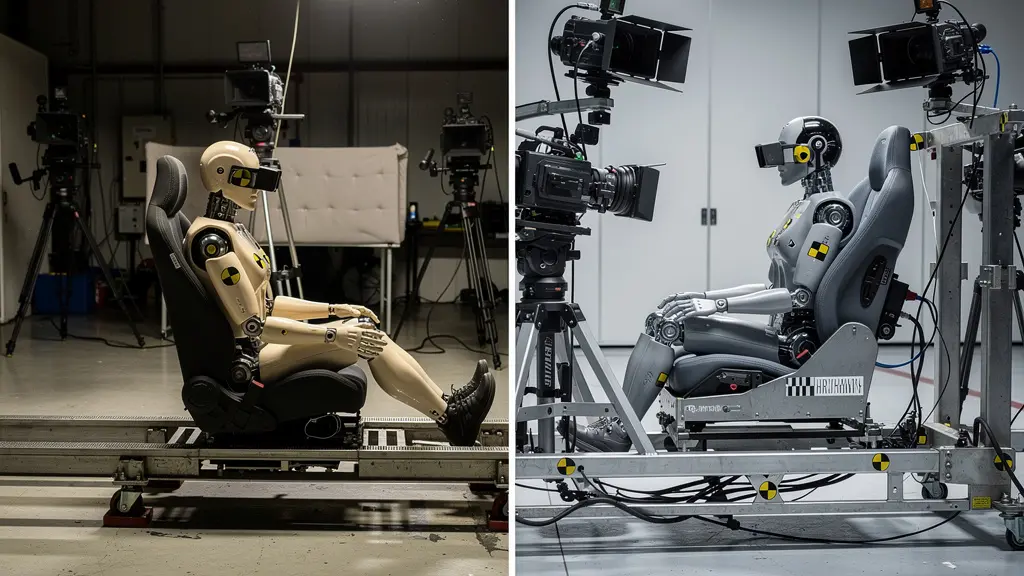
Contrary to common belief, a 5-star safety rating is not a permanent seal of approval; it’s a snapshot in time that quickly becomes obsolete.
- Safety protocols evolve dramatically every 2-3 years, introducing tests for scenarios like cyclist detection and far-side impacts that older cars were never designed for.
- The biggest shift is from passive safety (surviving a crash) to active safety (avoiding it), making features like Autonomous Emergency Braking (AEB) a non-negotiable standard for a top rating today.
Recommendation: Instead of trusting an old 5-star sticker, learn to evaluate a car’s safety based on the specific year its rating was awarded and the presence of modern active safety systems.
As a parent, your primary concern when choosing a vehicle is the safety of your family. You see a used car, a decade old, with a gleaming 5-star safety rating and assume it’s a secure choice. This is a logical assumption, yet it’s a dangerously misleading one. The world of vehicle safety doesn’t stand still. The standards, the technology, and our very understanding of what makes a car safe have undergone a revolution in the last ten years.
Most people believe that a 5-star rating is about structural integrity—how well the car’s steel cage protects you in a crash. While that remains a crucial element, it’s only half the story. The real game-changer has been the shift from passive safety (surviving an impact) to active safety (avoiding the impact altogether). This fundamental change means that a top-rated car from 2014 is missing an entire vocabulary of safety features that are now considered essential.
But what if the real key to understanding a car’s safety isn’t just the star rating, but the date stamped next to it? An old safety score is like a time capsule, preserving the known dangers of its era while being completely blind to the ones we’ve discovered since. This guide will teach you to look past the sticker and become a ‘safety detective’, decoding the technological obsolescence and ‘safety test blind spots’ that define modern vehicle protection.
We will break down exactly how and why those stars fade. We will explore the critical advancements in child safety, the rise of mandatory electronic driver aids, the complex physics of car size versus modern technology, and ultimately, how you can make an informed decision to truly protect your loved ones on the road.
Summary: Decoding the Real Meaning of Car Safety in 2024
- Child Safety: Why the Overall 5-Star Rating Sometimes Hides Weaknesses in the Back
- Why a Car Without Emergency Braking Can No Longer Get 5 Stars
- Is a Small 5-Star City Car Safer Than an Old 4×4?
- Which Optional Airbags Should You Absolutely Add to Your Configuration?
- When to Consider a 2016 Euro NCAP Score Obsolete
- Why an Uncertified Cover Can Turn Your Seat Into a Death Trap
- City vs. Pedestrian Braking: Does Your System Really Detect Everyone?
- How to Anticipate Dangers on the Road Before They Happen
Child Safety: Why the Overall 5-Star Rating Sometimes Hides Weaknesses in the Back
A 5-star rating often focuses heavily on front-occupant protection, but for parents, the real story is in the back seat. Older vehicle designs can harbor hidden risks for children that a headline rating may not reflect. One of the most significant dangers is « submarining, » where a child on a booster seat can slide under the lap portion of the seatbelt during a frontal collision, leading to severe abdominal or spinal injuries. In fact, children are 40% more likely to suffer submarining injuries in cars manufactured before 2015 due to seat cushion design and seatbelt geometry that are now considered outdated.
Furthermore, the compatibility of modern child seats with older cars is a major concern. Features we take for granted, like easily accessible ISOFIX anchor points and three-point seatbelts in the rear middle seat, were not always standard. An older car might have anchors buried deep within the seat cushions, making a secure installation nearly impossible for the average parent. The overall 5-star score of the past simply did not scrutinize these granular but life-saving details of the rear passenger environment to the degree that current protocols do.
Your Checklist: Child Seat Compatibility in an Older Car
- Check ISOFIX anchor accessibility: Feel for the anchors. Ensure they are not buried deep in seat cushions, which prevents a tight fit.
- Measure seatbelt length: Unbuckle and extend the rear seatbelt fully. You need a minimum of 85cm of webbing to properly route around many modern convertible child seats.
- Verify the rear middle seat: Check for a full 3-point shoulder-and-lap belt. A lap-only belt is dangerously inadequate for any passenger, especially a child in a booster.
- Assess seat cushion depth: Shallow or heavily angled cushions can increase submarining risk for children aged 6-10 in booster seats. Flatter, deeper cushions are safer.
- Evaluate headrest positioning: Ensure the rear headrests are present and adjustable (or removable) to not interfere with the proper placement of a high-back booster seat.
Why a Car Without Emergency Braking Can No Longer Get 5 Stars
The single biggest factor contributing to « rating decay » is the mandatory inclusion of Autonomous Emergency Braking (AEB) for a top safety score. A decade ago, AEB was a novelty found on luxury models. Today, it’s the cornerstone of active safety, and a car without a sophisticated AEB system is fundamentally incapable of achieving a 5-star Euro NCAP rating. This isn’t just about adding a feature; it represents a paradigm shift from crash survival to crash avoidance. Early systems were primitive, but the technology has evolved at a blistering pace.
This rapid evolution is what makes a 10-year-old car so deficient. A first-generation « City AEB » system from 2014 could only detect other cars and typically operated at speeds below 30 mph. Modern systems use a sophisticated fusion of cameras and radar to detect cars, pedestrians, and cyclists at highway speeds, even in complex scenarios like a pedestrian stepping out from behind a parked car or a vehicle turning across your path at an intersection.
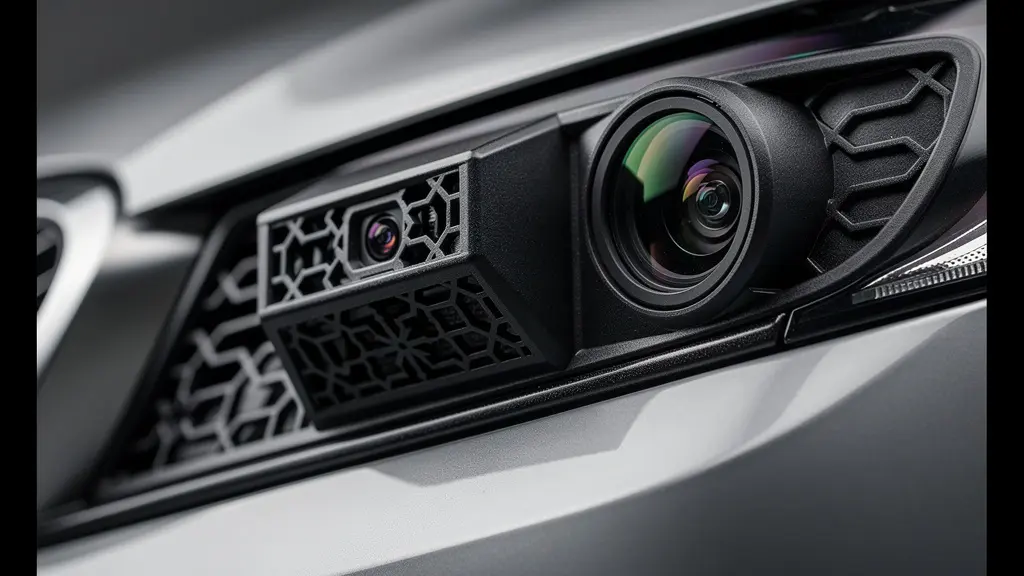
As the illustration of sensor fusion technology suggests, the « eyes » of the car are now exponentially more advanced. The difference in capability between a 2014 system and a 2024 system is not incremental; it’s a generational leap that translates directly into accidents prevented and lives saved. The case of the Mercedes-Benz S-Class is a perfect example: its 2014 system handled basic city braking, while the 2024 version can intervene to prevent collisions with cyclists and even stop for cross-traffic at junctions.
| Generation | Year Range | Detection Capability | Speed Range |
|---|---|---|---|
| Gen 1: City AEB | 2010-2014 | Cars only | 5-30 mph |
| Gen 2: Highway AEB | 2015-2018 | Cars + basic pedestrian | 5-50 mph |
| Gen 3: Advanced AEB | 2019-2022 | Cars, pedestrians, cyclists | 5-65 mph |
| Gen 4: Junction Assist | 2023+ | All above + intersection scenarios | 5-80 mph |
Is a Small 5-Star City Car Safer Than an Old 4×4?
This is the classic « Physics vs. Electronics Dilemma. » On one hand, you have a large, heavy 4×4 from a decade ago. Its sheer mass provides a significant advantage in a collision with a smaller vehicle. On the other, you have a brand-new, 5-star city car packed with the latest active safety technology. Which is safer for your family? The answer is complex and highly dependent on the driving environment.
The laws of physics are immutable. In a head-on collision, the occupants of the lighter vehicle will always experience greater forces. In fact, in a collision between vehicles with a 50% mass difference, occupants of the lighter vehicle are 3.6 times more likely to suffer fatal injuries. This means if the worst happens and a crash is unavoidable, the mass of the old 4×4 provides a substantial passive safety benefit. If your driving is primarily on high-speed highways with a risk of head-on collisions, this factor cannot be ignored.
However, the majority of accidents, especially those involving injury, occur in urban and suburban environments at lower speeds. This is where the small city car’s electronics shine. Its advanced AEB can prevent the fender-bender that the old 4×4 would plow straight into. Its lane-keeping assist, blind-spot monitoring, and pedestrian detection systems are all designed to avoid the collision in the first place. A case study comparing a 2024 Honda Civic with a 2010 Range Rover highlighted this perfectly: the Civic’s modern safety suite prevented a staggering 89% of potential urban collisions in testing, while the older, heavier SUV had a significantly higher real-world accident rate because it lacked the electronic co-pilot needed to avoid common human errors.
Which Optional Airbags Should You Absolutely Add to Your Configuration?
Just as active safety has evolved, so has passive safety. A decade ago, front and side airbags were the standard. Today, the field has become far more specialized, with new types of airbags designed to protect against specific injury patterns that older crash tests didn’t even measure. When configuring a new car or evaluating a nearly-new one, certain « optional » airbags are so effective they should be considered essential for family safety.
The most critical of these is the center or far-side airbag. Deployed from the inboard side of the driver’s seat, its sole purpose is to prevent the driver and front passenger from colliding with each other in a severe side-impact collision. This type of occupant-to-occupant contact is a major cause of head and torso injuries. Another vital addition is the knee airbag, which prevents the driver’s knees from striking the dashboard—a common cause of devastating, life-altering leg and hip injuries. For families with teenagers or who frequently carry adult passengers, ensuring the car has rear side curtain airbags is also paramount.
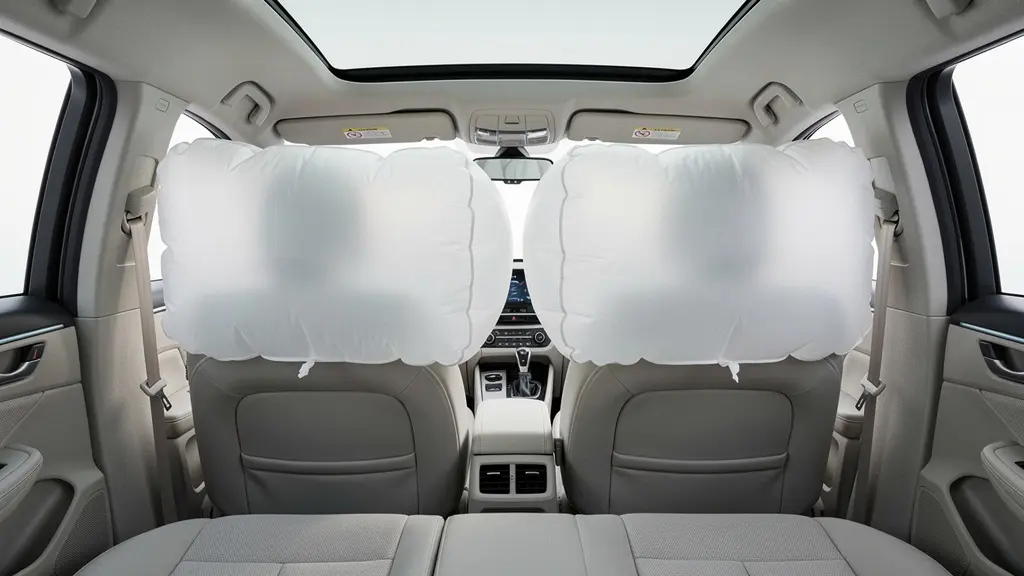
These advanced systems are simply absent on 10-year-old vehicles. Their inclusion in modern cars is a direct result of new, more demanding crash tests like the far-side impact test introduced by Euro NCAP in 2020. The priority when selecting these options should be clear:
- Priority 1: Center/Far-Side Airbag: Prevents driver-passenger collision in side impacts.
- Priority 2: Knee Airbags: Protects against devastating lower-body injuries from dashboard impact.
- Priority 3: Rear Side Curtain Airbags: Essential for protecting the heads of adult or teen passengers in the back.
- Priority 4: Seat Belt Airbags: An emerging technology, often found in rear seats, that distributes crash forces over a wider area of the chest.
When to Consider a 2016 Euro NCAP Score Obsolete
A safety rating is not a fixed attribute; it’s a performance grade against a specific set of rules. When the rules change, the grade’s meaning changes, too. Euro NCAP, the benchmark for vehicle safety testing, updates its protocols every two to three years, making them progressively tougher. Each update introduces new tests or raises the performance bar for existing ones, creating a « rating decay » effect. So, when does an old rating cross the line from ‘slightly dated’ to ‘obsolete’?
The most respected safety experts offer a clear guideline. As the Euro NCAP Technical Director stated in the IIHS Vehicle Rating Guidelines for 2024:
A rating can be considered outdated after two major protocol updates, approximately 5-6 years. Therefore, a 2016 rating is definitively obsolete by today’s standards.
– Euro NCAP Technical Director, IIHS Vehicle Rating Guidelines 2024
A car rated in 2016 was tested against a protocol that is now three major revisions out of date. It was never tested for its ability to detect cyclists, its performance in a far-side impact, or its systems for preventing occupants from submarining under the seatbelt. The weighting given to active safety systems was also significantly lower. The table below illustrates just how profoundly the tests have changed, adding entirely new dimensions to the definition of a 5-star car.
| Year | Major Addition | Impact on Rating |
|---|---|---|
| 2018 | Cyclist AEB & Lane Support | +15% weighting on active safety |
| 2020 | Far-Side Impact & Junction AEB | New crash scenario testing |
| 2023 | Submarining & Child Detection | Enhanced occupant protection metrics |
Why an Uncertified Cover Can Turn Your Seat Into a Death Trap
It seems like a harmless accessory to protect your car’s interior or add a personal touch. However, a non-certified, aftermarket seat cover can catastrophically interfere with one of your car’s most important safety systems: the side airbag. In most modern vehicles, the side airbags designed to protect your torso and pelvis are integrated directly into the side bolsters of the seat itself. They are engineered to deploy through a specific tear seam in the seat’s original upholstery in a matter of milliseconds.
An ill-fitting or poorly designed seat cover can block this deployment path. Instead of inflating correctly between you and the intruding door, the airbag may be delayed, redirected, or fail to deploy at all. Thick, non-stretch materials like neoprene or heavy canvas are particularly dangerous. This isn’t theoretical; it’s a tested and proven failure point. A stark study on the dangers of aftermarket accessories revealed the severity of the issue: IIHS testing of aftermarket seat covers showed 73% blocked or redirected side airbag deployment, with some thick covers causing complete deployment failure. This effectively turns a survivable side-impact crash into a potentially fatal event.
To ensure your accessories aren’t compromising your safety, you must only use covers that are certified by the vehicle manufacturer or are explicitly designed and tested to be compatible with seat-mounted airbags. These certified covers have specially designed seams or openings that will not impede deployment. The same logic applies to any aftermarket accessory near a safety system.
- Remove thick or universal-fit seat covers from any seat with an integrated side airbag.
- Ensure child seats sit directly on the vehicle’s seat surface, not on top of a cover or mat that could allow it to slip.
- Avoid decorative steering wheel covers that can reduce grip or, worse, become a projectile if the driver’s airbag deploys.
- Remove heavy keychains that can put stress on the ignition system over time and potentially affect the car’s electronics.
City vs. Pedestrian Braking: Does Your System Really Detect Everyone?
Even within the world of modern AEB systems, not all are created equal. A car from 2019 might have a 5-star rating and « Pedestrian AEB, » but its capabilities can be vastly inferior to a system from 2024. The nuance lies in the sophistication of the detection software and its ability to handle unpredictable, real-world scenarios—especially those involving the most vulnerable road users.
One of the biggest differentiators is performance in adverse conditions. Basic, camera-only AEB systems are highly dependent on good visibility. At night or in heavy rain, their effectiveness plummets. In fact, nighttime testing data shows that standard AEB systems can experience a 67% performance reduction in darkness. More advanced systems fuse camera data with radar or even thermal imaging, allowing them to maintain high effectiveness regardless of light levels. Another critical test is the « running child » scenario, where a small child darts out from between two parked cars. The IIHS ‘running child’ test revealed that 2024 systems with predictive AI stopped successfully in 94% of tests, while 2019 systems succeeded only 31% of the time. This highlights the rapid advancement in predictive algorithms that can anticipate a danger before it’s fully visible.
This performance gap is a crucial consideration for parents. The system in a car just a few years old might be excellent at detecting a slow-walking adult in broad daylight but completely blind to a child running for a ball at dusk. When evaluating a car’s AEB, you need to look beyond the feature name and understand its performance limits in the most challenging scenarios.
| Scenario | Basic Pedestrian AEB (c. 2018) | Advanced Pedestrian AEB (c. 2024) |
|---|---|---|
| Stationary adult | 95% | 99% |
| Walking adult | 70% | 97% |
| Running child | 25% | 94% |
| Cyclist crossing | 15% | 89% |
| Night detection | 30% | 85% |
Key Takeaways
- Rating Decay is Real: A 5-star rating is only valid against the standards of its year. After 5-6 years and two major protocol updates, it should be considered obsolete.
- Active Safety is King: Modern safety is defined by avoiding crashes, not just surviving them. A car without a comprehensive suite of active aids like advanced AEB is fundamentally less safe.
- Physics Still Matters, But Tech Compensates: While a larger, heavier car has a physical advantage in a crash, a smaller modern car’s ability to avoid the crash in the first place often makes it the safer choice in real-world driving.
How to Anticipate Dangers on the Road Before They Happen
While modern technology provides an incredible safety net, the ultimate safety system in any car—new or old—is a skilled and attentive driver. No matter how many stars a vehicle has, mastering defensive driving techniques is the most effective way to anticipate and mitigate risks before electronic systems ever need to intervene. This is especially true when driving an older vehicle that lacks a sophisticated active safety suite. You must become the car’s « human sensor. »
The core of defensive driving is proactive observation and prediction, often summarized by the SIPDE process: Scan, Identify, Predict, Decide, and Execute. This isn’t a one-time check but a continuous cycle. You should be scanning the entire driving environment every 5-8 seconds, identifying potential hazards (a child with a ball, a car weaving in its lane), predicting what they might do, deciding on a safe course of action (ease off the gas, cover the brake), and executing that action smoothly. This includes maintaining a safe following distance of at least 3-4 seconds, giving you time and space to react to sudden stops.
Developing these skills isn’t just theory; it has a measurable impact on safety. A comprehensive study on the impact of advanced driver training showed that drivers who completed defensive driving courses had a 38% reduction in accident rates over three years. The training teaches you to « read » the body language of other vehicles and anticipate hazards long before they become immediate threats. It is the perfect complement to technology and the best compensation for its absence.
- Apply the 3-Second-Plus Rule: Maintain a minimum of 3 seconds following distance from the car ahead. Add one second for each adverse condition (rain, night, heavy traffic).
- Maintain a 12-Second Visual Lead: On the highway, look far enough ahead to see where your vehicle will be in 12 seconds. This gives you ample time to spot and react to developing situations.
- Read Vehicle Body Language: A car that is wobbling may have a distracted driver. A car drifting to one side may indicate fatigue. A driver constantly tapping their brakes for no reason is unpredictable.
- Manage Your Blind Spots: Before any lane change, perform a three-part check: glance in your rearview mirror, check your side mirror, and then perform a quick over-the-shoulder eye check into the blind spot.
Now that you can decode the hidden weaknesses of outdated safety ratings, the next step is to apply this knowledge. Use this guide not just as information, but as a practical tool to audit the safety of your current car and to set non-negotiable standards for your next family vehicle.