
While Autonomous Emergency Braking (AEB) is marketed as a revolutionary lifesaver, its real-world effectiveness depends entirely on understanding its limitations. True safety doesn’t come from passively trusting the technology, but from becoming an informed operator who can anticipate its failures, navigate its hidden costs, and know when human oversight is still irreplaceable. This guide provides that critical knowledge.
The promise is compelling: a car that sees a hazard you might have missed and slams on the brakes to prevent a collision. This technology, known as Autonomous Emergency Braking (AEB), is rapidly becoming a standard feature in new vehicles. It’s lauded as a major leap forward in automotive safety, and insurance companies are taking notice, sometimes offering discounts to drivers of AEB-equipped cars. The basic idea is that these systems can dramatically reduce front-to-rear collisions, and the data often backs this up.
Most discussions about AEB stop there, focusing on the simple benefits and the basic technology of cameras and radar. But this rosy picture overlooks a more complex reality. The system’s effectiveness is not absolute; it operates within a fragile « sensor ecology » that can be disrupted by something as simple as low-angle sunlight, heavy rain, or a poorly cleaned windshield. The promise of safety can be undermined by startling « phantom events » where the car brakes for no apparent reason, or worse, fails to brake when it’s critically needed.
But what if the key to unlocking the true safety potential of AEB wasn’t just having it, but deeply understanding it? The purpose of this guide is to move you from being a passive user to an informed supervisor of your car’s safety systems. We will deconstruct the technology to reveal its real-world vulnerabilities and hidden costs. True confidence on the road comes not from blind faith in a black box, but from knowing exactly how it works, when it might fail, and why the driver’s role is more important than ever.
By exploring the nuances of this technology, from its struggles with pedestrian detection in the dark to the surprising costs of a windshield replacement, you will gain the operational awareness needed to be a genuinely safer driver. This article will walk you through the critical distinctions your AEB system makes, the environmental triggers for false alarms, the maintenance errors that can disable it, and the crucial reasons why your own eyes and judgment remain the ultimate safety features.
Contents: Your Guide to Mastering Autonomous Emergency Braking
- City vs. Pedestrian Braking: Does Your System Really Detect Everyone?
- Why Does Your Car Brake on Its Own with No Visible Obstacle?
- The Winter Cleaning Mistake That Disables Your Safety System
- Why Does Windshield Replacement Cost $250 More with AEB?
- How to Know If Your Emergency Braking Is Actually Active Before You Drive
- Why Can a Car Without Emergency Braking No Longer Get a 5-Star Rating?
- The Mistake of No Longer Turning Your Head (the « Life Saver Look ») Because You Have a Warning Light
- Warped Disc or Balancing Problem: How to Tell the Difference?
City vs. Pedestrian Braking: Does Your System Really Detect Everyone?
At its core, an AEB system is an exercise in pattern recognition. It’s programmed to identify the shape of a vehicle ahead and calculate the closing speed to determine if a crash is imminent. For this reason, AEB is remarkably effective at preventing or mitigating collisions with other cars, which have large, predictable shapes. In fact, studies from the Insurance Institute for Highway Safety (IIHS) suggest AEB can lead to a 50% reduction in front-to-rear crashes. However, the system’s confidence and capability decrease significantly when the objects become smaller, faster, and less predictable. There is a clear hierarchy of detection.
While most modern systems include pedestrian and cyclist detection, their performance is far from foolproof. The narrow profile of a cyclist or motorcyclist makes them harder to lock onto than a car. The small size and often erratic movements of children present an even greater challenge. But the most significant variable is light. In a 2022 study, the IIHS tested pedestrian AEB systems on 23 vehicles in nighttime conditions. The results were alarming: most systems performed poorly in the dark, failing to adequately detect or react to pedestrians. This highlights a critical limitation: your car’s « eyes » are not as good as your own, especially when visibility is low.
Furthermore, not all AEB is created equal. Systems are often categorized by their operational speed, such as « City AEB, » which works at lower speeds, and « Inter-Urban AEB, » designed for highway speeds. Some vehicles also feature « Reverse AEB, » but this is typically a separate system using different sensors. It is crucial to understand which types your vehicle is equipped with and their specific operational limits. The system is not an all-seeing guardian; it is a tool with a specific and limited operational design.
Why Does Your Car Brake on Its Own with No Visible Obstacle?
One of the most unnerving experiences for an AEB-equipped driver is a « phantom braking » event—a sudden, hard deceleration for no apparent reason. This is not a random malfunction. It is the logical, albeit incorrect, conclusion reached by a system misinterpreting its environment. The sensors that form the car’s digital eyes—typically a forward-facing camera and/or radar—are interpreting ambiguous data as a definite threat. Understanding the triggers for these phantom events is key to anticipating them.
The system’s « sensor ecology » is sensitive to a variety of environmental conditions that can fool it. These false positives often occur in specific situations:
- Low-angle sunlight directly hitting the camera lens can temporarily blind it, causing confusion.
- Radar waves can create strong reflections off large metal overhead signs or steel bridges, which the system may interpret as a stationary vehicle in your lane.
- Steam rising from manholes, heavy exhaust from a vehicle ahead, or even dense shadows can be misinterpreted as a solid object.
- When navigating a sharp curve, the radar may lock onto a car in an adjacent lane and perceive it as being directly in your path.
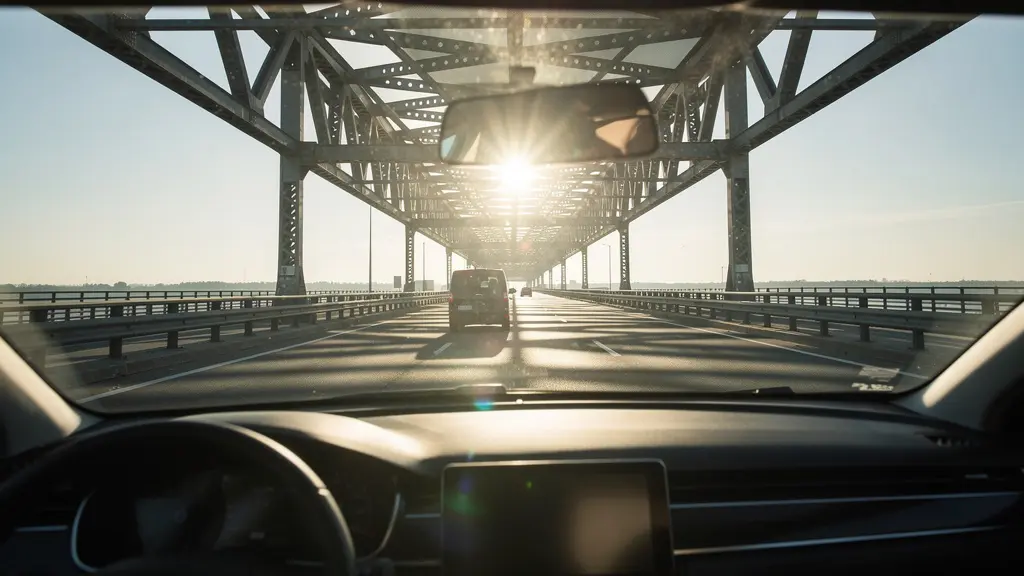
These events underscore a critical point about the technology. As Kelly Funkhouser, Vehicle Technology Manager at Consumer Reports, explains, « It’s important to remember these systems are using cameras and sensors that can get dirty, blinded by sunlight, or obscured in the rain. » The system does not « see » a car; it sees a data pattern that matches « car. » When a different object creates a similar data pattern, a phantom event can be the result. Maintaining control and being ready to override the system is a core part of driving with AEB.
The Winter Cleaning Mistake That Disables Your Safety System
The advanced sensors your AEB system relies on are exposed to the elements. Their ability to function correctly is entirely dependent on having a clear, unobstructed view. It’s well-known that adverse weather like rain, fog, and snow can affect your AEB system, often triggering a dashboard warning that the feature is temporarily unavailable. However, what is less understood is that improper cleaning, especially in winter, can do more than just temporarily obscure the sensors—it can permanently damage or misalign them.
Many drivers, in their haste to clear ice and snow, make critical errors that compromise the integrity of the system’s « eyes. » The camera is typically mounted high on the windshield near the rearview mirror, while radar sensors are often hidden behind the grille or in the lower bumper. Treating these areas like any other part of the car is a significant mistake. To maintain the health of your sensor ecology, you must avoid common pitfalls.
For instance, using a hard plastic ice scraper on a plastic sensor cover can create microscopic scratches that distort the radar’s « vision. » Similarly, applying waxes, ceramic coatings, or aggressive rain-repellent chemicals over sensor zones can blind them. Even a high-pressure wash aimed directly at a radar unit can be enough to knock it slightly out of alignment, rendering it ineffective or, worse, causing it to « see » threats that aren’t there. Preserving your car’s most important safety feature requires a gentle and deliberate approach to cleaning.
Your Action Plan for Maintaining Sensor Integrity
- Identify Sensor Locations: Consult your owner’s manual to precisely locate all forward-facing cameras and radar units on your vehicle.
- Inventory Cleaning Supplies: Use only soft cloths, mild soap, and water on sensor areas. Never use abrasive scrapers, harsh chemicals, or waxes.
- Check for Obstructions: Before each drive, especially in winter, visually inspect sensor areas for any buildup of snow, ice, mud, or even insects.
- Assess for Damage: Periodically check sensor covers for cracks, deep scratches, or hazing, which can degrade performance and require professional attention.
- Monitor Dashboard Warnings: Always pay attention to messages like « Front Camera Unavailable » or « Radar Obstructed. » If the message persists after cleaning, seek professional diagnosis.
–
Why Does Windshield Replacement Cost $250 More with AEB?
A small rock chip on the windshield used to be a simple, relatively inexpensive repair. With the advent of AEB, it has become a complex and costly procedure. The reason is simple: for most vehicles, the primary camera for the AEB system is mounted directly to the windshield. When the windshield is replaced, the camera is removed and reinstalled, a process that shatters its precise alignment. This introduces the critical concept of calibration integrity—the system is useless if it isn’t looking in exactly the right direction.
After a windshield replacement, collision repair, or even a wheel alignment, the system’s camera and radar sensors must be professionally recalibrated. According to experts, it is critical that an AEB system is calibrated in these common circumstances. An analysis of the technology confirms that if a system’s camera or sensor is not correctly aligned, the automatic braking may engage when not needed, or worse—not engage when it is. This isn’t an optional upsell from the repair shop; it’s a non-negotiable safety requirement to restore the system’s functionality.
This calibration process is highly technical and requires specialized equipment, which is why it adds significant cost to the repair bill. There are generally two types of calibration, and some vehicles require both.
| Calibration Type | Process | Time Required | Cost Range |
|---|---|---|---|
| Static Calibration | In-shop using specific target boards | 1-2 hours | $150-$250 |
| Dynamic Calibration | Road test following specific procedures | 30-60 minutes | $100-$200 |
| Both Required | Some vehicles need both methods | 2-3 hours total | $250-$450 |
This « hidden » cost of ownership is a crucial piece of operational awareness for any driver. It transforms a simple piece of glass into a complex component of the car’s electronic nervous system, and its maintenance must be treated with the seriousness it deserves.
How to Know If Your Emergency Braking Is Actually Active Before You Drive
With so many factors that can disrupt the AEB system—from a dirty sensor to a misaligned camera—how can you be confident it’s actually working before you pull out of your driveway? Fortunately, you don’t need to be a technician. Your vehicle is designed to perform a constant self-diagnosis and will clearly communicate if there’s a problem. The key is developing the habit of pre-drive operational awareness.
Your primary source of information is the instrument cluster. When you start your car, a host of warning lights illuminate briefly as the system runs a self-check. If a light related to AEB (often depicted as a car with radiating lines or an exclamation point) stays on, or if a text message like « Front Assist Not Available » appears, the system has detected a fault. This is your car telling you that one of its key safety features is offline. While it may be possible to manually disable AEB through the vehicle’s settings menu, it is strongly advised against, as it deactivates a crucial layer of protection.
The absence of a warning light is your « all clear. » It means the system has completed its self-check and is, in principle, ready to operate. Due to a voluntary commitment by automakers, nearly all new cars sold after September 1, 2022, have AEB as standard equipment. This makes understanding these dashboard indicators a fundamental skill for almost every new driver. A quick glance at the dashboard before putting the car in gear should become as instinctive as checking your mirrors or buckling your seatbelt. It is the simplest and most effective way to confirm your electronic co-pilot is on duty.
Why Can a Car Without Emergency Braking No Longer Get a 5-Star Rating?
In the world of automotive safety, the goalposts are always moving. Features that were once considered luxury add-ons eventually become industry-wide expectations. This is exactly what has happened with Autonomous Emergency Braking. Today, it is virtually impossible for a new vehicle to achieve a top safety rating from major testing bodies like the U.S. National Highway Traffic Safety Administration (NHTSA) or Euro NCAP without having AEB as a standard feature. The technology has been proven so effective that it has been reclassified from a « nice-to-have » to a « must-have. »
The data driving this shift is overwhelming. According to the NHTSA, a new rule mandating AEB on all new passenger vehicles by 2029 could save over 360 lives and prevent over 24,000 injuries each year. With such a dramatic potential to reduce harm, safety rating agencies have logically integrated it as a cornerstone of their evaluation criteria. A car that lacks this proven crash-avoidance technology is now considered fundamentally less safe than one that has it, regardless of its performance in crash tests.
This evolution didn’t happen overnight. The transition was gradual. As highlighted in a historical overview of the technology, safety organizations began rewarding AEB features as early as 2011. Euro NCAP started factoring AEB into its ratings between 2010 and 2014, effectively incentivizing manufacturers to adopt the technology. By making AEB a prerequisite for a 5-star rating, these agencies use their influence to force the entire industry to raise its safety baseline. They are stating, unequivocally, that modern car safety is no longer just about surviving a crash, but about actively avoiding it in the first place.
Key Takeaways
- AEB Is Powerful but Flawed: The technology excels at detecting cars but struggles with pedestrians in the dark, and can be fooled by environmental factors, causing « phantom braking. »
- Informed Oversight Is Crucial: The driver’s role is not obsolete. Understanding the system’s limits and knowing when to perform manual checks (like the « Life Saver look ») is irreplaceable for true safety.
- Maintenance Has Hidden Costs: Simple repairs like windshield replacement require expensive sensor recalibration, a non-negotiable step to maintain « calibration integrity » and system function.
The Mistake of No Longer Turning Your Head (the « Life Saver Look ») Because You Have a Warning Light
Perhaps the single greatest danger of advanced driver-assistance systems (ADAS) like AEB and blind-spot monitoring is not technological failure, but psychological complacency. As we become more accustomed to the car’s alerts and interventions, a dangerous temptation arises: to offload our own situational awareness to the machine. This leads to the critical error of replacing time-tested safety habits, like the physical head-check before changing lanes (the « Life Saver look »), with a simple glance at a warning light.
This over-reliance is not a theoretical problem; it has documented, tragic consequences. For example, official reports show that in Japan alone, there were hundreds of accidents between 2017 and 2019 caused by drivers placing too much confidence in automatic brakes. These incidents are a stark reminder that these systems are an *aid*, not a replacement for an alert and engaged driver. The technology is designed to be a backup for human error, not a substitute for human attention. A warning light can fail, a sensor can be blocked, and a camera can be blinded.
Your informed oversight is essential because there are numerous common scenarios where the technology is known to be weak, and only your eyes and brain can fill the gap. These include:
- Checking for motorcycles filtering between lanes, whose narrow profiles are often missed by sensors.
- Monitoring cyclists in busy urban environments, as their sudden lateral movements are highly unpredictable.
- Physically looking around a curve, where a sensor’s forward-facing field of view is inherently limited.
- Verifying your blind spot even if you have a monitor, because the ultimate responsibility for a safe maneuver remains with you.
Relying solely on a light on your mirror is a gamble on the flawless performance of an imperfect system. The « Life Saver look » is named that for a reason. It remains the most reliable tool at your disposal.
Warped Disc or Balancing Problem: How to Tell the Difference?
When your car experiences a sudden, jarring deceleration or a strong vibration, the immediate question is: was that the AEB system, or is there a mechanical problem with my brakes or wheels? Differentiating between a « phantom event » and a genuine mechanical fault is a critical diagnostic skill for the modern driver. Getting it wrong can lead to unnecessary anxiety and costly, misdirected repairs. Thankfully, a simple checklist can help you describe the symptoms accurately to a mechanic.
The key is to pay close attention to *when* and *how* the event occurs. A vibration that happens only when you apply the brake pedal strongly suggests a mechanical issue like warped brake discs. A vibration that appears at certain speeds even when you aren’t braking is a classic sign of a wheel balancing problem. A sudden, sharp braking event that occurs without any input from your foot on the pedal, often accompanied by a warning on the dashboard, is almost certainly an AEB activation—either real or phantom.
Use this diagnostic checklist to pinpoint the likely cause:
- Did a collision warning light or sound activate on the dashboard? → This points directly to an AEB event.
- Does the vibration or shuddering happen only when you are actively pressing the brake pedal? → This is likely warped brake discs.
- Does the vibration occur at a consistent speed (e.g., between 60-70 mph) without you braking? → This is a classic wheel balancing issue.
- Was the deceleration abrupt and without your input? → This signals an AEB activation.
Being able to provide this precise description to a service advisor is crucial. It helps them distinguish between a need for brake service and a need to investigate the ADAS sensors, saving time and money and ensuring the correct problem is addressed.
By understanding the intricate workings, limitations, and maintenance needs of your Autonomous Emergency Braking system, you transform from a passive passenger into an empowered, informed driver. This knowledge allows you to collaborate with your vehicle’s technology, leveraging its strengths while compensating for its weaknesses. The next logical step is to apply this knowledge specifically to your car by consulting your owner’s manual to learn the precise location of its sensors and the specific warnings it uses.