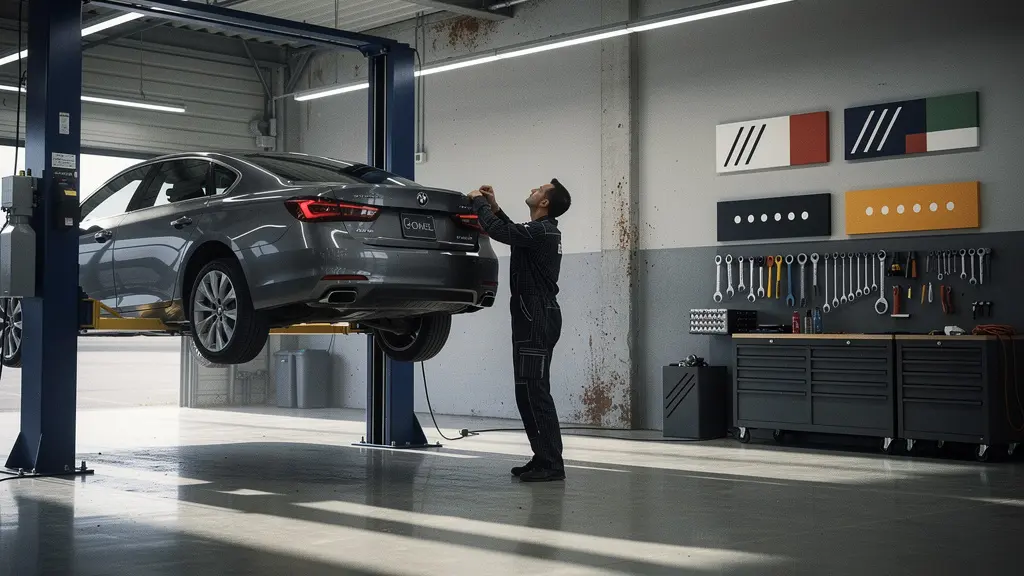
In summary:
- Perform five simple visual checks the day before your test to catch the most common, easily-fixed failures.
- Understand the critical difference between a ‘Major’ and ‘Dangerous’ defect to know your legal rights after a fail.
- Use a car’s MOT history not just as a record, but as a predictive tool to anticipate future repair costs.
- Adopt a proactive mindset, such as changing tyres at 3mm, to save money and ensure safety beyond the test.
- A complete service history isn’t just paperwork; it signals a well-maintained vehicle to the tester from the start.
That annual reminder dropping through your letterbox or pinging on your phone can bring a familiar sense of dread. The MOT test. It feels like a high-stakes exam for your car, where failure means not just inconvenience but unexpected and often costly repair bills. For many owners of cars over three years old, this anxiety is real and justified, with a staggering 40% of cars failing their first MOT attempt in the UK.
Most guides will give you the usual advice: « check your lights, check your tyres. » While correct, this advice barely scratches the surface. It tells you *what* to do, but not *why* certain small items cause so many failures, or how to think like a tester to spot issues before they become expensive problems. It’s a bit like studying for an exam by only reading the chapter titles. You miss the crucial details that make the difference between a pass and a fail.
But what if the key to passing wasn’t just a last-minute checklist, but a shift in perspective? What if you could understand the system, spot the hidden signals of a future failure, and know the small, cheap fixes that prevent the vast majority of re-tests? This isn’t about becoming a mechanic overnight. It’s about empowering you with the insider knowledge we testers use every day, turning that feeling of anxiety into one of quiet confidence.
This guide will walk you through the strategic knowledge you need. We’ll cover the simple pre-flight checks that matter most, decode the jargon of the test result, show you how to read a car’s past to predict its future, and explain why a little proactive maintenance is the smartest financial decision you can make for your vehicle.
To help you navigate these essential steps, this article breaks down everything you need to know. Below is a summary of the key areas we will cover to arm you with the confidence to face your next MOT.
Summary: A Strategic Guide to First-Time MOT Success
- The 5 Simple Checks to Do Yourself the Day Before the MOT
- Major vs Dangerous Defect: Can You Drive the Car Home?
- Driving Without an MOT to the Garage: What Are the Strict Rules?
- What Does the Past MOT History Reveal About a Car’s Reliability?
- The Blown Number Plate Bulb That Fails 15% of Cars Unnecessarily
- Car Without a Service Book: The Risky Gamble to Absolutely Avoid
- Why Changing Tyres at 3mm Is Safer Than Waiting for the 1.6mm Legal Limit
- How to Reduce Your Annual Maintenance Bill Without Voiding the Manufacturer’s Warranty
The 5 Simple Checks to Do Yourself the Day Before the MOT
The night before the test is your golden opportunity to prevent a fail for reasons that are, frankly, embarrassing. You don’t need any special tools, just ten minutes and a keen eye. These five areas account for a huge percentage of failures, and fixing them is often simple and cheap. Think of this as your pre-flight check to give your car the best possible chance of passing.
First, walk around the car and check every single light. That means headlights (dipped and main beam), sidelights, indicators, hazard lights, brake lights (you’ll need a friend or a reflective surface for this), and reverse lights. Crucially, don’t forget the number plate lights; at least one of the two must be working. Next, ensure your number plates are clean and easy to read. A plate obscured by dirt is a guaranteed fail.
Then, move on to your field of vision. Check the windscreen for any chips or cracks in the driver’s line of sight (a zone about the width of the steering wheel). A chip larger than 10mm in this area will fail. Test your wipers; they should clear the screen effectively without smearing or tearing. While you’re there, make sure your screen wash bottle is topped up. An empty reservoir is an instant failure.
Finally, perform two quick tests from the driver’s seat. Give the horn a short, sharp beep to confirm it works. Then, check that all your mirrors are secure, clean, and not cracked. These simple steps demystify a large part of the test and put control back in your hands.
By tackling these basics, you’re not just fixing potential issues; you’re starting the test on the right foot, showing the tester you’ve done your part.
Major vs Dangerous Defect: Can You Drive the Car Home?
Hearing your car has « failed its MOT » is a heart-sink moment, but what happens next depends entirely on two words: ‘Major’ or ‘Dangerous’. Understanding this distinction is vital, as it dictates whether you can legally drive the car away from the test centre. It’s the difference between a logistical headache and a legal minefield. Getting this wrong can have serious consequences for your licence and insurance.
A Major defect is a serious issue that must be repaired for the car to pass its MOT and receive a certificate. However, if your previous MOT certificate is still valid (i.e., you’re testing it before the expiry date), you can technically still drive the car. The official advice is that you should only drive it to a pre-booked appointment for repair. If your old MOT has expired, driving with a Major defect is illegal, except for that journey to a place of repair.
A Dangerous defect is in a completely different league. As the name implies, it means the vehicle has a direct and immediate risk to road safety. If your car is issued a ‘Dangerous’ fail, it is illegal to drive it on a public road under any circumstances. This overrides any existing MOT certificate. Your only options are to have it repaired on-site at the test centre or have it transported away.
As the Driver and Vehicle Standards Agency (DVSA) themselves state, this is not a point for negotiation. Their guidance is crystal clear, as a leading MOT tester blog highlights:
A ‘Dangerous’ defect can instantly invalidate your car insurance, even for the purpose of moving it from the test bay.
– DVSA Official Guidance, Driver and Vehicle Standards Agency MOT Testing Guide
The following table, based on official government guidelines, summarises the key differences you need to know.
| Defect Type | Can You Drive? | Legal Status | Insurance Valid? |
|---|---|---|---|
| Major Defect | Yes – if pre-booked for repair | Legal with restrictions | Grey area – check policy |
| Dangerous Defect | No – absolutely not | Illegal to drive | Instantly invalidated |
This knowledge protects you legally and financially, ensuring a failed test doesn’t spiral into a much more serious situation.
Driving Without an MOT to the Garage: What Are the Strict Rules?
There is a common and dangerous myth that you have a « grace period » to drive a car after its MOT expires. This is false. The only situation in which you can legally drive a vehicle without a valid MOT certificate is when you are driving it to a pre-booked MOT test appointment. However, this exception is governed by very strict rules, and getting them wrong can lead to a fine of up to £1,000.
The journey must be to a pre-booked test at a specific garage. You cannot simply be « on your way to get an MOT. » You need concrete proof of the appointment. This could be an email confirmation, a text message, or a printed job card from the garage showing the date, time, and location of your test. If you are stopped by the police, you will be expected to produce this evidence. Without it, you are driving illegally.
Furthermore, the journey must be reasonable. You are expected to take a direct and logical route to the test centre. Driving 40 miles to a specialist garage when there is a perfectly good test centre two miles from your home could be deemed unreasonable by the authorities, unless you have a very good reason (e.g., it’s a specialist vehicle). The law is designed to facilitate a test, not to allow you to run errands or take the scenic route.
It’s also crucial to remember that the vehicle must still be roadworthy. If the car has a known dangerous fault, such as faulty brakes or bald tyres, you cannot drive it, even to a pre-booked test. In this scenario, the vehicle must be towed or transported. Driving a car you know to be in a dangerous condition can lead to much more severe penalties, especially if it results in an accident.
In short, have your booking proof ready, drive directly there, and only do so if you are confident the car is fundamentally safe to be on the road.
What Does the Past MOT History Reveal About a Car’s Reliability?
One of the most powerful and underused tools at any car owner’s disposal is the free online MOT history check provided by the government. This digital record is more than just a list of passes and fails; it’s a detailed narrative of your car’s health. For an anxious owner, learning to read this history is like being able to see into the future, allowing you to spot patterns and predict potential failures before they happen.
The most important things to look for are the ‘Advisories’ or ‘Minor’ defects. These are issues that weren’t serious enough to cause a fail at the time, but the tester noted them for future attention. A single advisory for « slight play in steering rack » is one thing. But seeing that same advisory appear for two or three consecutive years is a huge red flag. It’s a clear signal that a minor issue is progressively worsening and is highly likely to become a Major defect at the next test. This is where proactive maintenance saves you money.
An analysis of over 815 million MOT records confirms this pattern. It shows that recurring advisories are strong predictors of future major failures. For example, a « slight play in steering rack » advisory that appears for 2-3 years in a row often becomes a Major defect within 12-18 months, leading to average repair costs of £300-£500. Spotting this pattern allows you to get the work done on your own terms, rather than as a distressed purchase after a fail.
The history also reveals a car’s ‘habits’. Does it regularly have issues with suspension components? Are electrical faults a common theme? This information helps you and your mechanic focus your pre-MOT checks on the vehicle’s known weak spots, making your preparation far more efficient.
Your 5-Point Action Plan for Auditing an MOT History
- Identify Recurring Advisories: List any advisory item that appears in more than one consecutive MOT. These are your top priority watch-list items.
- Track Component Groups: Group failures and advisories by system (e.g., brakes, suspension, electrics). Does one system show consistent weakness?
- Check Mileage vs. Wear: Note the mileage between tests. High mileage with few issues is a good sign. Low mileage with recurring advisories suggests a potential problem.
- Look for ‘Corrosion’ Patterns: Note the location of any corrosion advisories. Widespread or structural corrosion is a much bigger red flag than a single rusty bracket.
- Create a Pre-MOT Brief: Summarise your findings into a one-page brief for your mechanic before a service, asking them to specifically inspect the recurring issues you’ve identified.
It’s the ultimate tool for replacing anxiety with a clear, evidence-based maintenance strategy.
The Blown Number Plate Bulb That Fails 15% of Cars Unnecessarily
From a tester’s perspective, there is nothing more frustrating than having to fail an otherwise perfectly good car for a simple, cheap fault. And the king of these frustrating failures is the humble light bulb. It seems trivial, but a blown bulb is a clear-cut fail, and it happens far more often than people think. While the title highlights the number plate bulb, it’s a symbol for a wider issue: simple lighting faults.
In fact, according to recent DVSA statistics, nearly 20% of all MOT failures are due to lighting and signalling issues. This includes headlights, brake lights, indicators, and, yes, that infamous number plate bulb. A single bulb can cost as little as a pound, and changing it often takes minutes. Yet every day, owners are faced with the cost of a re-test (which can be up to half the original test fee) and the major inconvenience of having to book the car in again, all for the sake of a tiny filament.
Why is this so common? It’s a classic case of « out of sight, out of mind. » We check our headlights because we need them to see, but we rarely think about the lights on the back of the car. Number plate lights are particularly easy to miss. The rule is that the rear number plate must be clearly visible and legible from 20 metres, which requires illumination at night. At least one of the two bulbs must be working to pass the test.
This is the ultimate example of cost-benefit asymmetry in the MOT. The cost of prevention is minuscule—a few pounds for a pack of bulbs and a few minutes of your time. The cost of failure is significant—a re-test fee, time off work, and the stress of a failed test on your car’s record. A simple walk-around check the night before the test, getting a friend to check the brake lights while you press the pedal, is the highest-return investment you can make.
Check every light, every time. It’s the easiest win you’ll get.
Car Without a Service Book: The Risky Gamble to Absolutely Avoid
When you present your car for an MOT, the test is purely about roadworthiness on that specific day. The service history isn’t officially part of the inspection. However, arriving with a car that has no service book, or a folder of receipts, is a huge missed opportunity. It’s a gamble that can indirectly contribute to a fail and sends a subtle but powerful negative signal to the tester before they’ve even started the engine.
A comprehensive service history is the car’s CV. It tells a story of care and preventative maintenance. Research from automotive software providers shows that vehicles with a solid maintenance record have significantly fewer dangerous defects found during MOT tests. When a mechanic services a car, they’re not just changing the oil; they’re spotting potential MOT failure points, like worn brake pads or deteriorating suspension bushes, long before they become critical. A missing service book suggests this preventative layer of care has been absent.
This organized history of care is not just about preventing faults; it’s about perception. An experienced MOT tester I know puts it best:
A visible, well-stamped service book or folder of receipts on the passenger seat can create a positive bias, suggesting a well-cared-for car.
– Independent MOT Testing Centre Manager, Matters of Testing Blog – DVSA Official Publication
This « positive bias » is human nature. A tester who sees evidence of diligent maintenance is subconsciously primed to see a car that has been looked after. Conversely, a car with no history starts with a question mark over it. It suggests a history of neglect, prompting a tester to be, if anything, even more meticulous in their search for faults.
Even if you’ve lost the original book, you can create a ‘retroactive service dossier’. Gather all the receipts and invoices for parts and labour you have. Organising these in a simple folder demonstrates a history of care and helps a mechanic quickly understand what’s been done, potentially reducing diagnostic time and costs.

As you can see, a well-kept record is a powerful statement. It’s tangible proof that your car is not just a machine, but a valued asset that has been properly maintained.
It’s a simple, non-technical way to start your MOT on a positive footing, demonstrating responsible ownership from the outset.
Why Changing Tyres at 3mm Is Safer Than Waiting for the 1.6mm Legal Limit
Tyres are one of the most critical safety components on your car, and they are a major focus of the MOT test. The legal minimum tread depth in the UK is 1.6mm across the central three-quarters of the tyre’s width. A tyre with less than 1.6mm is an instant, clear-cut fail. However, from both a safety and a financial standpoint, thinking of 1.6mm as your target is a significant mistake. The smart threshold is 3mm.
Why 3mm? It’s all about performance in the wet. A tyre’s tread grooves are designed to channel water away from the contact patch to prevent aquaplaning. As the tread wears down, the volume of those grooves decreases, dramatically reducing their ability to clear water. A tyre with 3mm of tread has a significantly shorter stopping distance in wet conditions compared to one at 1.6mm. While a 2mm tyre will pass the MOT (often with an advisory), its safety performance is already seriously compromised.
This proactive approach also makes sound financial sense. According to Toyota UK’s own analysis, changing tyres at 3mm avoids the stress and cost of a « distressed purchase. » If your tyres are on the legal limit, you might scrape a pass with an advisory. This means a guaranteed fail within the next 12 months. More critically, if they fail, you’re forced to replace them at the test centre or a nearby garage, where prices can be 30-40% higher than if you’d shopped around online or at a specialist.
This image of a professional tread depth check illustrates the precision required. The difference between 3mm and 1.6mm is tiny to the naked eye but massive in terms of safety and cost.
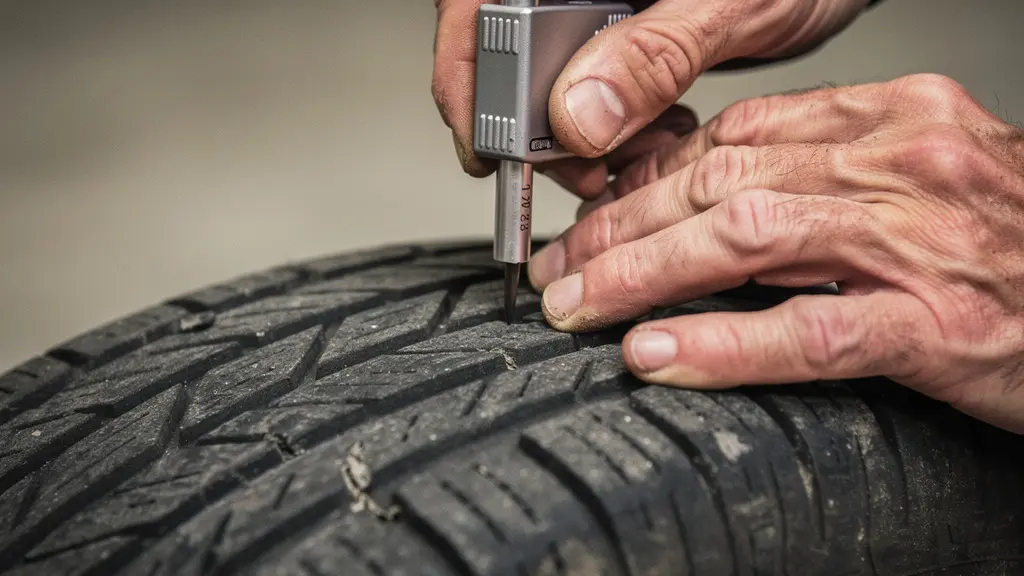
This is a perfect example of proactive maintenance. By changing your tyres before they reach the legal minimum, you are not just investing in your safety; you are also protecting yourself from inflated emergency-purchase prices and the certainty of a future MOT fail. You can easily check your tread depth with a 20p coin—if you can see the outer band of the coin when it’s inserted into the tread, your tread is below the legal limit.
It’s a strategic decision that enhances safety, avoids a certain future fail, and gives you control over one of the most significant running costs of your vehicle.
Key Takeaways
- The MOT test is a test of roadworthiness on the day; simple, last-minute checks on lights, wipers, and plates can prevent a huge number of unnecessary failures.
- Understanding the legal difference between ‘Major’ (repair and drive with caution) and ‘Dangerous’ (do not drive) defects is crucial to avoid fines and invalidated insurance.
- A car’s MOT history is a predictive tool. Recurring advisories are a strong signal of a future Major failure, allowing for proactive, cost-effective repairs.
How to Reduce Your Annual Maintenance Bill Without Voiding the Manufacturer’s Warranty
The ultimate strategy to avoid MOT-related anxiety and cost is, of course, regular, quality maintenance. However, many owners are concerned that straying from expensive main dealers for servicing will void their car’s manufacturer warranty. This is a common misconception. Thanks to UK law, you have the freedom to choose where you service your car without impacting your warranty, as long as certain conditions are met.
The key is to ensure the independent garage uses Original Equipment (OE) or equivalent quality parts and follows the manufacturer’s official service schedule to the letter. When you book a service, you must be explicit about this. Ask the garage to confirm in writing that they will use warranty-compliant parts and follow the correct schedule for your car’s age and mileage. A reputable independent garage will be happy to do this and will stamp your service book accordingly.
This approach can significantly reduce your annual maintenance bill. Main dealer labour rates are often substantially higher than those at independent specialists. By choosing a trusted local garage, you get the same (or sometimes better, more specialised) level of service at a much lower cost, all while keeping your warranty intact. This frees up your budget for proactive maintenance, like changing those tyres at 3mm or addressing MOT advisories before they become failures.
Furthermore, many garages offer a ‘pre-MOT check’. For a small fee, they will run through the key points of the test and identify any likely failure points. This is a fantastic investment. It gives you a clear picture of any work that needs doing, allowing you to get it done on your terms and on a fixed budget. This simple check can prevent the vast majority of common failures, turning the MOT itself into a formality rather than a gamble.
To put all these strategies into practice, the logical next step is to find a trusted local garage that understands these rules and can work with you to keep your car safe and your bills manageable.