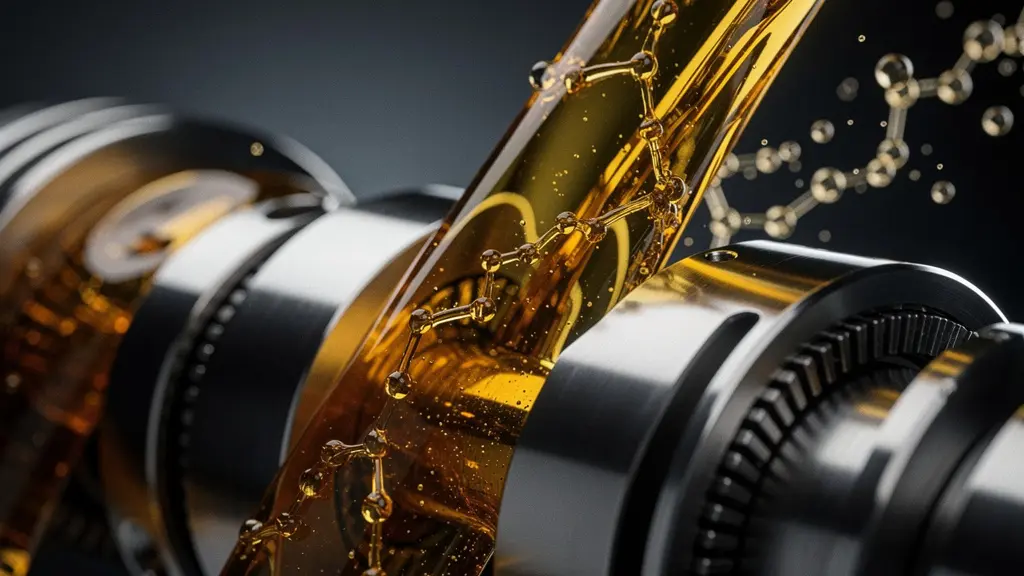
For a modern engine, using conventional oil instead of a specified synthetic is not a cost-saving measure; it’s a direct route to premature and catastrophic failure.
- The uniform molecular structure of synthetic oil provides critical thermal stability that prevents « coking » and sludge in high-heat areas like turbochargers and GDI systems.
- Manufacturer specifications (e.g., VW 504.00, BMW LL-04) are precise chemical blueprints, and using a generic oil, even of the same viscosity, can void your warranty and lead to damage.
Recommendation: Always use an oil that meets the exact OEM specification listed in your owner’s manual, not just a « recommended » viscosity grade. The long-term cost of engine repair far outweighs the savings on a bottle of oil.
Standing in the auto parts aisle, the price difference between conventional and full synthetic motor oil can be stark. It’s tempting to see the synthetic option as an expensive upsell, a premium product for high-performance racing, not for your daily driver. Many believe that as long as the viscosity is right, the cheaper oil will do the job, and that synthetic is just a way to « last a bit longer » between changes. This is a common and understandable assumption, but for a modern engine, it’s a dangerously flawed one.
The conversation around motor oil is no longer about good versus better; it’s about compatibility versus incompatibility. The stresses placed on today’s engines—with direct injection (GDI), variable valve timing (VVT), and ubiquitous turbocharging—create an internal environment where conventional oils physically and chemically break down. The real question isn’t whether synthetic oil is worth the extra cost, but rather, why its engineered molecular structure has become the only viable defense against the specific failure modes of modern engine technology.
This article will deconstruct the science from a chemical engineer’s perspective. We will move beyond marketing claims to examine the molecular differences, the non-negotiable role of OEM specifications, and the catastrophic consequences of using the wrong fluid. We will explore why what was once a premium upgrade is now a fundamental, mandatory component for your engine’s survival.
For those who prefer a visual format, the following video offers a complementary perspective, particularly addressing the common question of using modern synthetic oils in older vehicles.
To fully understand this necessity, we must break down the key aspects of motor oil science and its practical implications for you as a vehicle owner. The following sections will guide you through everything from deciphering the numbers on the bottle to protecting your engine’s most vulnerable components.
Summary: The Engineering Behind Why Modern Engines Demand Synthetic Oil
- 5W30 or 10W40: what do these numbers on the bottle really mean?
- Can you mix synthetic and mineral in an emergency?
- Does ‘High Mileage’ oil really help reduce leaks and consumption?
- Why can using generic oil in a VW or BMW void the warranty?
- How do you know if your oil is too old and starting to clog the engine?
- Oil, coolant, washer fluid: the essential monthly ritual
- Why paying dealership labor rates is no longer mandatory for your service book?
- Why shutting down the engine immediately after a highway run kills your turbo?
5W30 or 10W40: what do these numbers on the bottle really mean?
The numbers on a bottle of oil, known as the viscosity grade, are the first piece of the puzzle. The format ‘XW-XX’ provides two key data points. The first number, followed by a ‘W’, stands for ‘Winter’, not ‘Weight’. It indicates the oil’s viscosity (its resistance to flow) at cold temperatures. A lower number, like 5W, means the oil flows better when cold than a 10W oil, providing crucial protection during engine startup, where most wear occurs. Modern engines with tight tolerances and systems like Variable Valve Timing (VVT) demand this rapid flow.
The second number indicates the oil’s viscosity at the engine’s normal operating temperature (around 100°C or 212°F). A ’30’ weight oil is thinner at this temperature than a ’40’ weight oil. However, this is where the numbers stop telling the full story. The true advantage of a synthetic oil lies in its molecular uniformity. Conventional oil is refined from crude and contains hydrocarbon molecules of varying sizes. Synthetic oil is engineered in a lab to have uniformly sized molecules. This consistency provides superior thermal stability and shear resistance.
This engineered structure is not just a marginal improvement. Independent testing confirms this vast superiority; for instance, some studies have found that synthetic oils outperform conventional by an average of 47% across a full range of performance benchmarks. This isn’t just about longer drain intervals; it’s about a fundamental increase in the oil’s ability to resist breaking down under the intense pressure and heat of a modern engine. The viscosity numbers may be the same, but the underlying chemical stability is worlds apart.
Ultimately, while viscosity grades are a starting point, they only describe the oil’s flow characteristics. The real performance and protection come from the quality of the base stock, an area where synthetics are, by design, fundamentally superior.
Can you mix synthetic and mineral in an emergency?
In an emergency, if your oil level is critically low and the only option is a bottle of conventional mineral oil, the immediate answer is yes: any oil is better than no oil. However, it’s crucial to understand the severe compromise you are making from a chemical engineering standpoint. Mixing synthetic and conventional oil is not like blending two similar liquids; it’s more akin to diluting a high-purity chemical with a less-refined one. You don’t get the « best of both worlds »—you immediately downgrade the entire batch to the performance level of the inferior oil.
This happens because the non-uniform molecules of conventional oil disrupt the stable, engineered structure of the synthetic base stock. The superior oxidation resistance, thermal stability, and detergent-carrying capacity of the synthetic’s additive package are immediately compromised. The resulting mixture loses its ability to resist sludge formation at high temperatures and its capacity for extended drain intervals is eliminated.

The visualization above illustrates the problem at a microscopic level. The orderly synthetic molecules are disrupted by the chaotic structure of the mineral oil, preventing a uniform protective film from forming. This is not just a theoretical concern; it has been quantified in real-world testing.
Case Study: The Performance Downgrade of Oil Mixing
Motorcycle industry testing provides a clear demonstration of this principle. When synthetic and conventional oils were mixed in a 50/50 ratio, the blend immediately lost the synthetic’s key benefits. According to one analysis on high-performance engines, the recommended 10,000-mile drain interval of the synthetic oil was effectively cut in half to just 5,000 miles. Furthermore, the mixture showed a 30% reduction in oxidation resistance and a significant increase in deposit formation at high temperatures, effectively reverting to the performance profile of a basic conventional oil.
If you are forced to mix oils in an emergency, consider it a temporary patch. You should plan for a full oil and filter change at your earliest convenience to restore the engine’s required level of protection.
Does ‘High Mileage’ oil really help reduce leaks and consumption?
High-mileage oils are a specific formulation designed to address the common ailments of older engines, typically those with over 75,000 miles. Their primary goal is to combat minor oil consumption and small leaks from aging seals. From a chemical standpoint, they achieve this through two key modifications: a slightly thicker viscosity within the specified grade and the inclusion of special seal-conditioning additives.
As engines age, rubber seals and gaskets can become hard and brittle, causing them to shrink and allowing small amounts of oil to seep past. High-mileage oils contain ester-based additives designed to be absorbed by these seals, causing them to gently swell and regain some of their original flexibility. This can effectively stop or reduce minor weeping and leaks from areas like the crankshaft or valve cover gaskets. Additionally, they often have lower volatility, meaning less oil burns off as vapor past worn piston rings, which helps reduce overall consumption.
The following table breaks down the key chemical differences between a standard synthetic and a high-mileage variant, showing how each property impacts an older engine.
This formulation is not a mere marketing gimmick; it’s a targeted chemical treatment with measurable effects, as detailed in a comparative analysis of oil properties.
| Property | Standard Synthetic | High Mileage Synthetic | Impact on Older Engines |
|---|---|---|---|
| Viscosity Range | Standard grade (e.g., 5W-30) | Thicker within grade (heavy 5W-30) | Reduces oil consumption by 15-25% |
| Seal Conditioners | Minimal | Ester-based additives (2-3%) | Causes controlled seal swelling |
| Noack Volatility | 10-13% | 8-10% | Less burn-off past worn rings |
| Detergent Package | Standard | Enhanced cleaning agents | Removes existing sludge gradually |
| Change Interval | 7,500-10,000 miles | 5,000-7,500 miles | Shorter due to contamination |
However, it is critical to have realistic expectations. As experts in the field often clarify, these oils are a form of preventative maintenance, not a mechanical repair.
High Mileage oils can restore flexibility to seals through ester-based conditioners, but they cannot fix cracked gaskets or damaged seals – they’re a maintenance solution, not a repair
– Joey Cabrera, Maxima Racing Oils, ADV Pulse Technical Interview
If your engine has significant leaks or is consuming more than a quart of oil between changes, a high-mileage oil is unlikely to be the solution. In such cases, a proper mechanical diagnosis is necessary to identify and repair the root cause of the problem.
Why can using generic oil in a VW or BMW void the warranty?
One of the most critical and misunderstood aspects of modern vehicle maintenance is the difference between an oil’s viscosity grade (e.g., 5W-30) and a manufacturer’s OEM approval specification. For high-precision European engines, particularly from brands like Volkswagen, BMW, Mercedes-Benz, and Porsche, using an oil that merely matches the viscosity is not enough. These automakers publish specific, non-negotiable chemical blueprints that an oil must meet, such as VW 504.00 or BMW Longlife-04 (LL-04).
These specifications dictate a far more complex set of properties than just viscosity. They define the required High-Temperature/High-Shear (HTHS) stability, the precise composition of the anti-wear additive package (often low in SAPS – Sulphated Ash, Phosphorus, and Sulphur to protect emissions equipment), and the oil’s resistance to deposit formation. Using a generic 5W-30 that doesn’t carry the specific approval code means you are using a fluid that is chemically incompatible with your engine’s design, even if the « weight » is correct.
Automakers can and will deny a warranty claim for an engine-related failure if it’s determined that an unapproved oil was used. If a turbocharger fails due to coking or a timing chain tensioner clogs with sludge, and your service records don’t show the use of an oil with the correct specification, the repair will be on your dime. This makes adhering to the specification a crucial form of financial protection. To ensure you remain compliant, even when using an independent mechanic, a clear process is essential.
Your Action Plan: Ensuring Warranty Compliance with Oil Selection
- Locate your vehicle’s exact oil specification in the owner’s manual (e.g., VW 504.00, BMW LL-04). This code is non-negotiable.
- When purchasing oil or at a service center, verify the oil bottle explicitly states it is « approved » for your code, not just that it « meets » or is « recommended for » the specification.
- Understand that general API (American Petroleum Institute) or ILSAC ratings are not a substitute for specific European OEM approvals.
- Always keep detailed receipts and service records that clearly list the specific brand, grade, and—most importantly—the approval code of the oil used.
- Know your rights: in the US, the Magnuson-Moss Warranty Act prevents manufacturers from forcing you to use their specific brand of oil, but they can legally require you to use an oil that meets their published specification.
In short, the OEM specification is not a suggestion; it’s an integral part of the engine’s design. Ignoring it is a significant and costly gamble.
How do you know if your oil is too old and starting to clog the engine?
Beyond simply following the mileage or time intervals recommended by your manufacturer, there are physical and chemical signs that your oil has degraded to the point of being ineffective and potentially harmful. From an engineering perspective, oil « wears out » in two primary ways: additive depletion and oxidation. The additive package, which includes detergents to keep the engine clean and anti-wear agents, gets used up over time. The Total Base Number (TBN) is a measure of the oil’s reserve alkalinity used to neutralize acidic byproducts of combustion; when the TBN is depleted, corrosive wear can begin.
Simultaneously, constant exposure to high heat and oxygen causes the oil’s base stock to oxidize. This process thickens the oil, reduces its ability to flow, and leads to the formation of sludge and varnish. This sludge is the real danger, as it can clog narrow oil passages, starve critical components like bearings and hydraulic lifters of lubrication, and ultimately lead to catastrophic engine failure. A dark color alone is not a reliable indicator of bad oil; in fact, an oil that darkens is a sign that its detergents are working, holding contaminants in suspension.

As the image shows, the degradation is a gradual process from clean, golden oil to a dark, depleted state. However, there are more telling signs you can check for on your dipstick. A burnt, acrid smell indicates the oil has been subjected to extreme heat and has thermally broken down. More critically, if the oil feels gritty or has visible solid particles, it means that sludge is forming and the oil is no longer capable of holding contaminants in suspension. This is a red flag that an immediate oil change is required.
While a used oil analysis (UOA) is the only definitive way to know the exact condition of your oil, a regular check of the dipstick for texture and smell provides a valuable, real-world indication of when your oil’s protective capabilities are coming to an end.
Oil, coolant, washer fluid: the essential monthly ritual
While oil is the lifeblood of your engine, it doesn’t work in isolation. A monthly check of your key fluids is an essential ritual because they form an interconnected system where the failure of one directly impacts the others. Your engine’s oil and coolant systems are a prime example of this codependency. The coolant system’s job is to manage the bulk of the engine’s heat, while the oil is responsible for both lubricating and cooling critical, high-friction internal components like bearings and the undersides of pistons.
If your engine runs low on coolant and begins to overheat, the oil is immediately subjected to temperatures far beyond its design limits. Even the best full synthetic oil will begin to break down rapidly under these conditions, losing its viscosity and ability to protect moving parts. Conversely, running the engine low on oil places immense stress on the remaining fluid and the engine as a whole. In a typical five-quart system, being just one quart low is not a 20% problem; it’s a critical failure point.
The remaining four quarts of oil must now do the work of five, circulating faster and absorbing more heat and contaminants. This significantly accelerates its breakdown and reduces its ability to cool vital parts. In fact, engineering data shows that operating with insufficient oil causes a 25% increase in thermal and mechanical stress on the lubricant. This is why checking your dipstick monthly and ensuring the oil is between the ‘min’ and ‘max’ lines is not just about lubrication; it’s about thermal management.
This monthly ritual takes less than five minutes but is one of the most effective forms of preventative maintenance you can perform. It allows you to catch small issues like a minor coolant leak or early oil consumption before they escalate into major, engine-threatening problems.
Why paying dealership labor rates is no longer mandatory for your service book?
A common fear among new car owners is that servicing their vehicle at an independent shop will automatically void the manufacturer’s warranty. This belief often leads them to pay premium dealership labor rates for routine maintenance like oil changes. However, in many countries, consumer protection laws are in place to prevent this. In the United States, for example, the Magnuson-Moss Warranty Act is a federal law that explicitly protects consumers from this practice.
This act stipulates that a manufacturer cannot require you to use their branded parts or service centers to keep your warranty intact. You have the right to have your car serviced at any qualified independent shop or even do the work yourself. There is, however, one critical condition: you must use parts and fluids that are of equivalent quality and meet the manufacturer’s published specifications. As we discussed earlier, this means using an oil that carries the specific OEM approval code (e.g., BMW LL-04) for your vehicle.
This legal protection is well-established and confirmed by automotive authorities. As long as you adhere to the vehicle’s required specifications, your warranty remains valid.
Under the Magnuson-Moss Warranty Act, manufacturers cannot void your warranty for using independent shops, as long as you use parts and fluids of equivalent quality that meet their specifications
– Michael Calkins, AAA Technical Services Manager, AAA Technical Services
The key to exercising this right is meticulous record-keeping. When using an independent shop, you must ensure the invoice clearly details the exact brand, viscosity, and OEM approval code of the oil used, as well as the part number for the oil filter. Simply writing « 5W-30 Synthetic Oil Change » is not sufficient for warranty purposes. You must be proactive in requesting that your mechanic document this information precisely for your records.
By taking control of your service documentation, you can benefit from the competitive pricing of independent shops while ensuring your vehicle’s warranty remains fully intact, giving you the best of both worlds.
Key Takeaways
- Viscosity grades (5W-30) are only a starting point; the oil’s base stock (synthetic vs. conventional) and its adherence to OEM specifications determine its true suitability for a modern engine.
- OEM specifications (e.g., VW 504.00) are non-negotiable chemical requirements. Using an unapproved oil, even of the correct viscosity, can cause damage and void your warranty.
- The primary role of synthetic oil in turbocharged or GDI engines is to resist extreme heat and prevent « coking » (oil baking into hard carbon deposits), a failure mode conventional oils are not equipped to handle.
Why shutting down the engine immediately after a highway run kills your turbo?
For any vehicle equipped with a turbocharger, one of the most destructive habits is shutting the engine off immediately after a hard run, such as exiting the highway. This action can drastically shorten the life of your turbo due to a phenomenon called heat soak. A turbocharger operates under extreme conditions, with its turbine spinning at speeds up to 200,000 RPM and being exposed to exhaust gases that can heat its housing until it glows red. The only thing protecting its delicate bearings is a constant flow of clean engine oil.
This oil serves two purposes: it lubricates the spinning shaft and, just as importantly, it carries away immense amounts of heat. When you shut the engine off, the oil flow stops instantly. However, the turbo, especially the exhaust-side housing, remains incredibly hot. This residual heat « soaks » into the turbo’s center section, baking the thin layer of oil that remains in the bearing housing. Under these conditions, where oil temperatures can easily exceed 400°F (200°C), conventional oil will vaporize and cook into hard carbon deposits. This process is known as coking.
These carbon deposits act like sand in the works. They can clog the tiny oil feed lines and restrict flow, leading to oil starvation and catastrophic bearing failure. This is precisely where full synthetic oil proves its necessity. Its engineered molecular structure gives it a much higher thermal breakdown threshold. It can withstand these high temperatures without coking, ensuring that the oil passages remain clean and clear. However, even with synthetic oil, allowing for a cool-down period is a critical best practice.
After a spirited drive, simply let the engine idle for 30 to 60 seconds before shutting it down. This allows the oil to continue circulating, carrying away the residual heat and bringing the turbo’s temperature down to a safe level. This simple, no-cost habit is the single best thing you can do to ensure a long and healthy life for your engine’s turbocharger.
Frequently Asked Questions About Modern Engine Oils
What does milky or creamy oil on the dipstick indicate?
This indicates coolant contamination, likely from a blown head gasket. This requires immediate professional attention as it can cause severe engine damage.
Why is running one quart low more serious than it seems?
Running one quart low in a five-quart system increases thermal and mechanical stress on the remaining oil by 25%, causing it to break down much faster and reducing its cooling ability.
How do oil and coolant systems affect each other?
An engine running hot due to low coolant causes even the best synthetic oil to exceed its thermal limits and degrade rapidly. They work as a team—the failure of one directly impacts the other.