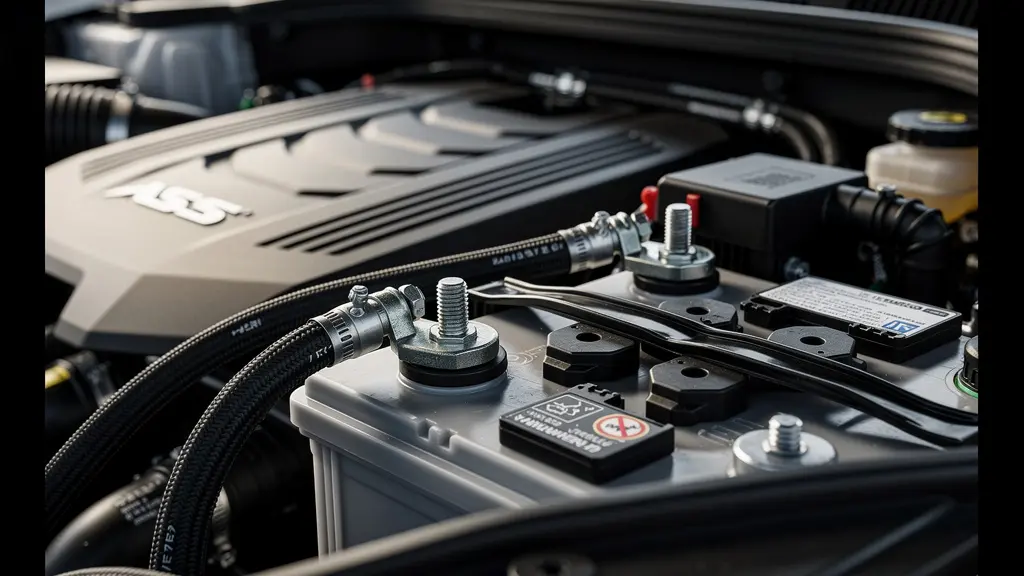
Contrary to common belief, a Start-Stop system that doesn’t activate is rarely a sign of a broken car. More often, it’s an intelligent energy manager protecting your battery and ensuring your comfort. This guide explains the complex but logical reasons—from engine temperature to battery state of charge—why the system deliberately stays inactive, revealing it’s not a fault, but a feature of its sophisticated self-preservation logic.
You pull up to a red light. You wait. And… nothing. The engine keeps humming, and that familiar, fuel-saving silence never arrives. You’re used to the automatic Start-Stop system doing its job, but today it’s stubbornly inactive. The immediate thought that flashes through your mind is likely, ‘Is something broken? Is this going to be an expensive fix?’ This anxiety is completely understandable, but in most cases, it’s misplaced.
As a diagnostic technician specializing in vehicle battery and energy management systems, I can tell you that the answer is almost always no. Your system isn’t broken; it’s being smart. You should think of it less as a simple on/off switch and more as a sophisticated energy manager for your entire vehicle. Its primary job isn’t just to save fuel, but to do so without ever compromising the vehicle’s health or your safety and comfort. Its refusal to activate is often a sign that it is working perfectly, making a calculated decision based on dozens of data points.
In this article, we’ll demystify the Start-Stop decision process. We will dive into the core logic that governs this technology, exploring precisely why the system prioritizes vehicle health, when it’s completely normal for it to remain inactive, and what simple factors you can check to ensure it operates exactly as intended.
This guide breaks down the complex inner workings of your car’s energy management system. Follow along as we unpack the key components and conditions that determine whether your engine shuts off at a stop.
Summary: A Technician’s Guide to Your Start-Stop System
- Moteur froid, clim à fond : les 5 raisons normales pour que le Start-Stop reste inactif
- Pourquoi ne faut-il jamais installer une batterie standard sur une voiture Start-Stop ?
- Le Start-Stop économise-t-il vraiment assez pour justifier le prix des pièces ?
- Le redémarrage fréquent use-t-il prématurément votre démarreur renforcé ?
- Est-il possible (et légal) de désactiver le Start-Stop en permanence ?
- Pourquoi rester au ralenti vous coûte plus cher que d’éteindre le moteur ?
- Batterie et antigel : les 2 points critiques pour démarrer par -5°C
- Coffre de toit et barres : combien vous coûtent-ils vraiment en carburant sur autoroute ?
Moteur froid, clim à fond : les 5 raisons normales pour que le Start-Stop reste inactif
The most common « fault » with a Start-Stop system isn’t a fault at all; it’s the system’s built-in prioritization logic at work. Before it will even consider shutting down the engine, the vehicle’s computer runs a rapid-fire diagnostic, checking a complex decision matrix. In fact, according to technical documentation, the system is constantly monitoring more than 10 simultaneous conditions to ensure an engine shutdown is safe and practical. If any one of these conditions isn’t met, the system stays off by design.
Here are the five most common and perfectly normal reasons your Start-Stop remains inactive:
- Engine Temperature: If the engine isn’t at its optimal operating temperature, the system will keep it running to warm it up faster, which is crucial for emissions control and component longevity.
- Battery State of Charge (SOC): This is the big one. If the battery’s charge is below a certain threshold (typically around 75-80%), the system’s self-preservation logic kicks in. It prioritizes keeping the battery charged over saving a small amount of fuel.
- Climate Control Demand: Running the air conditioning on full blast or the heat/defroster in winter puts a heavy load on the electrical system. The system will keep the engine running to power the compressor and fans to maintain your set cabin temperature.
- Safety Conditions: The system won’t activate if the driver’s seatbelt is unbuckled, the door is ajar, or the steering wheel is turned sharply (indicating an imminent maneuver).
- Engine Regeneration Cycle: For diesel vehicles, if the Diesel Particulate Filter (DPF) is in a regeneration cycle (burning off soot), the engine must keep running at a higher temperature.
Seeing your system inactive because of one of these reasons is a clear sign that its intelligent guardian role is functioning exactly as the engineers intended.
Pourquoi ne faut-il jamais installer une batterie standard sur une voiture Start-Stop ?
From a diagnostic standpoint, one of the most frequent causes of chronic Start-Stop issues stems from an incorrect battery installation. Installing a standard, conventional flooded-cell battery in a vehicle designed for Start-Stop is like asking a marathon runner to sprint the entire race; it’s simply not designed for the job and will fail prematurely.
Start-Stop vehicles require either an Enhanced Flooded Battery (EFB) or an Absorbent Glass Mat (AGM) battery. These are not just marketing terms; they represent fundamentally different technologies built for deep cycling and high electrical loads. A standard battery is designed to deliver one massive burst of power to start the engine and then be quickly recharged by the alternator. An AGM or EFB battery, however, must endure hundreds of engine starts per trip and power the car’s entire suite of electronics while the engine is off. This robust construction is why AGM batteries typically last two to three times longer than conventional batteries in these demanding applications.
The internal construction is what makes all the difference. An AGM battery, for example, suspends the electrolyte in fiberglass mats pressed between the lead plates, making it spill-proof and highly resistant to vibration while enabling much faster energy transfer.
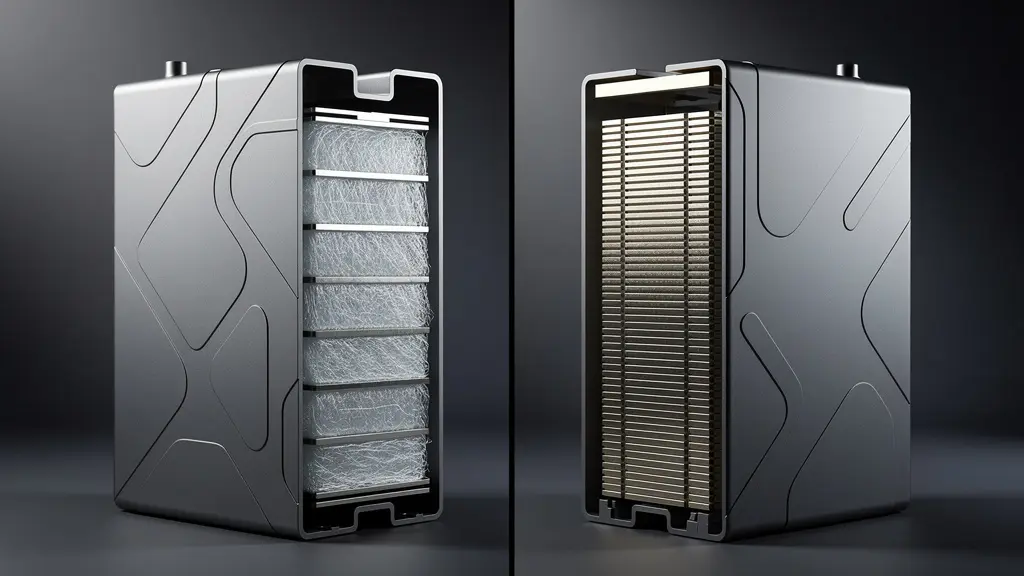
As the visual comparison shows, the tightly packed internal components of an AGM battery provide superior stability and a much larger surface area for energy exchange. A standard battery would quickly degrade under the constant charge-discharge cycles, leading to a low State of Charge (SOC) that would permanently disable the Start-Stop function long before the battery itself completely dies.
Le Start-Stop économise-t-il vraiment assez pour justifier le prix des pièces ?
This is a fair question, especially given that AGM batteries and reinforced starters are more expensive than their conventional counterparts. The answer is not a simple yes or no; it is a definitive « it depends on how you drive. » For a driver who spends most of their time in stop-and-go city traffic, the savings are substantial and absolutely justify the cost. Real-world testing has shown fuel savings ranging from 7% to over 26% in heavy urban environments.
However, the real return on investment depends entirely on your driving profile. As a comprehensive analysis from Consumer Reports demonstrates, the benefit varies dramatically between different types of drivers. Their findings show that while a city driver will see significant savings, a highway commuter may not.
| Driver Type | Fuel Savings Range | Break-even Period |
|---|---|---|
| City Driver (frequent stops) | 7.27-26.4% | 3-4 years |
| Highway Commuter | 2-5% | May not break even |
| Mixed Driving | 5-10% | 4-5 years |
Ultimately, the technology was designed and mandated primarily to reduce urban emissions and help manufacturers meet fleet-wide fuel economy standards. The financial benefit to the individual owner is a secondary, but often significant, perk. If your daily commute involves numerous red lights and traffic jams, the system is undoubtedly paying for itself over the life of the components. If you primarily drive on open highways, the benefit is more environmental than financial.
Le redémarrage fréquent use-t-il prématurément votre démarreur renforcé ?
One of the most persistent myths surrounding Start-Stop technology is that the constant restarting will quickly wear out the starter motor, leading to a costly repair. This concern would be valid if the system used a traditional starter motor. But it doesn’t.
Automotive engineers don’t use ‘traditional’ starter motors in these situations. The starter used for stop-start systems combines several technologies.
– Automotive industry source, Green Car Reports
These reinforced starters are a different breed of component. They are engineered with stronger materials, more robust gear mechanisms, and long-life brushes specifically for this high-cycle application. While a conventional starter might be rated for 30,000 to 50,000 starts in a vehicle’s lifetime, Start-Stop starters are built for an entirely different scale. OEMs mandate that these systems must be able to handle between 150,000 to 300,000 stop-starts, a number most vehicles will never reach.
Furthermore, engineers have cleverly designed these systems to minimize wear. Research has shown that up to 90 percent of the wear on a starter’s brushes occurs during the « coast-down » phase after the engine has already started. The higher-torque motors used in Start-Stop systems spin more slowly and have a much shorter coast-down time, which dramatically increases their longevity. You are far more likely to replace the vehicle before you wear out its factory-installed reinforced starter.
Est-il possible (et légal) de désactiver le Start-Stop en permanence ?
The « off » button on your dashboard is a temporary solution. Every manufacturer provides a way to disable the Start-Stop system for your current trip, but it will always re-engage by default the next time you start the car. This is by design, as the feature’s contribution to fuel economy is factored into the vehicle’s official EPA rating. For those seeking a more permanent solution, the path is less straightforward.
There are no manufacturer-sanctioned methods for permanently disabling the system. The aftermarket, however, has produced several solutions. These typically come in two forms: small hardware modules that plug into the vehicle’s diagnostic port or wiring harness, or software coding that alters the vehicle’s control module. These devices work by « remembering » the last state of the off button and automatically applying it every time the car is started.
While this may sound appealing if you find the system intrusive, as a technician, I must advise caution. Altering the vehicle’s factory programming or wiring can have unintended consequences. It can interfere with other integrated systems and, most critically, it can give the manufacturer grounds to deny a warranty claim if an electrical issue arises. While legal to install, these devices exist in a grey area regarding your vehicle’s warranty coverage.
Pourquoi rester au ralenti vous coûte plus cher que d’éteindre le moteur ?
The core premise of Start-Stop technology is based on a simple truth: an idling engine is a zero-mile-per-gallon machine. Any time your vehicle is stopped with the engine running, it is consuming fuel without covering any distance. An old myth used to claim that restarting an engine consumed more fuel than idling for a short period, but for modern vehicles, this is unequivocally false. For a modern direct-injection engine, the fuel-saving break-even point is just 3-5 seconds. If you are stopped for longer than that, you are wasting fuel.
While the amount of fuel consumed by an idling passenger car (roughly 0.2 to 0.4 gallons per hour) may seem small, the collective impact is staggering. According to the U.S. Department of Energy, passenger vehicle idling in the United States consumes more than 6 billion U.S. gallons of fuel annually. That’s a massive amount of wasted money and unnecessary emissions.
Every time the Start-Stop system activates, it is chipping away at this mountain of waste. It prevents the emission of pollutants and greenhouse gases and saves you money at the pump. When you multiply those small, individual savings across millions of vehicles and billions of stops, the technology’s large-scale environmental and economic benefit becomes crystal clear.
Batterie et antigel : les 2 points critiques pour démarrer par -5°C
Cold weather is the arch-nemesis of car batteries, and it’s a primary reason you’ll see your Start-Stop system take a long winter vacation. The chemical reactions inside a battery that generate electricity slow down dramatically as the temperature drops. This has a massive impact on its ability to both deliver and accept a charge. In fact, at -5°C (23°F), a battery’s effective capacity can be reduced by up to 40%.
Your vehicle’s intelligent energy manager is acutely aware of this. It sees the reduced capacity and the increased effort required to crank a cold engine with thick oil. It makes a logical executive decision: « I will preserve every available amp to ensure the next essential engine start is successful. » The system deliberately disables Start-Stop to allow the alternator to focus solely on recharging the cold-soaked battery.
This problem is compounded by the heavy electrical load of winter accessories. Your heated seats, defrosters, and steering wheel all consume a significant amount of power, placing further strain on the battery and making it even less likely that the system will reach the necessary health threshold for activation.
Action Plan: Audit Your Winter Power Consumers
- Heated Seats: Check power draw, as each seat can use 50-100 watts continuously.
- Heated Steering Wheel: Note its consumption, typically 40-60 watts when active.
- Rear Window Defroster: Be aware of its high usage, between 120-200 watts.
- Heated Windshield: Identify if your car has this, as it can draw up to 500 watts.
- Cabin Blower Fan: Running the fan on maximum can consume 200-300 watts, a significant drain.
If your Start-Stop works fine in the summer but disappears in the winter, this is almost certainly the reason. It’s not a bug; it’s a crucial feature protecting you from being stranded on a cold morning.
Key Takeaways
- System inactivity is most often a protective feature, not a fault. The energy manager prioritizes vehicle health and your comfort.
- Only a specific AGM or EFB battery can handle the high electrical demands and deep cycling of a Start-Stop system.
- The system’s financial benefit is directly tied to city driving; frequent stops in urban environments yield the highest fuel savings.
Coffre de toit et barres : combien vous coûtent-ils vraiment en carburant sur autoroute ?
When we talk about things that « cost » you fuel, we often think of engine performance. However, two types of « parasitic loads » can significantly impact your vehicle’s efficiency and even affect the Start-Stop system: aerodynamic loads and electrical loads.
First, the most obvious is aerodynamic drag. A sleek car is designed to slice through the air. Adding a roof rack or cargo box is like strapping a parachute to it. At highway speeds, this added drag can increase your fuel consumption by anywhere from 5% to a staggering 25%, depending on the size and shape of the carrier. This is a direct cost you pay at the pump every time you’re on the highway.
But there’s a second, more insidious parasitic load that directly affects your Start-Stop system: electrical drain. This isn’t just theory. I recently diagnosed a vehicle where the owner was convinced his Start-Stop system was permanently broken because it hadn’t engaged in three months. After a thorough check, the culprit wasn’t a single faulty component. It was a collection of small, aftermarket electrical accessories—a dashcam, a phone charger, a GPS tracker—that were creating a constant, low-level drain on the battery. This tiny but persistent drain was just enough to keep the battery’s State of Charge permanently below the 80% threshold required for Start-Stop activation.
Whether it’s the physical drag of a roof rack or the silent drain of an un-switched accessory, these parasitic loads place extra demands on your vehicle’s systems, costing you fuel and compromising the functionality of features like Start-Stop.
Now that you understand the sophisticated logic behind your Start-Stop system, the next logical step is to ensure your vehicle’s core electrical component is performing at its peak. Consider a professional battery health check to verify its state of charge and overall condition, preventing any potential issues before they arise.
Frequently Asked Questions About Start-Stop Systems
Can I permanently disable start-stop?
While every manufacturer allows you to temporarily disable auto start-stop with a button, none provide an official method to permanently disable it. This is because the feature is factored into the vehicle’s certified fuel economy and emissions ratings.
Will disabling affect my warranty?
Using aftermarket devices or software coding to permanently disable the system can be risky. Manufacturers can deny warranty claims for related electrical issues if they find evidence of tampering with the system’s factory settings or wiring.
Why would I want to disable it?
Some drivers find the system’s re-engagement not perfectly seamless and prefer a more consistent engine feel. In certain traffic situations, like managing a busy junction or roundabout, the slight delay of an engine restart can feel unpredictable, leading some drivers to disable it for more direct control.