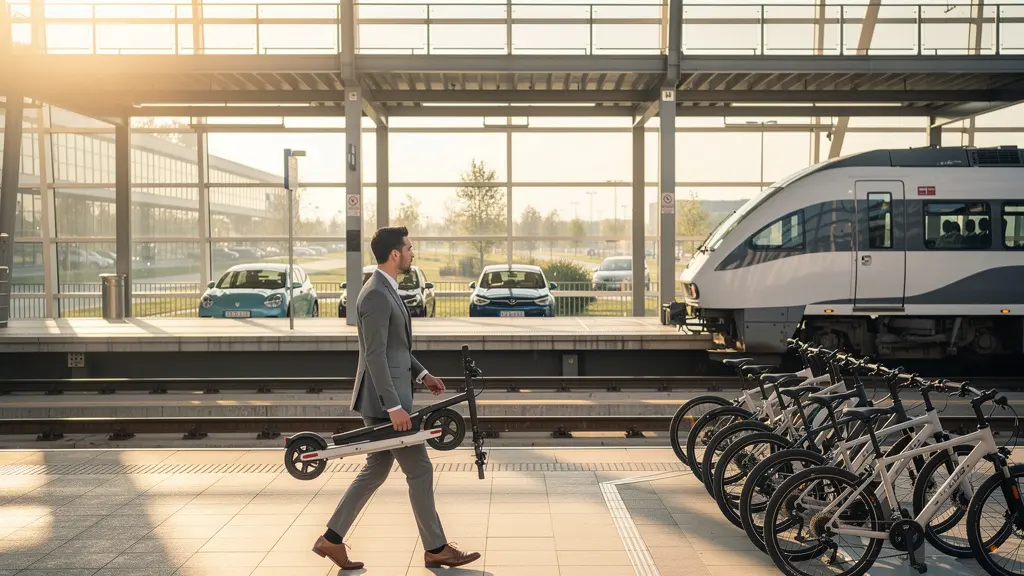
True mobility freedom isn’t owning a car; it’s mastering an integrated system that makes car dependency obsolete.
- The key is to build a personal « Mobility Stack » with layers for payment, long-haul travel, and last-mile access.
- Strategic « parking arbitrage »—parking for free on the periphery and using a scooter—consistently beats the cost and stress of city-center parking.
- Car sharing and subscription services become financially superior to ownership once you calculate the Total Cost of Mobility, including time wasted in traffic.
Recommendation: Audit your travel for one week. Track every trip, cost, and point of friction. This data is the foundation of your new, smarter mobility strategy.
The modern urban dilemma is a paradox of freedom. Owning a car, once the ultimate symbol of independence, has become a source of immense frustration—traffic, endless searches for parking, and spiraling costs. Yet, the thought of abandoning it conjures images of inconvenience and being at the mercy of public transit schedules. Many seek solutions in generic advice like « use a transit app » or « get a folding bike, » but these are isolated tactics, not a cohesive strategy. They fail to address the core friction that makes multimodal travel feel disjointed and inefficient.
But what if the entire premise was wrong? What if the goal wasn’t just to mix different modes of transport, but to consciously architect a personal, integrated system that is faster, cheaper, and more flexible than relying on a single vehicle? This is the visionary approach of the ‘Mobility Stack,’ a layered system you design yourself. It transforms you from a passive commuter into the active architect of your journey. It’s about making each part of your travel—from payment and parking to the first and last mile—work in perfect harmony.
This article is your blueprint for building that stack. We will deconstruct the journey, providing a strategic framework for each decision. We will explore how to create a frictionless payment layer, determine the precise financial tipping point where car ownership becomes a liability, and master the art of the « last-mile asset. » This is more than a guide to combining transport; it’s a new philosophy for navigating the urban landscape with intelligence and ease.
To navigate this new landscape, we’ve broken down the core components of a seamless multimodal strategy. This framework will guide you through the essential layers of your personal mobility system, from the digital tools in your pocket to the physical choices you make on the street.
Summary: Building Your Personal Mobility Stack
- What single app can you use to pay for parking, charging, and trains all at once?
- Car Club vs. Personal Car: At how many trips does ownership become a burden?
- Scooter in the trunk: The ultimate solution for parking far and free?
- How will ‘Low Traffic Neighbourhoods’ (LTNs) change your access to home?
- The all-inclusive subscription: The end of insurance and maintenance worries?
- Where to park on the outskirts to finish your trip by metro without paying a high price?
- Zipcar or Enterprise: Which subscription for two trips a week?
- Why is ‘Park and Ride’ 30% faster than city-center parking?
What single app can you use to pay for parking, charging, and trains all at once?
The dream of a single « super-app » for all mobility payments is the holy grail of urban transport, but the reality is more nuanced. No single application universally covers every service in every city yet. However, the solution lies not in finding one app, but in building a smart, layered Mobility Stack on your phone. This approach creates a system that is nearly as seamless, giving you control and minimizing friction at every transfer point.
The foundation of this stack is understanding the different types of apps. Data Aggregators are brilliant for planning, while Regional Integrators, where available, are the closest you’ll get to a unified payment system. The key is to orchestrate these tools to work for you. For the urban strategist, the goal is frictionless transfer, ensuring that the moment you step off a train, paying for a bike or scooter is an instantaneous, thought-free action enabled by your pre-configured digital wallet.

This table illustrates the current landscape of Mobility-as-a-Service (MaaS) applications, helping you choose the right tool for the right job within your digital mobility stack.
| App Type | Examples | Payment Integration | Best For |
|---|---|---|---|
| Data Aggregators | Citymapper, Transit, Moovit | Redirect to provider apps | Route planning, multi-modal journeys |
| Regional Integrators | Whim (Helsinki), Jelbi (Berlin) | Single payment for all modes | Cities with unified MaaS systems |
| Transit-Specific | Local transit apps | Direct payment for single mode | Regular commuters on one system |
| Universal Wallets | Apple/Google Pay | Works with NFC readers | Contactless-enabled systems |
Building this digital toolkit is the first step towards true mobility freedom. It’s about having the right information and the right payment method ready before you even need it, transforming your smartphone into a master key for the city.
Car Club vs. Personal Car: At how many trips does ownership become a burden?
The decision to own a car is often emotional, tied to ideas of freedom and convenience. However, a strategic, data-driven approach reveals a clear financial tipping point. For most urban professionals, the true Total Cost of Mobility goes far beyond a monthly car payment. When you factor in the « phantom costs »—insurance, city-center parking, rapid depreciation, and maintenance—the equation changes dramatically. Traditional ownership is a fixed-cost model in a variable-need world.
A detailed analysis of urban travel patterns shows that car ownership becomes a financial ‘burden’ for those making fewer than 6-8 significant trips per month. Below this threshold, the high fixed costs of a personal vehicle that sits idle 95% of the time are far outweighed by the pay-as-you-go flexibility of car clubs and sharing services. This is especially true in dense urban areas where alternatives are plentiful and the costs of ownership are highest. It highlights a stark reality where, for many, private cars are not assets but expensive liabilities.
The time cost is just as significant. Projections show urban dwellers will spend an average of 106 hours per year in traffic jams by 2050. Car sharing services, often with dedicated parking spots, and a multimodal approach allow you to bypass the worst of this congestion. The shift in mindset is profound: you stop paying to own a depreciating object and start paying for the pure utility of access, only when you need it. This financial and temporal calculus is the core logic that dismantles the necessity of personal car ownership for the modern city dweller, especially considering that for roughly 9% of American households, vehicle access is already not a given, making shared systems a matter of equity.
Scooter in the trunk: The ultimate solution for parking far and free?
The concept of a « last-mile asset » is a cornerstone of the advanced multimodal commuter’s strategy. Keeping a compact personal electric vehicle, like a folding e-scooter, in the trunk of your car isn’t about recreation; it’s a calculated move of parking arbitrage. This strategy allows you to bypass the exorbitant cost and scarcity of city-center parking by deliberately parking in cheaper, or even free, zones on the periphery. The scooter then becomes your high-speed tool to bridge the final kilometer, turning a parking inconvenience into a strategic advantage.
This transforms your car from a door-to-door vehicle into a long-range ‘mothership’ that gets you to the edge of the urban core. The scooter handles the congested, expensive final leg of the journey. The time saved by not circling for a parking spot, combined with the money saved on parking fees, often makes this the most efficient method for reaching a downtown office. To execute this perfectly, one must have the right gear, turning the car trunk into a prepared mobility locker.

However, not all last-mile vehicles are created equal. The choice between a folding e-bike, an e-scooter, or an electric skateboard depends on a trade-off between range, weight, legality, and the space in your trunk. An informed decision is crucial for a frictionless experience.
Ultimately, this strategy is about reclaiming control. You are no longer a victim of downtown parking dynamics. Instead, you’ve created a two-stage transit system that you fully command, optimizing for both cost and time. The scooter in your trunk is more than a gadget; it’s a declaration of your strategic superiority over the urban grid.
How will ‘Low Traffic Neighbourhoods’ (LTNs) change your access to home?
Low Traffic Neighbourhoods (LTNs), or « quartiers apaisés, » represent a fundamental reshaping of the urban landscape. Far from being a war on cars, they are a visionary redesign prioritizing human-scale living and efficient, multimodal transport. For the resident, the initial reaction might be concern over restricted car access. However, for the strategic commuter, LTNs are an opportunity to leverage their multimodal skills, turning a potential obstacle into an advantage.
The core principle of an LTN is to filter through-traffic, making streets safer and quieter for residents, cyclists, and pedestrians. This doesn’t mean you can’t access your home by car, but it does mean that using a car for short, local trips becomes less convenient than walking or cycling. This is where the Mobility Stack becomes essential. Access to your front door may now be faster via a cargo bike for groceries or an e-scooter for a quick errand than by navigating a filtered street network in a car.
The experience of cities like Barcelona with their ‘Superilles’ (superblocks) provides a powerful case study. Initially met with skepticism, these transformations have led to more vibrant local communities and, crucially, more efficient logistics. A case study on their implementation showed that restricted car access spurred an incredible growth in local cargo bike delivery services, which grew by 300% within two years. This proves that reallocating street space from cars to people and micro-mobility doesn’t stifle movement; it diversifies and optimizes it, particularly for last-mile logistics. LTNs will force a positive evolution in how we think about our own neighborhood mobility.
The all-inclusive subscription: The end of insurance and maintenance worries?
Car subscription services present a tantalizing offer: the convenience of a car without the headaches of ownership. The « all-inclusive » promise of no insurance paperwork, no maintenance scheduling, and no depreciation worries is a powerful lure for the modern urbanite seeking simplicity. This model effectively outsources the most stressful parts of car ownership, allowing you to treat a car like any other monthly service, such as Netflix or a gym membership.
However, a visionary understands that « all-inclusive » is a marketing term, not an absolute reality. The true cost and value of a subscription lie in the fine print. While base insurance is included, it often covers only the legal minimum. Generous mileage allowances can quickly be exceeded, leading to punitive per-kilometer charges. The flexibility to « switch anytime » might be constrained by minimum term lengths or significant swap fees. This isn’t a deal-breaker, but it requires a strategic approach.
The key is not to take the « all-inclusive » promise at face value, but to use it as a base layer in a more sophisticated Subscription Stack Strategy. This means choosing a base car subscription with a modest mileage allowance for essential car-only trips. You then layer on complementary subscriptions: an unlimited public transit pass for daily commutes and a small budget for bike-share or scooter rentals for last-mile connections. This layered approach is almost always more cost-effective and flexible than a single, high-tier car subscription. The table below deconstructs the common claims of subscription services, revealing where the hidden costs may lie.
| Aspect | Subscription Claims | Reality Check | Hidden Costs |
|---|---|---|---|
| Insurance | ‘Fully covered’ | Basic coverage only | Premium add-ons: $50-150/month |
| Maintenance | ‘All included’ | Scheduled only | Wear items often excluded |
| Mileage | ‘Generous allowance’ | 1000-1500km/month | $0.25-0.50/km overage |
| Flexibility | ‘Switch anytime’ | 30-90 day minimum | Switch fees: $200-500 |
| Tires | ‘Covered’ | Normal wear excluded | $500-1000/year |
Where to park on the outskirts to finish your trip by metro without paying a high price?
Mastering the art of peripheral parking is a key skill for the multimodal visionary. This strategy, known as parking arbitrage, involves leveraging location and information to access the city’s transport network without paying premium downtown parking prices. It’s a game of chess where your car is a piece you strategically place on the board’s edge to win the center. The secret is that an abundance of free or low-cost parking exists, hidden in plain sight, for those who know where to look.
The most obvious targets are official Park-and-Ride lots, but the real gems are unofficial, shared spaces. Analysis of commuter patterns consistently shows that the vast parking lots of large shopping centers and big-box stores are often underutilized during weekday commute hours. Many are conveniently located near transit lines and offer de facto free parking before the 10 am retail rush. Similarly, transit agencies often forge agreements with community hubs like houses of worship or entertainment venues, which have empty lots on weekdays, creating distributed, low-cost parking opportunities.
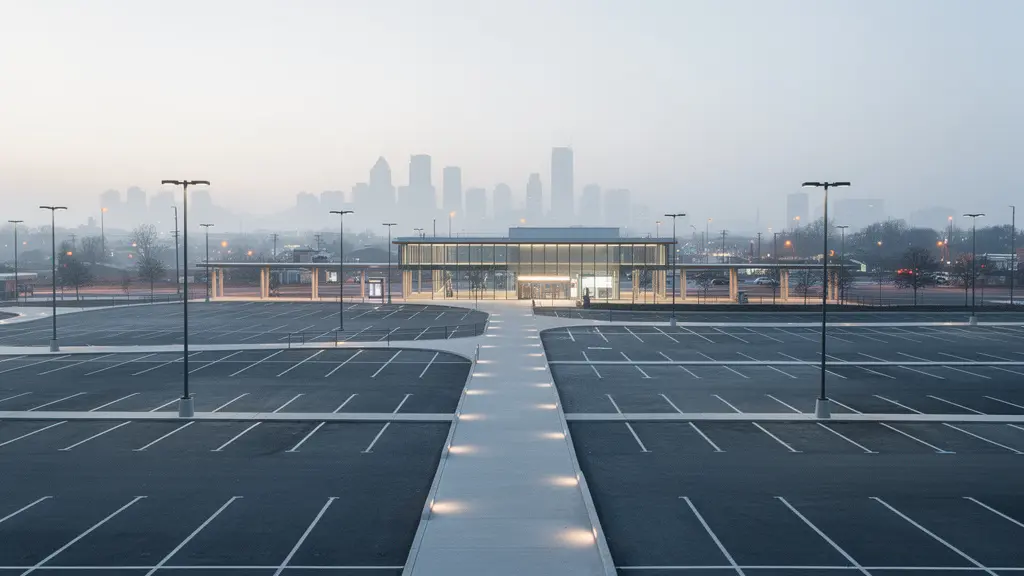
Finding these spots requires a new way of seeing the city map. It’s about using digital tools to your advantage. Satellite views on mapping apps can reveal large, unmarked lots within a 10-minute walk of a metro station. Specialized parking apps like SpotHero can uncover deep « early-bird » discounts in commercial lots that make them cheaper than official transit parking. This is not about leaving your car in dubious locations; it’s about identifying patterns and using technology to exploit inefficiencies in the urban fabric for your own benefit.
Your Action Plan: Finding Hidden Park & Ride Goldmines
- Use satellite view on maps to identify large parking lots within 800m of your target transit stations.
- Check parking apps like SpotHero or Parkopedia for « early-bird » rates in commercial lots, which are often 50-70% cheaper before 8 am.
- Search local community Facebook groups with keywords like ‘parking’ + ‘commute’ + your transit line’s name to find insider tips.
- Map out transit fare zone boundaries using agency websites; parking costs often drop dramatically just by crossing from one zone to another.
- Scout potential spots on a weekend trip: visit on a Sunday to assess safety, lighting, and the real walking route to the station.
Zipcar or Enterprise: Which subscription for two trips a week?
Choosing between car-sharing services like Zipcar (station-based) and Enterprise CarShare (a similar model) for a consistent, low-frequency need like two trips per week requires moving beyond brand names. The real decision lies in understanding your user profile. Are you a « Planner » who books trips in advance, or a « Spontaneous » user who needs a car on short notice? The architecture of the service you choose must match the rhythm of your life.
For a user with a predictable schedule of two trips per week, a station-based model like Zipcar is often superior. This model thrives on predictability. Because vehicles must be returned to the same spot, availability is generally more reliable for advance bookings. They are optimized for « round trips, » such as a planned weekly grocery run or a commute to a location not served by public transit. Their pricing structures, often with lower hourly rates for planned, multi-hour blocks, favor this type of usage.
The critical factor is the nature of those two trips. Are they short, 1-2 hour errands, or longer, half-day excursions? The table below offers a framework that expands beyond just Zipcar and Enterprise to include other models, helping you identify the « sweet spot » for your specific needs. It reframes the question from « which brand? » to « which model fits my life? ». The importance of these services is magnified when considering that for some communities, such as the 18% of Black households that lack vehicle access, they are a vital tool for social and economic mobility.
| User Profile | Best Option | Hourly Rate | Daily Cap | Sweet Spot |
|---|---|---|---|---|
| The Planner (books 24h+) | Station-based (Zipcar) | $12-18/hour | $80-100 | 2-6 hour trips |
| The Spontaneous | Free-floating (Car2Go) | $15-20/hour | $85-120 | Under 3 hours |
| Weekend Warrior | Traditional rental | N/A | $40-60 | Full day trips |
| Grocery Runner | Peer-to-peer (Turo) | $8-12/hour | $50-70 | 4+ hour blocks |
Key Takeaways
- Building a personal « Mobility Stack » with layers for payment, long-haul, and last-mile travel is more effective than relying on a single transport mode.
- The true cost of car ownership includes « phantom costs » like insurance, parking, and depreciation, making car-sharing financially superior for low-frequency urban users.
- Mastering « parking arbitrage »—parking cheap on the periphery and using a last-mile asset like an e-scooter—is a key strategy to save time and money.
Why is ‘Park and Ride’ 30% faster than city-center parking?
The claim that Park and Ride (P&R) can be significantly faster than driving directly downtown seems counterintuitive. After all, you’re adding a transfer. Yet, the data consistently supports this conclusion, and the reason lies in a more holistic calculation of « journey time. » The visionary commuter understands that the clock doesn’t stop when you exit the highway; it stops when you arrive at your office desk. The « 30% faster » figure comes from eliminating the two biggest time sinks of urban driving: the search for parking and the walk from parking.
A study of Seattle’s transit system provided concrete numbers to back this up. It revealed that Park & Ride users saved an average of 18 minutes in travel time compared to their counterparts driving downtown. The breakdown is revealing: a staggering 12 minutes of that saving came from avoiding the soul-crushing search for an available spot, and another 8 minutes were saved by not having to walk from a distant, overpriced lot to the final destination. The P&R lot offers near-instant parking, and the express bus or train drops you in the heart of the business district.
Furthermore, this calculation doesn’t even include the « quality time » factor. The 20-30 minutes spent on an express bus or train are not dead time. It’s productive time that can be used for reading, answering emails, or simply de-stressing before the workday begins. Driving in stop-and-go city traffic is cognitively demanding and stressful. The P&R system exchanges this ‘bad’ time for ‘good’ time, a benefit that is hard to quantify but immensely valuable. This is the ultimate win of the multimodal system: it’s not just faster; it’s smarter.
Now that you possess the framework for a smarter commute, the next step is to put it into practice. Start by auditing your own travel patterns and begin assembling your personal Mobility Stack today to reclaim your time, money, and urban freedom.