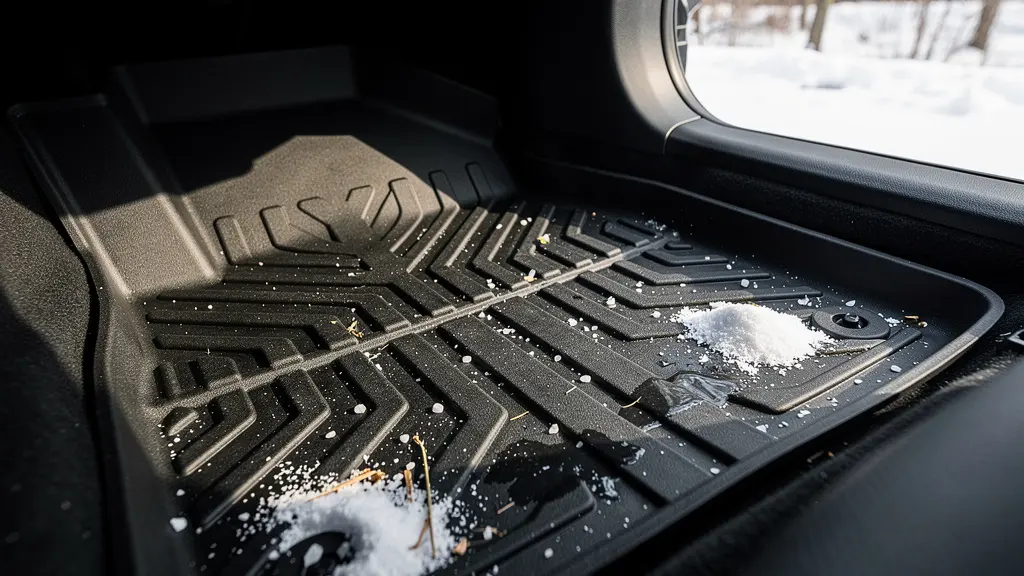
Custom-fit rubber mats are not an accessory; they are a critical vehicle integrity system that actively prevents costly, long-term damage.
- They eliminate the safety risk of pedal interference caused by slipping universal mats.
- They contain corrosive moisture (rain, snow, road salt) that can lead to floor pan rot and electrical issues.
- They are the single most effective way to preserve your car’s interior, directly protecting its resale value.
Recommendation: Treat high-quality, custom-fit TPE rubber mats as a non-negotiable part of your winter car care, just like you would winter tyres or an antifreeze check.
As a professional detailer, I see the brutal reality of the British winter written all over the inside of cars. It starts with a bit of mud on the carpet, a damp smell after a rainy week, and the crunch of road salt underfoot. Most drivers see this as a simple cleaning issue, a minor annoyance to be dealt with later. They buy cheap, universal mats, assuming they’re doing enough. This is a fundamental, and often costly, misunderstanding.
The common wisdom is that mats are for keeping carpets clean. While true, that’s like saying a roof is for keeping the rain off your head. It ignores the far more serious, hidden consequences of failure. The real fight isn’t against visible dirt; it’s against moisture ingress. Water and salt don’t just stain; they seep through ill-fitting mats, soak into the underlay, and begin a slow, silent attack on your car’s floor pan, electronics, and air quality.
But what if we stopped thinking of floor mats as a superficial accessory and started seeing them for what they truly are: a strategic defence system for your vehicle? The real key to protecting your investment isn’t just wiping away mud, but creating an impermeable barrier that safeguards your car’s structural integrity, safety, and long-term value. This isn’t about cleanliness; it’s about preservation.
This guide will deconstruct why custom-fit rubber mats are an essential investment. We will explore the hidden dangers of poor-fitting mats, how a quality set prevents structural corrosion, the best materials to choose, and how this single purchase can save you hundreds, if not thousands, of pounds in the long run.
Summary: Why a Detailer Swears by Custom Rubber Mats for Winter
- Universal sliding mats: the hidden deadly danger under your feet
- How waterproof mats prevent rainwater from rotting your floorpan?
- The quick cleaning technique to keep your mats looking new without effort
- How to get rid of the chemical smell of new mats in 24h?
- OEM vs rubber mats: what do used car buyers prefer?
- The interior neglect mistake that costs £500 on trade-in
- Road courtesy: why mud flaps reduce spray for those behind you?
- Hard-shell liner or flexible mat: which trunk protection fits your needs?
Universal sliding mats: the hidden deadly danger under your feet
The most immediate and terrifying failure of a poor-quality mat isn’t dirt; it’s a loss of control. Universal « one-size-fits-all » mats are the prime culprit. Lacking factory anchor points and a precise fit, they inevitably slide and bunch up under the pedals. This isn’t just an annoyance; it’s a critical safety failure known as pedal interference. When a loose mat slides forward, it can trap the accelerator pedal down or prevent the brake pedal from being fully depressed. In a panic situation, the consequences can be catastrophic.
This is not a hypothetical problem. In the US, it’s estimated that around 16,000 accidents per year are linked to pedal misapplication, with mat interference being a significant contributing factor. The high-profile Toyota recalls for unintended acceleration were directly linked to accelerator pedals becoming trapped by improperly secured or stacked floor mats. Investigators found that the design of the pedals could make entrapment more likely, forcing a massive recall to ensure driver safety. A custom-fit mat, locked into the vehicle’s factory anchors, makes this type of incident virtually impossible.
Choosing a mat isn’t about carpet coverage; it’s about ensuring the primary controls of your vehicle remain unobstructed at all times. A mat that can shift an inch is an inch too dangerous. This is the first and most important reason why « good enough » is a risk no driver should take.
How waterproof mats prevent rainwater from rotting your floorpan?
Once you’ve addressed the immediate safety risk, the next battle is against the silent killer of a car’s interior: moisture. Every time you get in your car on a wet day, you bring in water, grit, and corrosive road salt. On a standard carpet mat, this moisture soaks through and becomes trapped in the thick foam underlay beneath your car’s carpet. It never truly dries in a cold, damp winter. This creates a perfect environment for structural corrosion. Your car’s floor pan is painted steel, and constant, trapped dampness will eventually lead to rust, or what we in the trade call « floor pan rot. »
A quality, custom-fit waterproof mat made from Thermoplastic Elastomer (TPE) functions as a complete containment system. Its design is engineered with several key features to combat moisture ingress. Firstly, it has high, raised edges that form a perfect seal against the sides of the footwell, creating a tray-like barrier. Secondly, a network of deep grooves and channels traps and holds water, mud, and snow, preventing it from sloshing around and escaping over the sides. This ensures the moisture stays on the mat, not in your car’s structure.
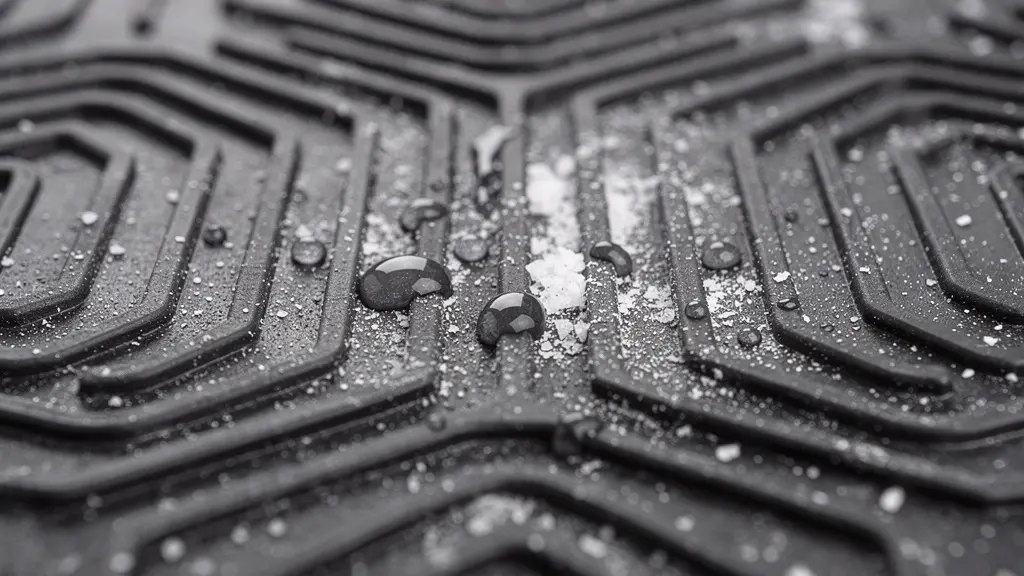
As you can see, these channels are not just for looks; they are an engineered landscape designed to manage liquid. By containing the water, you can simply lift the mat out, pour the water away, and leave your car’s floor bone dry. This stops rust before it can ever start, prevents musty odours from mould growth in the underlay, and protects sensitive electronics that often run under the carpet.
The quick cleaning technique to keep your mats looking new without effort
One of the biggest resistances I hear to rubber mats is the perceived hassle of cleaning. People imagine scrubbing away for ages. The reality is the opposite. Cleaning a carpet mat is a chore involving vacuuming, shampooing, and long drying times. Trying to remove caked-in mud or a spilled coffee from fabric is a genuine battle. In contrast, maintaining a set of high-quality TPE rubber mats is astonishingly simple and fast, which is why they are standard issue in any serious off-road or utility vehicle.
Because the material is non-porous, dirt and liquids sit on the surface instead of soaking in. This means that 90% of the time, cleaning is a 30-second job. You remove the mat, give it a shake to get rid of loose debris, and put it back. For more serious winter grime—the kind of caked-on mud and salt that would ruin a carpet mat—the process is still incredibly straightforward and requires no special products or equipment.
Action Plan: Professional Mat Cleaning in Under 5 Minutes
- Remove & Rinse: Take the mats out of the vehicle. Use a basic garden hose to spray off the majority of the mud, salt, and grime.
- Scrub if Necessary: For seriously stubborn gunk, apply a small amount of regular dish soap and use a medium-stiff brush to gently scrub the surface and channels.
- Rinse Thoroughly: Hose the mat down again to remove all soap residue. You’ll see the water run clean almost instantly.
- Dry Completely: Let the mats air dry for a few minutes or wipe them down with an old towel. Critically, never put a wet mat back in your vehicle.
- Re-install: Once dry, lock them back onto the factory anchor points. They will look as good as new.
This simple routine means you can maintain a factory-fresh look all winter with minimal effort, preventing the build-up of dirt that makes a car feel old and worn.
How to get rid of the chemical smell of new mats in 24h?
A common and unpleasant experience with cheap rubber products is the overpowering chemical or « tyre shop » smell that fills your car. This is often caused by volatile organic compounds (VOCs) and plasticisers used in low-grade PVC or traditional rubber manufacturing. The smell can be nauseating and is a sign of off-gassing, where chemicals are released into the air you breathe. Many people try to « air them out, » but the smell can linger for weeks.
However, this problem is entirely avoidable by choosing the right material. The best custom-fit liners are not made from traditional, smelly rubber but from a modern, engineered material called Thermoplastic Elastomer (TPE). This advanced compound is a game-changer for interior air quality. It is specifically designed to be stable, durable, and, most importantly, almost completely inert.
Unlike some rubber mats that can emit a strong smell, TPE mats are virtually odorless, providing a more pleasant environment inside your vehicle.
– Tacoma4G Forum Review, TPE VS Rubber Floor Mats Comparison 2024
The solution to getting rid of the chemical smell is to not introduce it in the first place. High-quality TPE mats are made from materials that are 100% recyclable and free from harmful chemicals like BPA, lead, or PVC. This means there is no off-gassing and no odour from day one. You can install them straight out of the box without worrying about headaches or that unpleasant rubbery stench. In this case, prevention is the only cure, and choosing a premium TPE mat ensures your cabin remains a neutral, pleasant space.
OEM vs rubber mats: what do used car buyers prefer?
When it comes to selling a car, the interior condition is a massive factor in how buyers perceive its value and how well it has been cared for. A worn, stained, or dirty carpet is an immediate red flag. So, what do savvy buyers prefer to see? The original, pristine OEM (Original Equipment Manufacturer) carpet mats, or a set of high-quality, aftermarket rubber liners? The answer, from a value preservation perspective, is both.
A smart owner keeps the original OEM carpet mats clean and stored away, and uses a set of custom-fit rubber liners for daily driving. When it’s time to sell, they present the car with the perfectly preserved, like-new OEM mats re-installed. The buyer sees an immaculate interior that looks like it has barely been used. The aftermarket rubber mats have acted as a sacrificial layer, taking all the wear and tear. A premium aftermarket liner is not just a mat; it’s effectively a second, more durable interior lining for your car. The difference in protection is significant.
| Feature | OEM Carpet Mats | WeatherTech-style FloorLiners |
|---|---|---|
| Coverage | Basic floor coverage | Full footwell including sides and behind pedals |
| Protection | Protects against light dust | Protects against spills, mud, and tiny debris |
| Impression | Standard, expected feature | Sign of a meticulous, caring owner |
| Preservation | Is the item being preserved | Is the item doing the preserving |
As this comparison from an independent review highlights, a full liner offers a level of coverage that standard mats simply can’t match. An informed buyer knows that a car fitted with quality liners has likely been well-maintained. It signals that the owner cared about preventing long-term damage, which builds immense trust and helps you command a higher price.
The interior neglect mistake that costs £500 on trade-in
In the world of car detailing and sales, we have a saying: « the interior sells the car. » A buyer can forgive a small scuff on the bumper, but a stained, smelly, or worn-out interior is a deal-breaker. It screams neglect. This is where the true return on investment for quality floor mats becomes crystal clear. Neglecting your car’s floor is arguably the single most expensive interior mistake you can make.
A dealer appraising your car for a trade-in will instantly assess the interior. If they see worn-through carpets, salt stains, and a damp smell, they don’t just see a car that needs cleaning. They see a car that will require a full interior valet, potentially shampooing or even carpet replacement, just to be presentable on the forecourt. This cost is immediately deducted from your trade-in offer. A tired interior can easily knock £300-£500 off the value of an average family car, sometimes more.
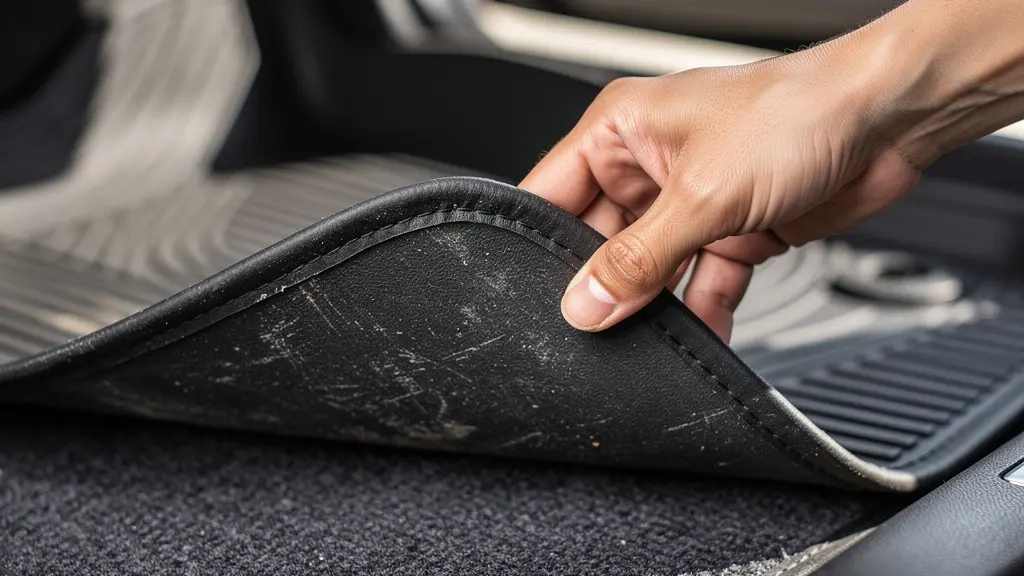
This is where the maths becomes compelling. A premium set of custom-fit liners might cost £150-£200. That single purchase completely eliminates the risk of that £500 value loss. As one industry review notes, a relatively small investment protects thousands in resale value by ensuring the interior remains pristine and easily cleanable. You are not « spending » money on mats; you are « investing » it to prevent a much larger, almost certain, financial loss when it comes time to sell or trade in.
Road courtesy: why mud flaps reduce spray for those behind you?
Thinking about how your vehicle impacts its surroundings is a sign of a considerate and thorough owner. The topic of mud flaps, for example, is all about containing the spray your tyres kick up, improving visibility and safety for drivers behind you. It’s part of a holistic approach to responsible vehicle ownership, especially in winter. This same comprehensive mindset should be applied to the inside of your car, where the enemy is the grime you bring in with you.
A complete interior defence strategy doesn’t just stop at the driver’s feet. Winter grime doesn’t discriminate. Passengers in the back, especially children, will bring in just as much mud, snow, and salt. Leaving the rear footwells with only the standard carpet mats is a common oversight that undermines the entire effort. You end up with a protected front and a deteriorating, damp rear, leading to the same problems of mould and corrosion.
Therefore, a full set of mats for both front and rear is essential. Furthermore, the system only works if it’s managed. During periods of heavy snow or rain, it’s crucial to regularly lift the mats out and drain the collected water. Letting a deep pool of icy water sit in the mat for days on end is not ideal, as it can still slosh out during hard cornering or braking. A complete winter protection mindset means treating your mats as an active system: install them everywhere and maintain them regularly.
Key Takeaways
- Safety First: Custom-fit mats that lock in place eliminate the risk of pedal interference, a known cause of serious accidents.
- Corrosion Prevention: Waterproof TPE mats with raised edges create a barrier that stops salt and water from reaching and rotting your car’s metal floor pan.
- Value Preservation: A £150-£200 investment in quality mats can prevent a £500+ deduction in your car’s trade-in value by keeping the original interior immaculate.
Hard-shell liner or flexible mat: which trunk protection fits your needs?
The final frontier in vehicle interior protection is the boot. This area often sees the worst abuse, from muddy wellies and wet dogs to leaky shopping bags and DIY supplies. Just like the main cabin, the boot floor is susceptible to damage and staining. The two main options for protection are rigid, hard-shell plastic liners and flexible TPE rubber mats.
A hard-shell liner offers excellent puncture resistance, making it ideal for those who regularly transport sharp or heavy-duty items. However, their rigidity can be a drawback. In cold weather, they can become stiff and brittle, making them difficult to install or remove for cleaning. They can also slide around more easily if the fit isn’t perfect, and they offer minimal sound-dampening from road noise.
Flexible TPE mats, on the other hand, offer superior versatility. They are easy to roll up and remove, remain pliable even in freezing temperatures, and their softer material provides effective sound-dampening. Their superior « shape memory » also means they are less likely to curl at the edges over time, maintaining a snug fit. As one engineering team notes, material flexibility is key to long-term performance.
WeatherTech’s rigidity can lead to edge curling as the material struggles to retain shape under thermal stress, while Lasfit’s flexible blend remains pliable in all climates with superior shape memory.
– Lasfit Engineering Team, Comprehensive Floor Liner Material Review
| Feature | Rigid Hard-Shell Liner | Flexible TPE Mat |
|---|---|---|
| Cold Weather Performance | Becomes stiff and hard to handle | Remains pliable and easy to manage |
| Installation / Removal | Can be cumbersome and awkward | Slides or rolls into place easily |
| Sound Dampening | Minimal acoustic benefit | Effectively reduces road noise |
| Best For | Heavy, sharp, industrial loads | Groceries, pets, luggage, general use |
For most everyday users—families, pet owners, and outdoor enthusiasts—the flexible TPE mat offers the best balance of robust protection, ease of use, and all-weather performance.
Ultimately, protecting your vehicle is a system of proactive choices. By viewing custom-fit mats not as a cosmetic add-on but as an essential investment in safety, structural integrity, and financial value, you adopt the mindset of a professional. Take the time to equip your car properly, and it will reward you with a cleaner, safer, and more valuable ownership experience for years to come.