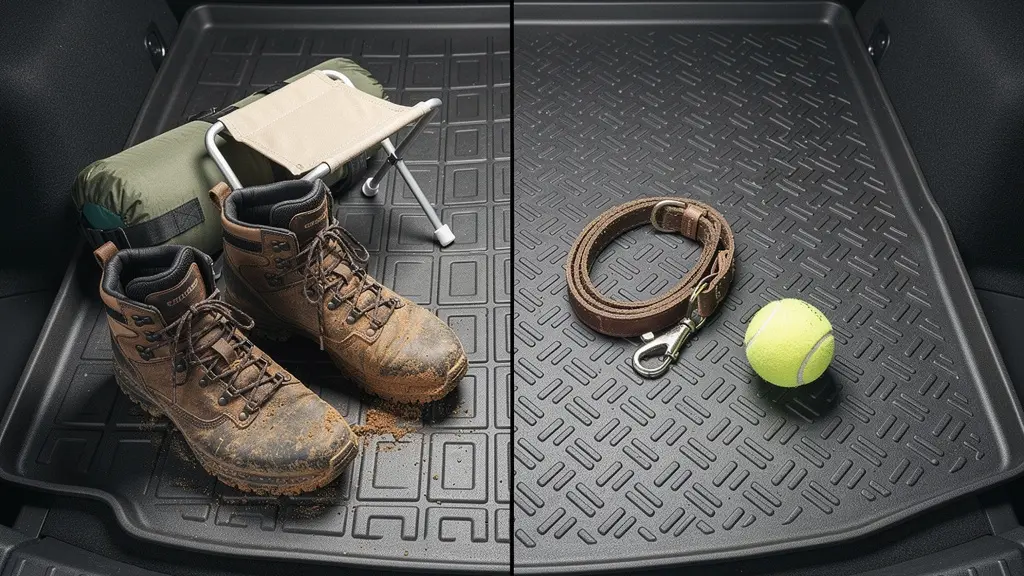
The right trunk liner isn’t just about rigid vs. soft; it’s the foundation of your vehicle’s entire cargo system.
- Rigid, high-lipped trays offer unmatched containment for liquid spills, making them ideal for messy jobs or wet gear.
- Soft, rubberized mats provide superior grip, ensuring safety for pets and preventing cargo from becoming a projectile during sudden stops.
Recommendation: Choose the liner that solves for your most frequent, high-risk scenario. For daily dog transport, prioritize grip (soft mat). For construction or landscaping work, prioritize containment (rigid tray).
The scuff marks on the bumper, the persistent smell of wet dog, or the sinking feeling of a paint can tipping over in a sharp turn—for any active vehicle owner, the cargo area is a battleground. Whether you’re a dedicated dog owner, a weekend DIY warrior, or both, protecting your vehicle’s interior from the inevitable mess is a top priority. The market offers a seemingly simple choice: a hard, rigid plastic bin or a flexible, soft mat. Most comparisons stop there, focusing on basic pros and cons like ease of cleaning or initial cost.
This approach, however, misses the bigger picture. The reality is that your trunk liner is not an isolated accessory. It is the foundational layer of your entire cargo ecosystem. The material, texture, and design you choose directly influence the safety of your pet, the stability of your cargo, the effectiveness of other accessories like safety barriers, and even your vehicle’s fuel efficiency. It’s a strategic choice that dictates how you can use your space for years to come. In fact, the consequences of a poor choice are common, as research shows that 78% of pet owners report damage to their vehicle’s cargo area from their furry companions.
Instead of just asking « which material is better? », this guide will help you think like a system designer. We will analyze how each liner type performs in specific, real-world scenarios, empowering you to build a cohesive and highly functional cargo space that truly meets your needs, from preventing bumper scratches to optimizing your storage for a cross-country road trip.
To help you navigate these critical decisions, this article breaks down the key considerations for choosing the right trunk protection. Explore the topics below to build a cargo solution that works for you.
Summary: A Systemic Approach to Choosing Your Trunk Liner
- How to prevent bumper scratches when your dog jumps in?
- Spilled oil or paint: how does a high-lipped tray save your carpet?
- Why is a non-slip mat essential for safety in an emergency?
- How to protect the entire floor when turning your car into a van?
- Net or metal barrier: what to choose to stop a dog from jumping into the front?
- Why is emptying your trunk the easiest way to save money?
- Open rails, integrated, or fixed points: which mounting foot for your roof?
- Rigid or soft roof box: which will survive your winter vacation?
How to prevent bumper scratches when your dog jumps in?
Bumper scratches from an excited dog are not a sign of bad behavior; they’re often a symptom of instability. When a dog prepares to jump into a trunk, it needs a secure, predictable surface for both its launch and landing. A slippery, hard plastic surface offers minimal traction, causing paws to scramble for grip. This scrambling action is what leads to claws raking across the bumper and trunk lip. The solution isn’t just about covering the bumper, but about addressing the root cause: a lack of grip.
This is where the material of your liner becomes critical. While rigid TPE (Thermoplastic Elastomer) liners are durable, their smooth surface can be like an ice rink for a dog. A soft rubber mat, especially one with a textured pattern, provides the high-friction surface necessary for confident entry and exit. It gives your dog stable footing, reducing the frantic clawing that damages your vehicle. For many dog owners, this single factor makes a soft mat the superior choice, as it directly enhances their pet’s safety and comfort while preventing cosmetic damage.
The difference in surface properties is significant and directly impacts your dog’s experience. This table breaks down the key distinctions:
| Feature | Rigid TPE Liner | Soft Rubber Mat |
|---|---|---|
| Surface Friction | Low – Smooth plastic | High – Textured rubber |
| Dog Paw Grip | Poor – May cause scrambling | Excellent – Stable footing |
| Noise Level | Higher – Items slide | Lower – Items stay put |
| Cleaning Ease | Excellent – Wipe clean | Good – May trap hair |
Ultimately, preventing bumper scratches starts inside the trunk. By providing a high-traction foundation with a soft, textured mat, you give your dog the confidence to jump in cleanly, making bumper protector flaps a secondary line of defense rather than a necessity.
Spilled oil or paint: how does a high-lipped tray save your carpet?
For the DIY enthusiast, gardener, or contractor, the cargo area is less a pet taxi and more a mobile workshop. Here, the greatest threat isn’t fur, but liquids: motor oil, paint, bags of wet soil, or leaking coolers. A simple flat mat, whether carpet or rubber, offers little to no protection against spills of any significant volume. Once a liquid escapes its container, it will inevitably find its way to the edges and seep into your vehicle’s factory carpet, leading to permanent stains and odors.
This is the scenario where a rigid, tray-style liner proves its absolute superiority. The defining feature of these liners is their tall, continuous perimeter wall, effectively turning your trunk into a shallow, waterproof basin. This design provides total containment. A tipped-over gallon of paint or a leaking five-quart jug of oil is held securely within the tray, allowing you to safely remove the liner and clean up the mess outside the vehicle. The best models are laser-measured for a perfect fit, ensuring no gaps for liquid to escape. These can feature 1.25 inch to 2.5 inch perimeter walls, offering substantial capacity for even major spills.
In the event of a large liquid spill on a rigid liner, a careful removal process is crucial to avoid making the situation worse. Following a clear procedure prevents the contained liquid from sloshing over the sides.
- First, apply an absorbent material like cat litter or a commercial spill absorbent directly onto the liquid within the liner.
- Allow it to absorb for 10-15 minutes. This solidifies the liquid, dramatically reducing the risk of spillage during removal.
- Carefully lift the liner out of the vehicle by its corners, keeping it as level as possible.
- Once outside, dispose of the absorbent material and clean the liner with the appropriate solvent or degreaser.
- Before reinstalling, inspect the liner’s seams and edges for any potential cracks or damage that could compromise future containment.
For anyone transporting liquids, chemicals, or messy materials, the containment capability of a high-lipped rigid tray is non-negotiable. It offers peace of mind that a soft mat simply cannot match, acting as a failsafe that saves your carpet and your resale value.
Why is a non-slip mat essential for safety in an emergency?
In everyday driving, a toolbox or a grocery bag sliding around in the back is a minor annoyance. In an emergency maneuver—a sudden swerve to avoid an obstacle or a hard brake—that same object becomes a dangerous projectile. Unsecured items in the cargo area are subject to inertia; they will continue moving at the vehicle’s original speed and direction until stopped by an immovable object, like the back of a seat, a window, or a pet barrier. This can cause significant damage and, more importantly, poses a serious safety risk.
A non-slip mat acts as a critical safety device by maximizing static friction. The high-grip rubber surface, often enhanced with deep grooves or a textured pattern, holds items in place, resisting the forces of acceleration, braking, and cornering. While a rigid plastic liner allows items to slide freely, a quality rubber mat keeps them anchored. This principle is a cornerstone of a safe cargo ecosystem. As one expert tester noted after putting a liner through its paces, the frustration is real:
As someone who uses their cargo area to its maximum capacity, one of my pet peeves is my gear sliding around as I navigate through corners
– Dan Russo, Husky Liners Field Test Report
The texture of a non-slip surface is specifically engineered to counteract movement. This visual demonstrates how a patterned surface creates thousands of contact points to hold cargo securely.
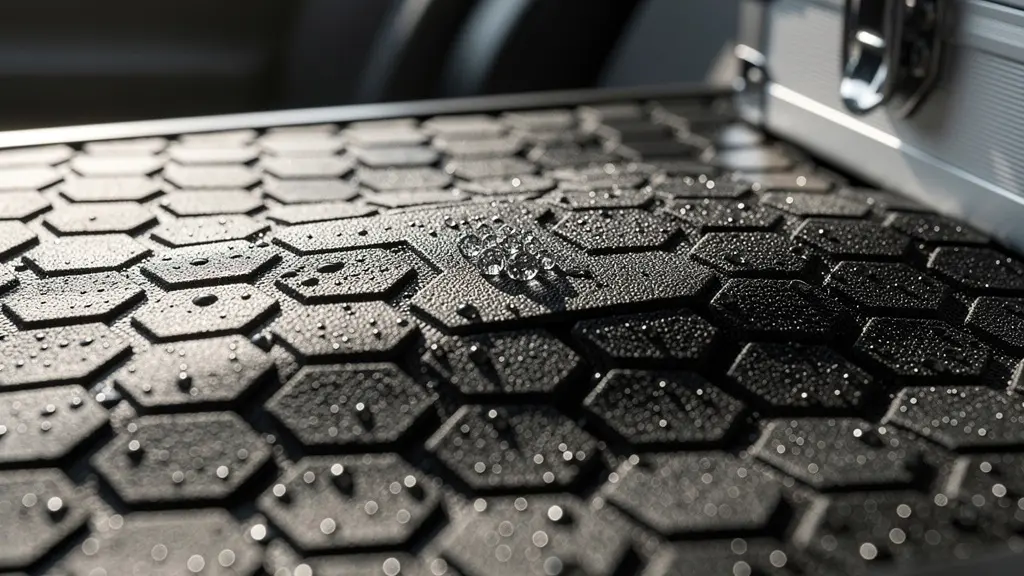
This stabilizing effect is just as crucial for pet safety. For a dog, a slippery surface in a panic stop can cause injury as they slide into the sides of the vehicle or a crate. A non-slip mat gives them the footing they need to maintain their balance, dramatically improving their safety and reducing their stress during travel. Therefore, whether you’re hauling hardware or your four-legged friend, choosing a mat with superior grip is a fundamental investment in safety.
How to protect the entire floor when turning your car into a van?
Many SUV and hatchback owners rely on their vehicle’s versatility, frequently folding down the rear seats to transport large items like furniture, bikes, or landscaping materials. In this « van mode, » standard trunk liners fall short. They protect the cargo floor but leave the backs of the folded rear seats completely exposed to scratches, dirt, and damage. A one-piece rigid liner is particularly problematic in this scenario, as it cannot adapt to a split-folding seat configuration.
To achieve total floor protection, you need a solution designed for modularity and full coverage. This is where flexible, multi-piece systems excel. These systems typically consist of a main cargo mat and separate pieces that cover the back of each section of your folding seats (e.g., for 60/40 or 40/20/40 splits). They connect with features like heavy-duty zippers or Velcro, creating a seamless, uninterrupted protective surface whether the seats are up or down. Companies like 4Knines have perfected this with systems using adjustable straps and quick-release buckles that attach to the headrests, ensuring the seat-back portions stay in place.
When choosing a full-coverage solution, the trade-offs between a single rigid piece and a modular soft system become clear.
| Feature | One-Piece Rigid | Modular Soft System |
|---|---|---|
| Seat Split Compatibility | Limited | 60/40, 40/20/40 |
| Gap Coverage | May leave gaps | Bridges gaps effectively |
| Installation Flexibility | Fixed position | Adjustable sections |
| Weight | 8-15 lbs | 3-5 lbs per section |
For users who frequently fold their seats, a modular soft system is the only practical choice. It bridges the gap between the cargo floor and the seat backs, a notorious collection point for dirt and debris. This complete, adaptable coverage ensures every square inch of your potential load floor is protected, preserving your vehicle’s interior no matter what you’re hauling.
Net or metal barrier: what to choose to stop a dog from jumping into the front?
A dog barrier is an essential safety accessory, preventing a dog from distracting the driver or becoming a projectile in a crash. However, the stability and effectiveness of many barriers—especially pressure-mounted metal types—are directly dependent on the surface they are braced against: your trunk liner. This is a perfect example of accessory interdependence within your cargo ecosystem.
A rigid plastic liner with a smooth, low-friction surface provides a very poor base for a pressure-mounted barrier. Under pressure or vibration, the barrier’s rubber feet can easily slip, causing it to loosen, rattle, or even fail. A soft, high-friction rubber mat, in contrast, provides an ideal foundation. The textured surface gives the barrier’s feet a secure purchase, preventing slippage and ensuring it remains firmly in place. This interaction between liner and barrier is a critical safety consideration that is often overlooked. Choosing the right liner makes your other safety equipment work better.
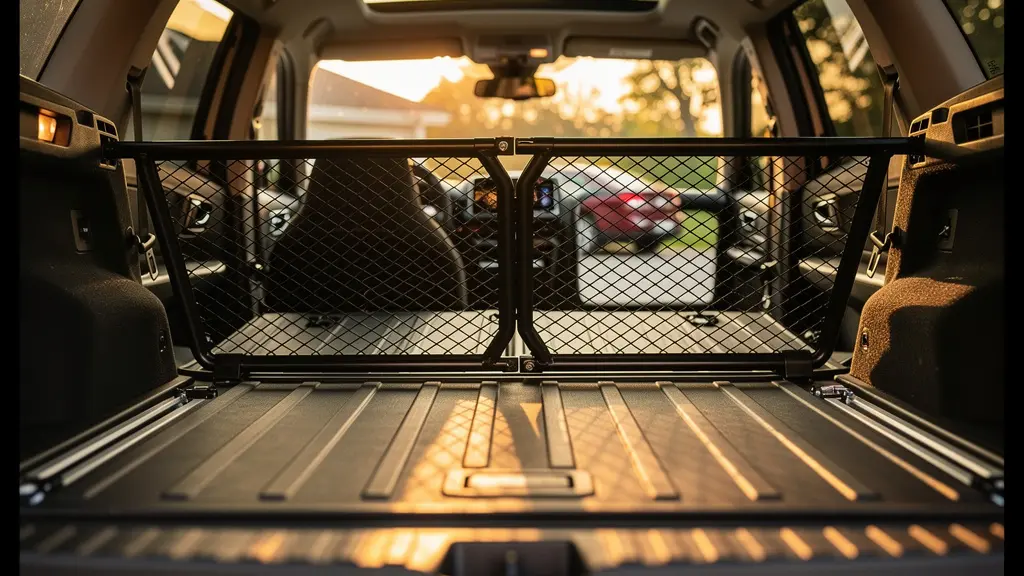
For those who already have a rigid liner, all is not lost. You may need to opt for a barrier that bolts to the vehicle’s C-pillars or attaches to the rear headrest posts, rather than one that relies on pressure against the floor. Alternatively, placing high-friction rubber pads under the barrier’s feet can help mitigate slipping. Before you buy a barrier, you must evaluate its compatibility with your existing liner.
Your 5-Point Barrier and Liner Compatibility Check
- Assess Anchor Points: Check if your chosen liner design obstructs any factory-installed anchor points or D-rings that a barrier might need to attach to.
- Test Surface Grip: Evaluate the friction of your liner’s surface. A pressure-mounted barrier requires a high-friction base like rubber to prevent slipping under force.
- Compensate for Rigid Liners: If you have a smooth, rigid liner, consider barriers that mount to headrests or side panels, or add separate rubberized feet under a pressure-mounted model.
- Leverage Soft Mats: For soft, textured mats, standard pressure-mounted barriers are generally effective and can be installed with confidence.
- Dampen Rattles: Regardless of type, add small foam or rubber pads at all contact points between the barrier and the vehicle (or liner) to eliminate rattling and noise during transit.
Why is emptying your trunk the easiest way to save money?
The simplest and most overlooked component of an efficient cargo strategy has nothing to do with what you buy, but with what you carry. Every pound of unnecessary weight in your vehicle requires energy to accelerate and transport, which directly translates to increased fuel consumption. Your trunk can easily become a rolling storage unit for items you don’t need for your daily commute: sports equipment, old project supplies, or heavy toolboxes.
The physics are straightforward. While the exact impact varies by vehicle, a commonly cited rule of thumb is that for every 100 pounds of extra weight, a vehicle’s fuel efficiency can decrease by 1-2%. It may not sound like much, but it adds up over thousands of miles. A set of golf clubs (20-30 lbs), a heavy-duty jack (30-40 lbs), and a box of assorted tools (30 lbs) can easily add up to 100 pounds of dead weight that you’re paying to haul around every single day.
Developing the habit of regularly emptying your trunk of non-essential items is the cheapest way to improve your fuel economy. A good liner actually facilitates this habit. A clean, protected surface makes you more likely to keep the space organized and less likely to let it become a permanent home for clutter. Think of your trunk as temporary storage, not a garage extension. By carrying only what you need for a specific trip, you reduce wear and tear on your vehicle and save real money at the pump over the long term.
Open rails, integrated, or fixed points: which mounting foot for your roof?
When your internal cargo space isn’t enough, the roof becomes prime real estate. But how you use your roof rack is directly influenced by the capability of your internal liner. This is where system-level thinking pays dividends, particularly in fuel economy. External cargo, especially bulky roof boxes, creates significant aerodynamic drag. A compelling study from Consumer Reports revealed that rooftop carriers reduced fuel economy by 13% at highway speeds of 65 mph.
A premium internal cargo ecosystem allows you to be more strategic about what goes on the roof. By having a fully protected, waterproof, and easy-to-clean trunk area—thanks to a high-lipped rigid liner—you gain the confidence to carry messy, wet, or heavy items inside the vehicle. This reserves the roof space for items that are clean, lightweight, and bulky, such as luggage or camping gear.
Case Study: The Internal vs. External Cargo Strategy
An owner with a high-lipped rigid trunk liner can confidently place muddy hiking boots, wet ski equipment, or bags of garden mulch directly inside their vehicle for the drive home. The mess is completely contained and can be hosed out later. This leaves their roof rack free for a streamlined, aerodynamic box containing clean luggage. In contrast, an owner with only a basic carpet mat might be forced to put the dirty items on the roof (risking a mess) or place their clean luggage in a less secure, drag-inducing roof basket, thereby worsening their fuel economy on a long trip.
The type of roof you have—whether it’s bare, has raised side rails, flush rails, or fixed mounting points—determines the kind of rack feet you’ll need. But the *strategy* for what you put up there starts in the trunk. By investing in a capable internal liner, you are not just protecting your carpet; you are enabling a more fuel-efficient and logical approach to total vehicle storage.
Key takeaways
- Rigid, tray-style liners offer unparalleled containment for liquids and are the best choice for protecting against spills.
- Soft, rubberized mats provide superior grip, which is essential for the safety and comfort of pets and for preventing cargo from sliding.
- Your trunk liner is the foundation of a « cargo ecosystem »; its properties directly affect the performance and safety of other accessories like dog barriers and roof storage.
Rigid or soft roof box: which will survive your winter vacation?
A winter vacation presents the ultimate test for your vehicle’s cargo system, subjecting it to extreme temperatures, moisture, and road salt. While choosing between a rigid or soft roof box is important, the strategy must again start inside the car. Your trunk liner is the frontline defense against the wettest and dirtiest elements of winter: snow-caked boots, dripping skis or snowboards, and wet outerwear.
Here, a high-lipped, rigid TPE liner is the clear winner. Its waterproof basin contains all melted snow and slush, preventing it from soaking into your vehicle’s carpet where it can cause mold, mildew, and rust. Furthermore, material quality is paramount in the cold. Low-grade plastics can become brittle and crack in freezing temperatures, but premium TPE liners are engineered to withstand the extremes. A quality proven by tests showing TPE maintains flexibility at -40°F to 140°F, ensuring it won’t fail when you need it most.
With a reliable internal liner managing the wet gear, your roof box can be dedicated to what it does best: protecting your dry luggage and clothing. For winter, a rigid, hardshell roof box is generally superior to a soft bag. It offers better security, superior weather protection against driving snow and ice, and its aerodynamic shape minimizes the impact on fuel economy compared to a flappy, soft-sided carrier.
A successful winter cargo strategy is a two-part system:
- Inside: Use a high-lipped rigid trunk liner made from cold-rated TPE or TPO to contain all wet, snowy, and salty gear.
- Outside: Use a rigid, aerodynamic roof box to keep luggage, clothing, and other dry goods safe and protected from the elements.
- Process: Always install the liner before loading any gear to prevent road salt from even touching the factory carpet. Upon returning, the liner can be removed and hosed off, completely restoring your trunk to pristine condition.
By viewing your trunk liner not as a simple mat but as the foundational component of a complete cargo ecosystem, you can make a choice that enhances safety, protects your investment, and supports all of your adventures. The next step is to assess your primary needs—be it pet safety, spill containment, or modular flexibility—and select the liner that provides the strongest foundation for your specific lifestyle.