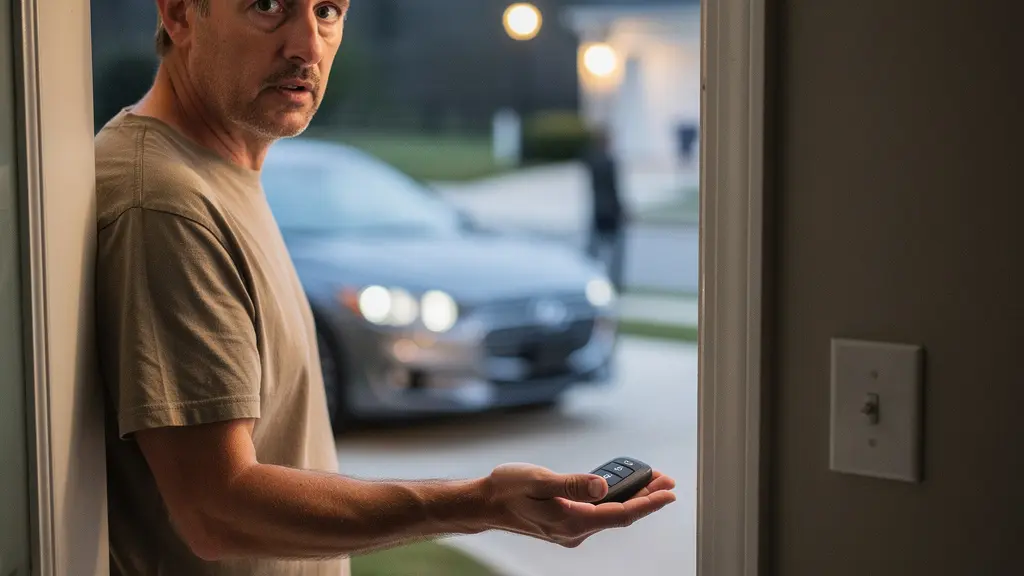
Effective keyless car security is not about a single gadget, but a strategic system of layered defences designed to frustrate thieves at every turn.
- Blocking the initial signal (the relay attack) is the first and most crucial layer, but it is not foolproof on its own.
- Adding a secondary authorisation step, like a PIN code, creates a powerful barrier even if the car is unlocked.
Recommendation: Audit your vehicle’s vulnerabilities and build a multi-layered security plan combining signal blocking, physical deterrents, secondary authorisation, and post-theft tracking for comprehensive protection.
The convenience of keyless entry has become a standard feature on modern vehicles, but it has also introduced a significant vulnerability. You walk away from your locked car, confident it’s secure, yet thieves can capture your key’s signal from inside your home and drive away in under a minute. This method, known as a relay attack, has turned the very technology designed for ease of use into a critical security risk for concerned owners of desirable SUVs and sports cars.
The common advice often revolves around simple, singular solutions: buy a signal-blocking pouch, use a steering wheel lock, or store your keys in a metal box. While these tips have merit, they treat the problem as a simple lock that needs a single key. This approach is dangerously incomplete. It overlooks the sophisticated and adaptable nature of modern car theft, where criminals can pivot to different threat vectors if one is blocked.
The true key to protecting your investment is to stop thinking in terms of individual products and start thinking like a security professional. This means adopting a strategy of layered defence. The goal isn’t just to find one magic bullet, but to build a system of interlocking digital and physical barriers. Each layer is designed to add friction, time, and risk to the theft process, making your vehicle an unprofitable and unattractive target. This guide will walk you through building that system, from foundational signal hygiene to advanced tracking and insurance requirements.
This article provides a comprehensive roadmap for securing your vehicle against modern threats. We will explore each layer of defence, from understanding the initial vulnerability to implementing robust countermeasures and ensuring you are compliant with insurance mandates.
Summary: A Layered Defence Against Keyless Car Theft
- Why does your key in the entryway allow thieves to drive off with your car?
- Code PIN on the steering wheel: is it the ultimate solution against modern theft?
- What certification (Thatcham S5/S7) does your insurer require to cover theft?
- Is the £10 anti-wave pouch as effective as a £500 alarm?
- What to do if your own security system refuses to start the car?
- How to erase your contacts and GPS history before selling your car?
- Leaving your car at the station: are the theft risks real?
- Is a GPS tracker worth the monthly subscription for a family car?
Why does your key in the entryway allow thieves to drive off with your car?
The vulnerability of keyless entry systems lies in their fundamental design: they are always listening. Your key fob constantly emits a low-power radio signal, waiting for a « request » from your car. When you’re close enough, the car authenticates the key and unlocks. A relay attack exploits this conversation. Thieves use two devices: one to capture the signal from your key (even through your front door or a wall) and a second to « relay » it to your car. The car is tricked into thinking the key is right next to it, allowing thieves to unlock the doors, start the engine, and drive away. This entire process can be silent and take less than 60 seconds.
This isn’t a theoretical risk; it’s a widespread and effective method. The scale of the problem is significant, as many vehicles lack sufficient factory-installed protection against this specific threat vector. For instance, extensive testing by Germany’s ADAC revealed a stark reality: out of hundreds of keyless vehicles examined, only just under 10% could not be opened using relay attack equipment. This demonstrates that relying solely on the manufacturer’s default security is often not enough.
To understand this threat, it is helpful to visualize the invisible signals being manipulated. The illustration below shows how an amplifying device intercepts and extends the key’s signal to the car.
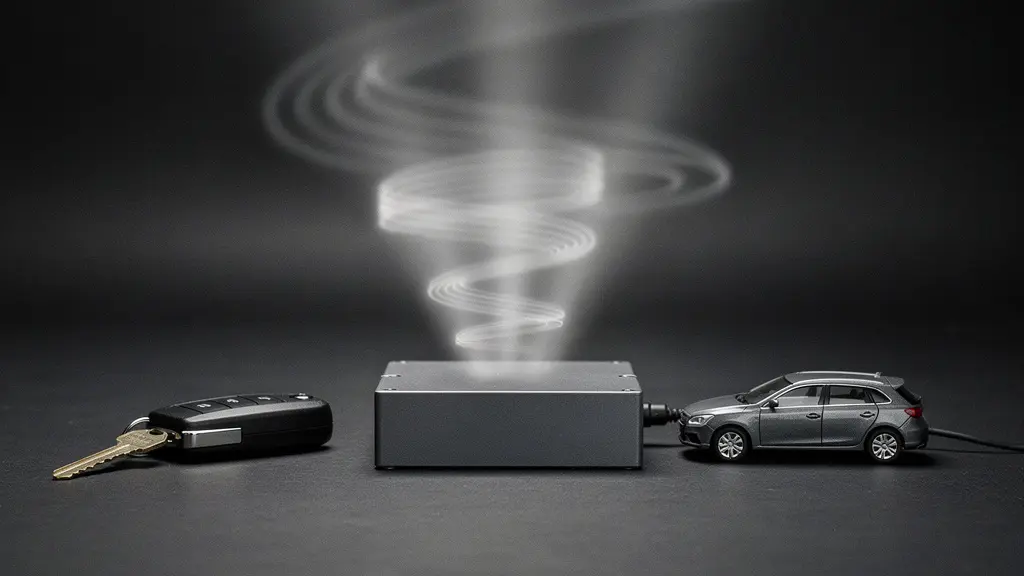
This diagram highlights the core of the problem: the signal itself is the « key. » By controlling the signal, thieves gain control of the vehicle. Therefore, the first and most critical layer of your security strategy must focus on what we call signal hygiene—actively managing and shielding your key fob’s broadcast to prevent it from being captured in the first place. Without a signal to amplify, the relay attack fails at its first step.
Code PIN on the steering wheel: is it the ultimate solution against modern theft?
While blocking the key’s signal is a crucial first layer, a determined thief might find a way around it or use another method to enter the vehicle. This is where a second layer of defence becomes vital: secondary authorisation. A PIN-to-drive system, often installed as an aftermarket « Ghost Immobiliser, » is an excellent example. It requires the driver to enter a unique code using existing buttons on the steering wheel or dashboard before the engine can be started. This completely disrupts the theft process. Even if thieves successfully perform a relay attack to unlock the doors, they are met with a dead car that will not start, adding immense friction and deterrence.
This concept interrupts the vehicle’s standard authorisation chain (Key Present -> Start Button -> Engine On). By inserting a required PIN code into that sequence, you create a powerful barrier that isn’t dependent on the key’s signal alone. The beauty of these systems is their stealth; there are no visible modifications or flashing LEDs to give their presence away, leaving thieves confused and forced to abandon the attempt.
Case Study: Tesla’s PIN-to-Drive as a Factory-Installed Defence
Some manufacturers are integrating this logic directly. Tesla’s PIN-to-Drive feature serves as a prime example of a secondary authorisation layer. Even if a thief manages to unlock a Tesla via a sophisticated relay hack, the car remains immobilised until a four-digit code is entered on the central touchscreen. While no single feature is a silver bullet—the owner must remember to enable and use it—it demonstrates the power of requiring an explicit, knowledge-based input from the driver before allowing the vehicle to be driven away. This effectively neutralises a successful relay attack at the final, critical stage.
These systems are also designed for practicality. As the team at Carwow notes, « Systems with this feature can be temporarily disarmed so that someone else can drive the car without the owner having to disclose the PIN. » This is typically achieved through a « valet mode, » ensuring that security doesn’t come at the cost of everyday usability when leaving your car with a mechanic or parking attendant. Ultimately, a PIN code system acts as your vehicle’s digital deadbolt, providing robust protection that goes beyond simple signal blocking.
What certification (Thatcham S5/S7) does your insurer require to cover theft?
For high-value or high-risk vehicles, many UK insurers go a step further and mandate the installation of a Thatcham-certified tracking and recovery system as a condition of theft coverage. This represents the third layer of defence: post-theft recovery. However, not all trackers are created equal in the eyes of an insurer. The two most common standards you will encounter are Category S7 and the more stringent Category S5. Understanding the difference is critical, as installing the wrong one could invalidate your theft cover.
The fundamental difference between S5 and S7 lies in a feature called Automatic Driver Recognition (ADR). A standard S7 tracker primarily provides GPS location data after a theft has been reported. An S5 system, however, includes driver ID tags (or uses a smartphone app) that must be present when the car is started. If the vehicle is moved without a recognised tag, an alert is automatically sent to a monitoring centre, often before the owner even realises the car is missing. This provides a much faster and higher-confidence theft alert.
The following table, based on information from an analysis by Motoring Research, breaks down the key distinctions you need to communicate to your insurer.
| Feature | Thatcham S5 | Thatcham S7 | Practical takeaway |
|---|---|---|---|
| Primary purpose | Post-theft tracking plus automatic driver recognition (ADR) as an extra layer | Location tracking without ADR | S5 adds an “is the right driver present?” check; S7 focuses on recovery after theft. |
| Driver ID / ADR tag | Required: the driver carries a tag; starting/moving without it triggers an alert | Not required | S5 can detect an unauthorised drive-away even if thieves have the key signal. |
| Automatic unauthorised-use detection | Yes (via missing ADR tag) | No (no ADR) | S5 can produce earlier, higher-confidence alerts; S7 relies more on you discovering theft. |
Ultimately, your insurance provider has the final say. Before investing in an expensive system, you must verify their exact requirements. Don’t assume an « S7 tracker » is sufficient if they mandate the ADR capabilities of an S5 system. Getting this wrong can be a costly mistake in the event of a claim.
Your Action Plan: Verifying Tracker Certification with Insurers
- Identify the exact security/tracker product name and its certification details from your installer or manufacturer documentation.
- Use Thatcham Research’s official Security Certifications database to verify that the product is listed as certified and matches your installed configuration.
- Save proof of certification and installation (certificate reference, installer confirmation) in a safe place you can access at renewal time.
- Notify your insurer proactively that a Thatcham-certified system is installed and ask precisely what category they will accept for theft cover.
- Ask explicitly whether the category you have (e.g., S5 vs. S7) changes your premium, excess, claim handling, or the conditions of your theft cover.
Is the £10 anti-wave pouch as effective as a £500 alarm?
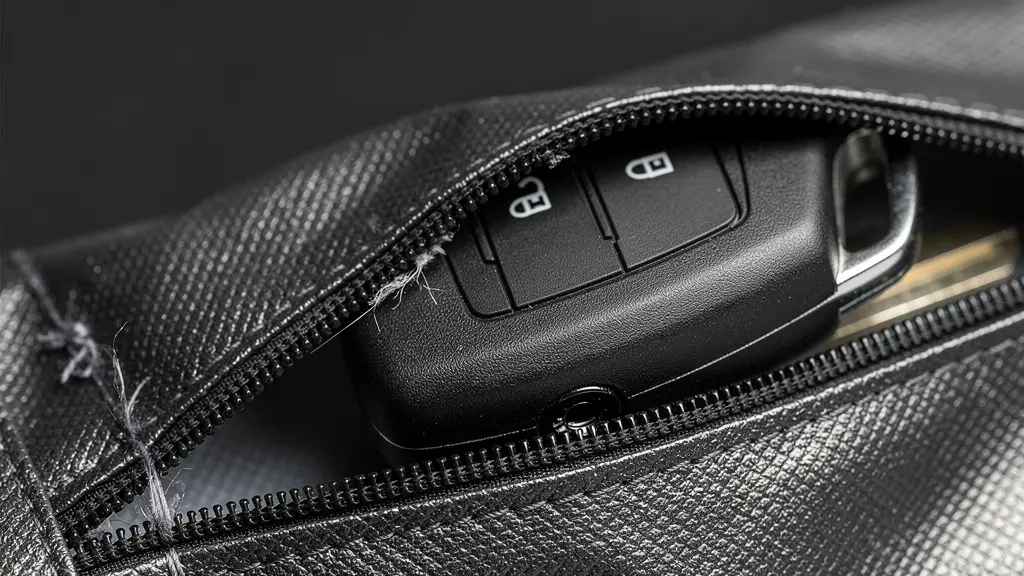
This question compares two different layers of security, and the answer is that they are not mutually exclusive—they serve different purposes. A high-quality signal-blocking pouch, or Faraday pouch, is a remarkably effective tool for its specific job: implementing good signal hygiene. It is designed to create a « black hole » for your key fob’s radio signal, preventing it from being captured by a relay attack device. For a very low cost, it provides a powerful defence against the most common keyless theft method. In this specific role, it is arguably more effective than a traditional alarm, which only sounds after a break-in has already occurred.
However, its effectiveness is entirely dependent on its quality and correct use. The market is flooded with cheap imitations that fail to block signals reliably. As Clive Wain, a security expert, warned in Fleet News, « While a good quality pouch will provide reliable protection… poor imitations are proving to offer little more than peace of mind. » A faulty pouch gives a false sense of security, which is more dangerous than no protection at all. Regular testing is essential.
The texture and construction of the pouch, especially its metallic lining and seams, are critical to its function and durability. A close-up view reveals the layers responsible for blocking the signal and the wear points that can lead to failure over time.
A £500 alarm system, on the other hand, is a different kind of deterrent. It is designed to draw attention, frighten away thieves, and alert you or others to an intrusion attempt, such as a window being smashed or a door being forced. While it won’t stop a silent relay attack, it provides a crucial layer of protection against more traditional, physical break-ins. Therefore, the £10 pouch and the £500 alarm are not competitors; they are complementary parts of a robust, layered security strategy. The pouch protects against the silent digital threat, while the alarm protects against the noisy physical one.
What to do if your own security system refuses to start the car?
One of the most frustrating scenarios for a vehicle owner is being locked out or immobilised by the very system designed to protect them. When your car refuses to start, and you suspect the anti-theft system is the culprit, the cause is often a simple, self-inflicted issue rather than a catastrophic failure. Before panicking or calling for a tow truck, running through a quick diagnostic checklist can often resolve the problem in seconds. The most common cause is also the most ironic: your signal-blocking pouch is working too well, and you’ve forgotten your key is still inside it while you’re trying to start the car.
Start with the simplest checks. Is the key fob still sealed in its Faraday pouch or box? Have you recently dropped the pouch, or does it show signs of wear? A degrading pouch can cause inconsistent behaviour, sometimes working and sometimes failing. Some key fobs also have a feature to manually disable their wireless signal to save battery or for security; verify it hasn’t been left in this « sleep » state. If these basic steps don’t resolve the issue, the next action depends on whether your system is factory-installed or aftermarket. Factory immobiliser issues are best handled by the main dealer, while problems with aftermarket alarms or PIN-code systems should be directed to the original installer. Keeping both numbers handy is a wise precaution.
Expert Caution: The OBD Port « Achilles’ Heel »
Even with perfect signal hygiene, criminals can pivot to other threat vectors. The National Insurance Crime Bureau (NICB) highlights a method where thieves gain physical access to the car (e.g., smashing a window) and then plug their own device into the vehicle’s On-Board Diagnostics (OBD) port. As detailed in a Houston Police Department warning shared by the NICB, this port gives them access to the car’s computer, allowing them to program a new key on the spot. This underscores the importance of layered security. While a Faraday pouch stops relay attacks, it does nothing to prevent this physical/digital hybrid attack. Solutions like a physical lock for the OBD port or a PIN-to-drive immobiliser provide the necessary additional layer of defence against this specific vulnerability.
When troubleshooting, it’s always wise to have a baseline reference. As the NHTSA advises, you should always « Refer to your Owner’s Manual for further details on how your vehicle is operated in normal and emergency situations. » It often contains model-specific procedures for overriding or resetting security features that could save you significant time and expense.
How to erase your contacts and GPS history before selling your car?
Protecting your car from being stolen is one thing; protecting your personal data from its next owner is another. Modern infotainment systems are data goldmines, storing everything from your home address and daily commute routes to your full phone contact list and private text messages. Handing over your keys without performing a thorough digital « wipe » is a major privacy risk. This isn’t just a theoretical concern; it’s a common oversight with real-world consequences. A survey reported by MotorFinanceOnline revealed that a staggering 33% of used car buyers found personal data from the previous owner still stored in the vehicle’s system.
This leftover data can expose your home location, your workplace, the homes of your friends and family, and even login credentials for integrated apps like Spotify or Amazon Music. To prevent this, you must treat the sale of your car like the sale of a smartphone or laptop: all personal data must be securely erased. This goes beyond simply unpairing your phone via Bluetooth. You need to delve into the system’s settings to clear navigation history, saved destinations, and synced contacts. Furthermore, don’t forget about physical data links like integrated garage door openers, which should also be cleared.
To ensure a complete data cleanse before you sell, follow a structured process. The U.S. Federal Trade Commission (FTC) provides a clear checklist for this exact purpose. Here are the essential steps:
- Delete Phone Data: Remove all synced contacts, call logs, and text messages from the car’s address book.
- Clear App Logins: Sign out of any and all applications stored in the car, including music streaming, navigation accounts, and connected-car services.
- Erase Navigation History: Delete all stored data such as saved addresses, the « Home » location, and previous route history.
- Clear Garage Door Codes: Erase any codes for garage door openers that are stored in the vehicle’s built-in universal remote.
- Perform a Factory Reset: If available, use the infotainment system’s factory reset option. Afterwards, double-check that all Bluetooth devices and Wi-Fi networks have been removed.
- Cancel Subscriptions: Ensure you cancel or transfer any connected subscriptions, such as satellite radio, in-car Wi-Fi hotspots, or telematics services, so they are no longer linked to you or the vehicle.
Taking these steps ensures that when you hand over the keys, you’re only selling the car, not giving away a detailed map of your life along with it. This act of « digital hygiene » is a non-negotiable part of a responsible vehicle sale.
Leaving your car at the station: are the theft risks real?
Yes, the risks are very real. Train station car parks, particularly those used by daily commuters, present a uniquely attractive environment for car thieves. They offer a target-rich environment with a high concentration of vehicles that are guaranteed to be left unattended for a predictable and extended period—typically 8-10 hours during the workday. This gives criminals a long, uninterrupted window to assess targets, defeat security measures, and make a clean getaway. Unlike a residential street where a neighbor might notice suspicious activity, a busy station car park provides a degree of anonymity.
The threat is not just anecdotal; it is backed by data. For example, a UK Parliament written answer citing British Transport Police data reported a significant number of incidents. The data shows there were 1,853 thefts of motor vehicles from rail station car parks in the UK between January 2020 and early December 2024. This highlights that these locations are active hunting grounds for thieves who understand the patterns of commuter behaviour.
Even in a well-lit car park with CCTV, the risk remains. Professional thieves are adept at working quickly and discreetly, often using relay attacks that leave no sign of forced entry. The presence of a camera might deter an amateur, but it is a minor obstacle for a determined professional.

Given this elevated risk, relying on a single layer of security is insufficient. When parking for a long duration, you should employ multiple layers of defence. This includes impeccable signal hygiene (always using a Faraday pouch for your key), adding a highly visible physical deterrent like a steering wheel lock to increase the time and effort required for theft, and having a robust recovery system like a tracker. A multi-layered approach turns your car from an easy target into a high-effort, high-risk proposition that most thieves will prefer to pass over in favour of a less-protected vehicle nearby.
Key takeaways
- True security is a system of layered defences, not a single product.
- Signal hygiene (blocking your key’s signal) is the first and most critical layer against relay attacks.
- Secondary authorisation (like a PIN code) and post-theft tracking (like a Thatcham-certified device) provide essential subsequent layers of protection.
Is a GPS tracker worth the monthly subscription for a family car?
For many owners of standard family cars, a GPS tracker with a monthly subscription can seem like an unnecessary expense. However, in the context of modern theft techniques and rising vehicle values, the calculation has changed. A tracker should not be seen as a preventative measure—it won’t stop your car from being stolen. Instead, it is a powerful recovery tool that dramatically increases the chances of getting your vehicle back. Considering the immense disruption, financial loss, and stress a theft causes, a modest monthly fee can be a very worthwhile form of insurance.
The scale of vehicle theft makes recovery tools more relevant than ever. As David Glawe, President and CEO of the National Insurance Crime Bureau (NICB), explained in a statement shared by Zurich Insurance, « From keyless entry hacks to relay attacks on key fobs, perpetrators are exploiting vulnerabilities in modern vehicle security measures with alarming success rates. » This reality is reflected in the numbers. For instance, Zurich reports that 1,020,729 vehicles were stolen in the U.S. in 2023 alone. With over a million vehicles disappearing each year in the U.S., a tool that can pinpoint your car’s location for law enforcement becomes incredibly valuable.
Case Study: The Value Proposition of Insurance-Grade Tracking
Not all trackers offer the same value. The « Return on Investment » for a subscription changes when you consider insurance-grade systems like Thatcham S5 trackers. As frameworks from Motoring Research explain, the subscription for an S5 system doesn’t just buy you a « live location » dot on a map. It funds a 24/7 monitoring service and Automatic Driver Recognition (ADR). If your car is moved without the authorised driver tag, the service is alerted automatically and can coordinate with the police. This proactive, high-confidence alert system is fundamentally more valuable for recovery than a consumer-grade tracker that relies on you to notice the theft and report it. For a family’s primary vehicle, this level of service can be the difference between a quick recovery and a total loss.
Ultimately, the decision comes down to a personal risk assessment. For a high-value or high-risk vehicle, or for an owner seeking maximum peace of mind, the monthly subscription for a quality, monitored tracking service is a logical and justifiable part of a comprehensive, layered security strategy. It is the final safety net when all other preventative layers have been breached, providing a concrete path to recovery in a worst-case scenario.
To effectively protect your vehicle, the next logical step is to audit your current security layers—from signal hygiene to physical deterrents and potential recovery systems—and identify the most critical gaps to fill based on your specific vehicle and risk environment.