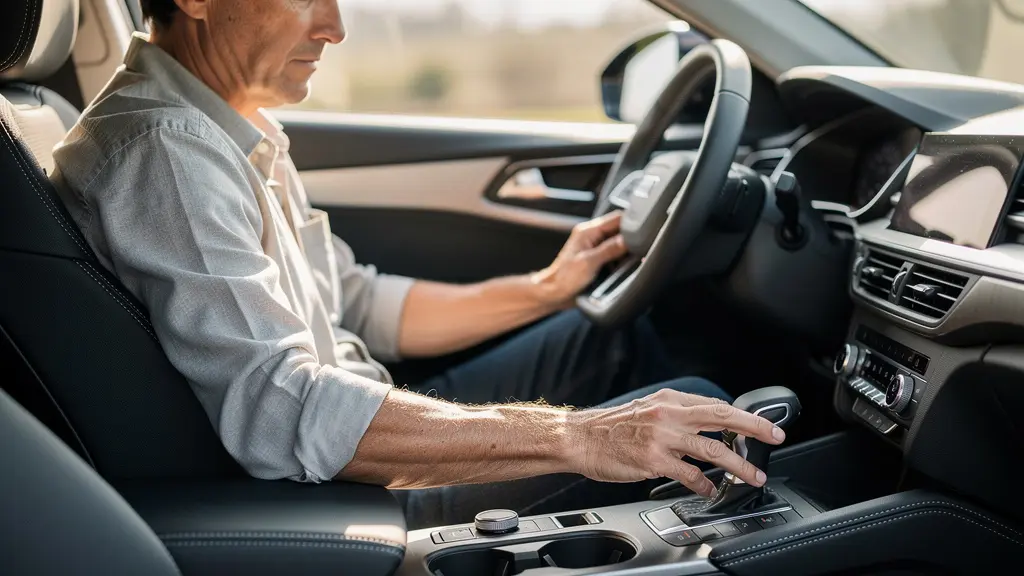
True driving comfort doesn’t come from a single ‘perfect’ seat position, but from creating a dynamic ergonomic system that actively prevents the build-up of postural debt.
- The most common seat adjustments often fail because they overlook secondary pressure points, like the compression of nerves and blood vessels in your thighs and pelvis.
- Ergonomic blind spots, such as your wallet’s position or how you use the clutch and cruise control, are significant hidden causes of chronic pain.
Recommendation: Shift your focus from finding one static setup to a routine of micro-adjustments and targeted counter-posture stretches during every long journey.
For any professional driver or daily commuter, it’s a familiar story: that deep, nagging ache in the lower back that begins as a whisper and becomes a roar after a couple of hours behind the wheel. You’ve likely tried the standard advice—adjusting the backrest, moving the seat forward, fiddling with the lumbar support. Yet, the pain persists. This is because the conventional approach to car seat ergonomics is fundamentally flawed for long-haul drivers. It treats the body as a static object to be propped up, rather than a dynamic system under continuous stress.
The real issue isn’t just about finding one ideal position; it’s about understanding and counteracting the cumulative micro-traumas that driving inflicts on your spine, pelvis, and legs. Every minute spent in a fixed posture, absorbing road vibrations and performing repetitive motions, contributes to a « postural debt » that standard settings can’t resolve. The pressure on your spinal discs, the constant tension in your hip flexors, and the restricted blood flow in your legs are the real culprits.
This guide will shift your perspective from static settings to dynamic ergonomics. We will deconstruct each element of your driving posture, not just to find a comfortable starting point, but to create an active system that protects your body over the long haul. We’ll uncover the ergonomic blind spots you’ve been missing, explain the biomechanics behind why common adjustments fail, and provide a concrete, actionable routine to turn your driver’s seat from a source of pain into a tool for support and endurance.
To navigate this comprehensive guide effectively, the following summary outlines the key areas we will cover. Each section is designed to build upon the last, moving from foundational adjustments to the nuanced strategies that make all the difference on long journeys.
Summary: A Deep Dive into Driving Ergonomics
- External Cushion vs. Integrated Adjustment: What’s the Solution for an Older Car?
- Why Does Raising Your Seat Too High Worsen Pressure on Your Thighs?
- The Wallet Position: The Simple Mistake Causing Your Leg Pain
- Is Heat Really Beneficial for Lumbar Pain While Driving?
- The 3 Stretches to Do at a Rest Stop to Decompress the Spine
- The Manual Gearbox in the City: The Ergonomic Mistake That Tires Your Left Leg
- When Does Cruise Control Actually Make You Use More Fuel (Mountains/Hills)?
- How to Anticipate Dangers on the Road Before They Happen?
External Cushion vs. Integrated Adjustment: What’s the Solution for an Older Car?
For drivers with older vehicles, the lack of modern, multi-directional seat adjustments is a primary source of discomfort. Worn-out foam and sagging seat pans fail to provide the necessary support, forcing your pelvis into a posteriorly tilted position that flattens the natural curve of your lumbar spine. The choice then becomes whether to augment the existing seat with external cushions or to consider more permanent integrated solutions. Each approach has distinct trade-offs in terms of cost, effectiveness, and safety.
External cushions are the most accessible solution, offering targeted support where the original seat fails. A lumbar roll can restore the lower back curve, while a wedge cushion can level the seat base to prevent pelvic tilt. However, their portability and low cost come at the expense of stability and customization. Integrated adjustments, if they can be retrofitted, offer a far superior, safer, and more durable solution, but at a significantly higher cost. This comparative analysis highlights the key differences:
| Feature | External Cushion | Integrated Adjustment |
|---|---|---|
| Cost | $20-80 | $500+ (if retrofitted) |
| Portability | Can transfer between vehicles | Fixed to specific car |
| Customization | Limited to cushion thickness | Multi-directional adjustment |
| Durability | 2-3 years typical | Lifetime of vehicle |
Choosing the right support depends on diagnosing your specific issue. If you feel pressure and aching under your thighs, the seat base has likely sagged and requires a wedge cushion to level your hips. If the pain is centered in your mid-to-lower back, a dedicated lumbar roll is the priority. In many cases, a combination of supports is necessary to rebuild a sound ergonomic foundation in an aging car seat.
Why Does Raising Your Seat Too High Worsen Pressure on Your Thighs?
A common piece of advice is to raise the seat so your hips are level with or slightly above your knees. While well-intentioned, this can lead to a significant ergonomic error if done excessively. Raising the seat too high creates a « waterfall » effect, where the edge of the seat cushion acts as a fulcrum, concentrating your leg’s weight and compressing the sensitive tissues on the back of your thighs. This compression restricts blood flow and can irritate the sciatic nerve, leading to numbness, tingling, and pain that radiates down your leg.
The goal is not to have your legs dangling, but to ensure there is a small, friction-free space between the front of the seat and the back of your knees. As a clinical rule of thumb, ergonomic guidelines recommend maintaining a 2-3 finger gap between the back of your knees and the seat edge. This gap ensures that your circulation is unimpeded and that you can fully depress the pedals without your thighs pressing hard against the seat. The physical therapy practice AmeriCare has documented that training drivers to check this simple two-finger gap is highly effective in reducing thigh pressure and improving comfort on long drives.
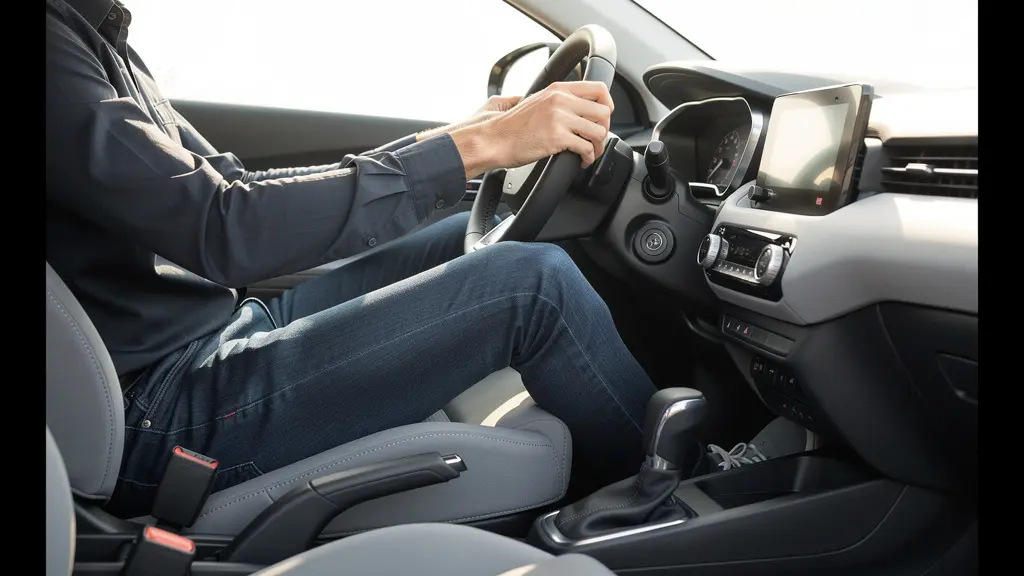
As the illustration demonstrates, the correct height allows your feet to rest comfortably on the floor or pedals while maintaining that crucial gap. Your knees should be at a relaxed, open angle, typically around 90-100 degrees. If your feet can’t comfortably reach the pedals after establishing this gap, you should move the entire seat forward, rather than lowering it and sacrificing the all-important circulation space.
The Wallet Position: The Simple Mistake Causing Your Leg Pain
One of the most overlooked ergonomic blind spots for drivers is the habit of sitting on a wallet. Placing a thick wallet in a back pocket creates an asymmetrical foundation for your pelvis. This seemingly minor imbalance forces one side of your pelvis to be higher than the other, causing a lateral tilt that travels up your spine. Your body then attempts to compensate by curving the spine, leading to muscle strain, joint stress, and significant lower back pain over time. More critically, the wallet can directly compress the sciatic nerve against the pelvic bone.
This condition, sometimes called « wallet neuritis » or piriformis syndrome, creates sharp, radiating pain, numbness, or tingling that can travel from your buttock down the back of your leg. It mimics classic sciatica but is caused by direct, localized pressure. As experts in a study published by the Cureus Journal noted, this is a clear mechanical issue:
Wallet neuritis has been well-described in men; prolonged sitting on the fatty wallet may pose pelvic and gluteal structures including piriformis muscle under exorbitant mechanical strains.
– Dr. MAB Siddiq et al., Cureus Journal – PMC Study on Wallet Neuritis
The solution is simple and immediate: never drive with a wallet in your back pocket. Move it to a front pocket, a jacket pocket, or the car’s center console before you even start the engine. This single change can eliminate a major source of nerve compression and spinal misalignment, and for many, it provides surprisingly rapid relief from chronic leg and hip pain during long drives.
Is Heat Really Beneficial for Lumbar Pain While Driving?
Heated seats can feel like a godsend for a sore lower back, and for good reason. Applying heat increases blood flow to the lumbar muscles, which helps relax tight tissues and reduce the perception of pain. For short-term relief, it’s an effective tool. However, using continuous heat on a long drive can be counterproductive. The constant warmth can mask underlying pain signals, encouraging you to stay in a poor posture for too long. When the muscles are progressively fatiguing, continuous heat can hide the warning signs until the pain becomes severe.
A more therapeutic approach is heat cycling. This involves using the heat intermittently to gain the benefits of muscle relaxation without masking crucial feedback from your body. Dr. Ghalambor’s clinical experience with professional drivers shows that those who cycled heat on and off reported better long-term outcomes than those who left it on continuously. A strategic heat cycling protocol looks like this:
- Apply heat for 15-20 minutes to increase circulation and relax tight muscles.
- Turn the heat off for at least 20 minutes to allow your body to reset and prevent pain masking.
- For acute inflammation, you can alternate heat with a portable ice pack to manage both muscle tightness and swelling.
- Always monitor your pain levels. If pain worsens with heat, discontinue it immediately, as it may indicate an inflammatory issue.
Think of heat not as a constant comfort feature, but as a therapeutic tool to be applied with intention. Combining this cycling strategy with small postural adjustments every hour provides a powerful one-two punch against stiffness and pain.
Key Takeaways
- True driving ergonomics is dynamic; focus on micro-adjustments and active recovery, not a single static position.
- The « two-finger rule » is a critical test to ensure proper seat height and prevent circulation blockage in your thighs.
- Counter-stretches at rest stops are non-negotiable for decompressing the spine and reversing the « postural debt » of sitting.
The 3 Stretches to Do at a Rest Stop to Decompress the Spine
After hours of sitting, your body accumulates significant « postural debt. » Your hip flexors shorten, your chest muscles tighten, and your lumbar spine remains in a state of flexion and compression. Simply walking around at a rest stop is not enough to reverse this. You need to perform targeted counter-posture stretches that actively decompress the spine and lengthen the muscles that have been shortened for hours. This routine should be a non-negotiable part of every long drive, performed at least every 1.5 to 2 hours.

The key is to move your body in the opposite direction of its driving posture. The hip flexor lunge, as shown above, is arguably the single most important stretch for any driver, as it directly counters the hip flexion that is a primary cause of lower back pain. By integrating a few key movements, you can release tension and reset your posture before getting back on the road.
Your Essential Rest Stop Decompression Routine
- Standing Hip Flexor Lunge: Stand beside your car for balance. Step one foot back into a lunge, keeping your back straight. Gently lower your back knee toward the ground and push your hips forward until you feel a stretch in the front of your hip. Hold for 30 seconds on each side.
- Doorway Chest Stretch: Place your forearm on your car’s door frame with your elbow bent at 90 degrees. Gently step forward with the opposite foot until you feel a stretch across your chest and the front of your shoulder. This reverses the forward hunch. Hold for 30 seconds.
- Standing Spine Extension: Stand tall with your feet shoulder-width apart. Place your hands on your lower back for support. Gently and slowly arch your back, pushing your hips forward and looking up toward the sky. Perform 10 slow and controlled repetitions to decompress the lumbar discs.
- Glute Activation Squats: Before getting back in the car, perform 5-10 simple bodyweight squats. This reactivates your gluteal muscles, which tend to « switch off » during prolonged sitting, ensuring they are ready to support your pelvis again.
- Repeat Every Break: Make this quick routine a mandatory ritual at every stop. Consistency is what prevents the cumulative build-up of strain.
This five-minute investment in active recovery is the most powerful tool you have to combat the physical toll of long-haul driving. It actively « repays » the postural debt you’ve accumulated, allowing you to start the next leg of your journey with a reset spine and relaxed muscles.
The Manual Gearbox in the City: The Ergonomic Mistake That Tires Your Left Leg
Driving a manual car, especially in stop-and-go city traffic, introduces a unique ergonomic challenge: repetitive strain on the left leg and hip. Each time you depress the clutch, you engage your hip flexors, glutes, and calf muscles. Done hundreds of times during a commute, this can lead to muscular fatigue, imbalances, and trigger point pain in the left gluteal muscles, which can mimic sciatic pain. A comprehensive meta-analysis reveals that up to 53% of professional drivers experience lower back pain, and repetitive asymmetrical movements are a significant contributing factor.
The most common mistake drivers make is « hovering » over the clutch pedal or keeping it depressed at long traffic lights. This holds the leg muscles under constant isometric tension, restricting blood flow and accelerating fatigue. The solution is to adopt the « Rest at Neutral » technique, giving your leg a break at every opportunity.
- When stopped for more than 3-5 seconds, immediately shift into neutral and release the clutch.
- Place your left foot flat on the « dead pedal » or footrest to the left of the clutch. This allows the hip and leg muscles to fully relax.
- Avoid the habit of « riding the clutch. » Depress it fully and release it smoothly; don’t hold it at a halfway point.
- If stopped for more than 30 seconds, engage the parking brake and take both feet off the pedals completely.
- While waiting, perform small ankle circles to promote circulation in your lower leg.
By consciously moving your foot to the dead pedal at every stop, you break the cycle of constant tension. This small change in habit dramatically reduces the cumulative load on your left leg, preventing the fatigue and muscle imbalances that contribute to lower back and hip pain.
When Does Cruise Control Actually Make You Use More Fuel (Mountains/Hills)?
While the impact of cruise control on fuel consumption in varied terrain is a frequent topic, its effect on your body’s ergonomics is a far more critical and often ignored concern for long-haul drivers. Using cruise control for extended periods can lead to a condition known as « static foot syndrome. » By holding your feet motionless for hours, you severely reduce circulation in your lower legs, leading to stiffness, ankle pain, and a decreased sense of body awareness. A case study by fleet management company Brightmile found that drivers using cruise control for long stretches developed significant stiffness and discomfort, but implementing foot activation drills reduced these complaints by a staggering 40%.
The lack of micro-movements from active pedaling means your calf muscles are not contracting to help pump blood back up to your heart. This stagnation is an ergonomic blind spot that contributes to overall fatigue and discomfort. To counteract this, you must introduce deliberate movement back into the equation, even when cruise control is engaged.
- Ankle Circles: Every 15-20 minutes, perform 10 slow ankle rotations in each direction with both feet.
- Point and Flex: Actively point your toes forward and then pull them back toward your shins. Repeat this 15 times to engage the calf and shin muscles.
- Shift Your Weight: Periodically shift your right foot’s position on the floor, and use the dead pedal to brace and adjust your left leg’s position.
- Disengage and Re-engage: On safe, open stretches of road, briefly disengage cruise control every hour for a few minutes to actively use the pedals. This is a powerful « reset » for your neuromuscular system.
Using cruise control doesn’t have to mean your lower body goes completely dormant. By incorporating these simple activation drills into your routine, you can maintain healthy circulation and prevent the stiffness associated with static foot syndrome.
How to Anticipate Dangers on the Road Before They Happen?
Anticipating road dangers is typically about defensive driving—watching other cars and scanning the horizon. However, for a driver battling chronic pain, the most immediate dangers can be internal. An incorrect posture doesn’t just cause discomfort; it can actively compromise your safety. If your seat is too far back, your reaction time to brake or steer is delayed. If you’re too close, you risk serious injury from the airbag in a collision. Proper ergonomic setup is, therefore, a critical component of road safety.
Your posture directly influences your ability to control the vehicle and react to unexpected events. For instance, safety guidelines specify that a 10-12 inch minimum distance is required between your chest and the steering wheel for the airbag to deploy safely and effectively. Being too close negates its safety function. Furthermore, a posture that causes pain and fatigue is a distraction, reducing your cognitive bandwidth to anticipate external hazards. The safest driver is a comfortable, alert, and well-supported one.
This entire guide has focused on building a dynamic system to manage your body, but the ultimate goal is to eliminate pain as a distraction. If you’ve applied these principles and still suffer from persistent pain, it’s a sign that you may have an underlying issue that requires professional assessment. As Dr. Ghalambor of the NorTex Spine & Joint Institute states, pain is not an inevitability: « Many people assume driving pain is just part of getting older or working long hours. But with proper evaluation, we often find treatable causes. »
Treating your driving posture with the seriousness of a safety system is the final piece of the puzzle. It transforms ergonomics from a comfort issue into a core element of defensive driving, allowing you to focus your full attention on the road ahead.
By consistently applying these advanced ergonomic principles, you can take control of your comfort and safety on the road. If chronic pain continues to be a factor despite these adjustments, it is a clear signal to seek a professional evaluation from a physical therapist or a specialist in pain management to identify and treat the root cause.