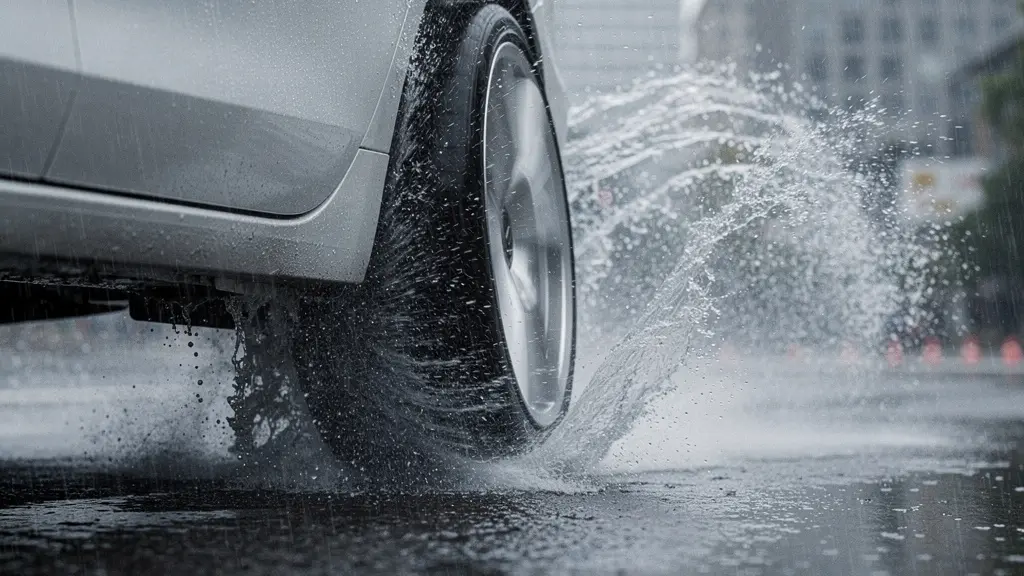
Most drivers instinctively understand they should slow down in the rain, but few grasp the unforgiving physics involved. This isn’t about simple addition; it’s about exponential forces. The doubling of stopping distance is a direct consequence of reduced friction and the laws of kinetic energy, which dictate that a small increase in speed or decrease in grip results in a dramatic, non-linear increase in the energy your brakes must dissipate.
A sudden downpour on the highway. The car in front of you brakes unexpectedly. You hit your own brakes, but there’s a heart-stopping moment where the car seems to glide forward, seemingly ignoring your command. This unnerving experience isn’t a failure of your reflexes; it’s a direct lesson in vehicle dynamics. While most driving advice simply states « double your following distance in the rain, » it rarely explains the brutal physics behind that recommendation. We are conditioned to think in linear terms: a little more speed, a little more braking pressure. The reality is far more dramatic.
As a vehicle dynamics engineer, my perspective is grounded in first principles: friction, mass, and energy. The transition from a dry to a wet road surface is not a minor adjustment; it is a fundamental shift in the physical environment your car operates in. The forces at play don’t just add up; they multiply. Your tires, brakes, and even the weight distribution of your vehicle are all part of a complex system whose performance degrades exponentially when water is introduced.
This article will deconstruct the phenomenon of wet-weather braking. We will move beyond the simple rules of thumb and delve into the core reasons why your car behaves so differently. We will analyze the sequence of events from the moment you perceive a hazard to the final stop, examining how each component of the braking system is compromised by water. Understanding this is not just an academic exercise; it is the key to transforming from a reactive driver, who is a victim of physics, into a proactive driver who uses that knowledge to maintain a constant margin of safety, no matter the weather.
To fully grasp the critical factors that influence your vehicle’s ability to stop, we will break down the science behind each element. This summary outlines the key physical principles we will explore to build a complete picture of wet-weather driving safety.
Summary: The Unseen Physics Behind Your Brakes
- How far have you already traveled before you even hit the brake pedal?
- Why does going from 30 to 40 mph double the risk of death for a pedestrian?
- Worn tires at 2mm vs. new: what’s the braking difference on wet roads?
- Why multiplying your distances by 10 on ice is not an exaggeration?
- How does a car loaded with luggage change your braking point?
- Why changing at 3mm is safer than waiting for the legal limit of 1.6mm?
- Why ‘spongy’ brake fluid is an invisible danger?
- Why the 2-second rule is no longer enough on a wet highway?
How Far Have You Already Traveled Before You Even Hit the Brake Pedal?
The total stopping distance is a sum of two distinct phases: reaction distance and braking distance. Before your car’s brakes can even begin to do their work, your brain must first process a hazard and send a signal to your foot. This cognitive-to-physical process is not instantaneous. According to highway safety research, a driver’s typical reaction time is about 1.5 seconds. While this may sound brief, the distance covered in that time is significant and often dangerously underestimated.
Consider this: at 60 mph (approximately 88 feet per second), your vehicle travels 132 feet—more than the length of a semi-trailer—before your foot even makes contact with the brake pedal. This distance is a fixed cost of human neurology, independent of your car’s condition or the weather. It is a critical, unchangeable part of the stopping equation. In poor visibility conditions, such as heavy rain, your perception time may increase, further extending this reaction distance.
Therefore, the first battle in any emergency stop is fought and lost before the mechanical systems are even engaged. The space cushion you leave in front of your vehicle is not just for the braking itself; a large portion of it is consumed by your own reaction time. Understanding this separates the wishful thinking from the physical reality of driving, forcing an appreciation for maintaining a safe following distance as a buffer against human processing delays.
Why Does Going from 30 to 40 Mph Double the Risk of Death for a Pedestrian?
The relationship between speed and stopping distance is not linear; it is exponential. The primary reason lies in the physics of kinetic energy, defined by the equation E = ½mv², where ‘E’ is kinetic energy, ‘m’ is mass, and ‘v’ is velocity. The crucial element here is that velocity is squared. This means that when you double your speed, you quadruple the kinetic energy that your brakes must dissipate to bring the vehicle to a stop. This quadrupling of energy translates directly to a quadrupling of braking distance, assuming constant friction.
This exponential increase in energy has catastrophic consequences in collisions. The impact forces exerted on an object (or person) are a direct result of this kinetic energy. Research from the AAA Foundation for Traffic Safety shows that a pedestrian hit at 32 mph has a 25% risk of fatality, but this risk doubles to 50% when the impact speed increases to just 42 mph. This is not a linear increase; it’s a terrifying jump in lethality caused by a modest 10 mph increase in speed.

This principle is the single most important concept to understand in vehicle dynamics. Small, seemingly insignificant increases in speed have a disproportionately large effect on the energy you must control. When you choose your speed, you are not just choosing your travel time; you are choosing the amount of kinetic energy you are responsible for, an amount that can quickly overwhelm your vehicle’s braking capacity and turn a near-miss into a tragedy.
Worn Tires at 2mm vs. New: What’s the Braking Difference on Wet Roads?
If kinetic energy is one side of the braking equation, the coefficient of friction is the other. Your tires are the only part of the vehicle in contact with the road, and their ability to maintain grip is paramount. On wet surfaces, this task becomes infinitely more complex. The primary function of the tread pattern on a tire is not for dry grip, but to channel water away from the contact patch, allowing the rubber to connect with the asphalt.
As a tire wears, the depth of these channels decreases, reducing its capacity to evacuate water. When the volume of water on the road exceeds the tire’s ability to clear it, a thin film of water can form between the tire and the road. This is hydroplaning (or aquaplaning), where the tire effectively surfs on the water, losing all directional control and braking ability. The vehicle becomes a projectile, unresponsive to steering or braking inputs.
The performance drop-off is alarming. As tread depth diminishes, the speed at which hydroplaning occurs lowers dramatically. Crucially, even before full hydroplaning, the reduced water-clearing ability significantly lengthens braking distances. Safety research consistently shows that a vehicle with tires at the legal minimum tread depth can take far longer to stop in the wet than one with new tires. In fact, some tests demonstrate a 44% increase in wet braking distance as tires wear down. One comprehensive test even found that worn tires could double the wet stopping distance compared to new ones, a critical failure in an emergency.
Why Multiplying Your Distances by 10 on Ice is Not an Exaggeration
To fully appreciate the role of friction, it’s instructive to examine the most extreme case: ice. While driving on wet roads reduces the coefficient of friction, driving on ice causes it to plummet to near zero. The fundamental principle is the same as in rain, but magnified to a terrifying degree. The microscopic irregularities of the road surface that provide grip are now covered by a smooth, low-friction layer.
The result is a catastrophic loss of braking and steering ability. The advice from the UK Highway Code to increase stopping distances by a factor of ten in icy conditions is not hyperbole; it is a direct reflection of the physical reality. Testing by tire manufacturers like Continental confirms that braking distances on ice can be 5 to 10 times longer than on a dry surface. At 30 mph, a car that stops in 75 feet on a dry road could require up to 750 feet—the length of two and a half football fields—to stop on ice.
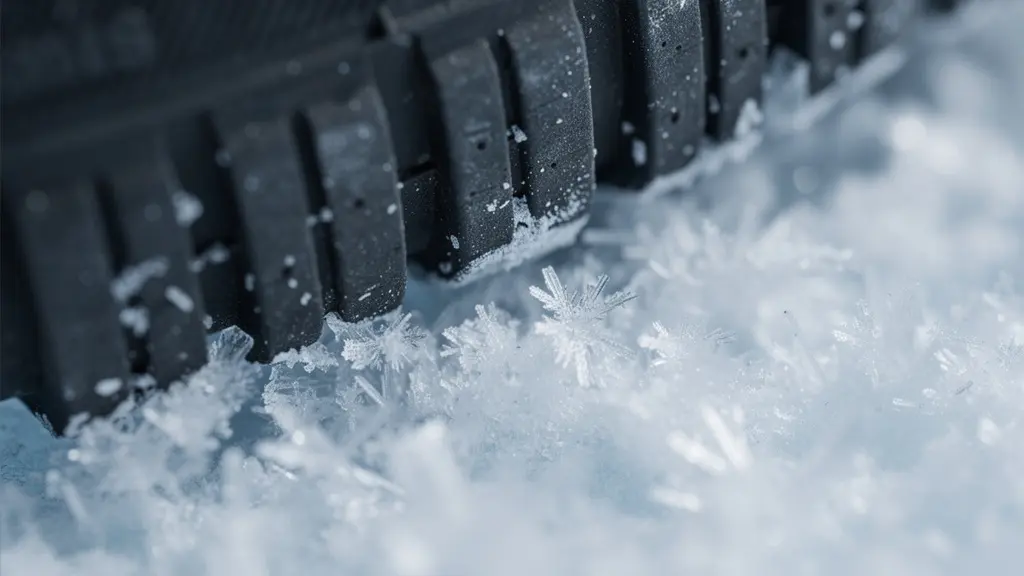
This extreme example serves as a powerful reminder of how dependent we are on the coefficient of friction. The energy of the moving vehicle remains the same, but the force available to counteract it has been drastically reduced. When driving in wet conditions, you are operating on a spectrum of reduced friction. Rain might sit at one end of that spectrum, but as the temperature drops towards freezing, you move closer to the treacherous reality of ice, where the laws of physics leave no margin for error.
How Does a Car Loaded with Luggage Change Your Braking Point?
The third key component in the physics of braking is mass. Newton’s second law of motion (F=ma) tells us that the force (F) required to decelerate a vehicle is a product of its mass (m) and the rate of acceleration (a, or in this case, deceleration). In simpler terms, the more mass a vehicle has, the more force its brakes must generate to stop it in the same distance. Alternatively, if the braking force remains constant, a heavier vehicle will take longer to stop.
This is often overlooked in daily driving. A car carrying a family and a trunk full of luggage for a vacation is significantly heavier than one with only a driver. This added mass increases the vehicle’s inertia—its resistance to a change in velocity. The brakes, designed for a certain operating range, now have to work much harder to dissipate a greater amount of kinetic energy (since E = ½mv², more ‘m’ means more ‘E’).
Vehicle safety studies indicate this is not a trivial effect; a heavily loaded vehicle can experience a 30-50% increase in braking distance. This effect is compounded in wet weather. Not only do you have reduced friction between the tires and the road, but you also have a greater mass pushing the vehicle forward. It’s a double jeopardy scenario: your ability to stop is reduced, while the demand on your braking system is increased. When towing a trailer or carrying heavy cargo, you must mentally adjust your braking points and following distances to account for this increased inertia.
Why Changing at 3mm is Safer Than Waiting for the Legal Limit of 1.6mm
The performance of a tire is not linear throughout its lifespan. The degradation in wet-weather performance accelerates dramatically as the tire approaches the end of its life. While the legal minimum tread depth in many regions is 1.6mm (2/32″), from an engineering standpoint, this should be considered a « fail » limit, not a « safe » limit. The difference in safety between a tire at 3mm and one at 1.6mm is not small; it is a performance cliff.
As we’ve established, tread depth is critical for hydroplaning resistance. Research and testing organizations like Germany’s ADAC have long advocated for replacement at higher tread depths. Their safety research recommends a minimum of 3mm for summer tires and 4mm for winter/all-season tires. Why? Because the rate of water evacuation drops off exponentially in those final millimeters of tread. Safety testing demonstrates that the wet braking distance can increase by as much as 44% when going from a tire with 3mm of tread to one with 1.6mm. This is a massive reduction in the safety margin, occurring precisely when a driver might think they are still « legal » and therefore safe.
Treating the legal limit as a target is a fundamental misunderstanding of risk. The 1.6mm mark is the absolute last line of defense before the tire is considered completely unsafe for public roads. A proactive, safety-oriented approach involves replacing tires when they reach 3mm, preserving a crucial margin of performance for emergency situations in the wet. Waiting until the wear bars are flush with the tread is gambling that you will not encounter a panic-braking scenario in the rain.
Your 5-Point Tire and Brake Safety Audit
- Tread Depth Check: Use a tread depth gauge or the « penny test » to check multiple points across all four tires. Is the depth consistently above 3mm (4mm for winter)?
- Pressure Inspection: Using a reliable gauge, check that all four tires are inflated to the pressure recommended on the vehicle’s door jamb sticker, not the number on the tire sidewall.
- Visual Inspection: Look for cracks, bulges, or uneven wear patterns on the tire sidewalls and tread. Uneven wear could indicate alignment or suspension issues.
- Brake Fluid Level: Visually check the brake fluid reservoir in the engine bay. Is the fluid level between the MIN and MAX marks? Is the fluid color light and clear, or dark and murky?
- Brake Pedal Feel: With the engine off, press the brake pedal. Does it feel firm or does it sink slowly to the floor (« spongy »)? Sponginess indicates potential air or moisture in the system.
Why ‘Spongy’ Brake Fluid is an Invisible Danger
While tires manage the friction with the road, the brake system itself is responsible for converting kinetic energy into heat. This is accomplished via a hydraulic system, and the integrity of that system hinges on one critical, and often neglected, component: brake fluid. Most brake fluids are hygroscopic, meaning they have a natural tendency to absorb moisture from the atmosphere over time. This moisture is an insidious and invisible threat to your braking performance.
The danger lies in the difference in boiling points. Fresh, high-quality brake fluid has a very high boiling point (often over 400°F / 200°C) to withstand the intense heat generated during braking. Water, however, boils at 212°F (100°C). As brake fluid becomes contaminated with moisture, its overall boiling point is significantly reduced. Brake fluid testing shows that a mere 3% moisture content can reduce the boiling point by 25% or more. Under heavy or prolonged braking, this contaminated fluid can boil within the brake lines or calipers.
When the fluid boils, it creates pockets of steam. Unlike liquid, which is incompressible, steam is highly compressible. This leads to the dreaded « spongy » or « soft » brake pedal. The force you apply to the pedal is wasted on compressing the steam bubbles instead of activating the brake pads. In a worst-case scenario, this results in a sudden and total loss of braking power, known as brake fade. The National Highway Traffic Safety Administration (NHTSA) outlines this danger clearly:
Water in the brake lines boils at a much lower temperature than brake fluid. This creates steam, which is highly compressible and leads to sudden loss of braking power.
– National Highway Traffic Safety Administration, Brake Maintenance Guidelines
This is why vehicle manufacturers recommend changing brake fluid at regular intervals (typically every two years), regardless of mileage. It is a maintenance item designed to purge the accumulated moisture and restore the integrity of the hydraulic system, ensuring your brakes are there when you need them most.
Key Takeaways
- Kinetic energy increases with the square of speed, meaning small speed increases have a massive impact on the force your brakes must overcome.
- Tire tread depth is paramount for wet safety; its function is to evacuate water, and its effectiveness drops exponentially as it wears past 3mm.
- Braking is a system: the interaction between driver reaction, speed, tire condition, vehicle mass, and brake system integrity determines your true stopping distance.
Why the 2-Second Rule is No Longer Enough on a Wet Highway
All of the physical principles we’ve discussed—reaction time, kinetic energy, friction, and mass—converge on one practical, actionable behavior: maintaining a safe following distance. The widely taught « two-second rule » is a simplified guideline for dry conditions. It provides a buffer that roughly accounts for your reaction time plus a portion of the vehicle’s braking distance in ideal circumstances. When rain enters the equation, this rule becomes dangerously inadequate.
As stated by Rule 227 of the UK Highway Code, stopping distances in the wet will be at least double those on dry roads. This is a conservative estimate. If your tires are worn or your car is heavily loaded, the distance can be even greater. Therefore, the time gap to the vehicle in front must be adjusted accordingly. If the distance doubles, the time gap must also double. The two-second rule must become, at an absolute minimum, a four-second rule in the rain.
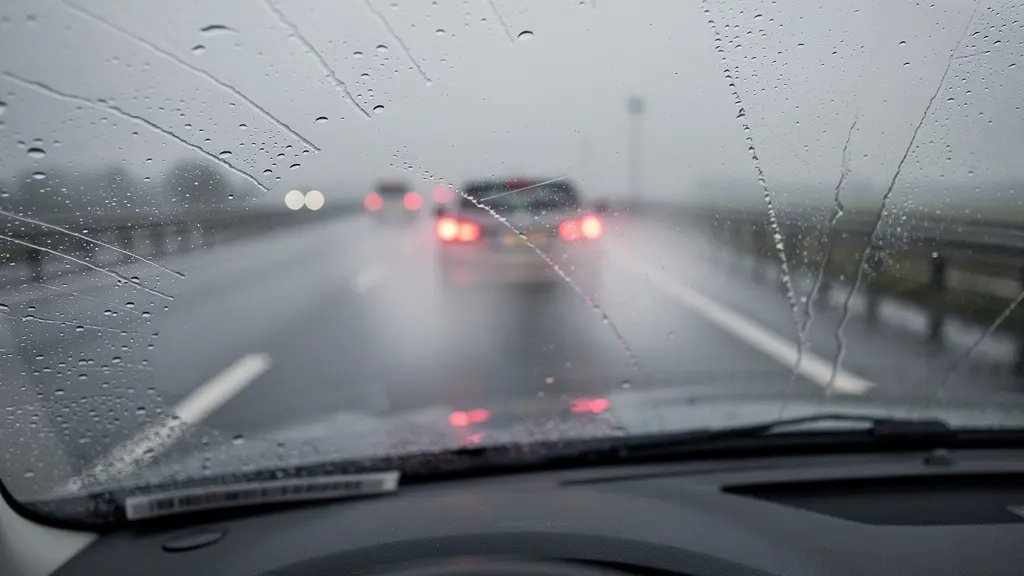
This increased gap serves multiple purposes. First, it directly compensates for the longer braking distance required on a low-friction surface. Second, it provides a larger buffer to account for the increased cognitive load and potentially slower reaction times caused by poor visibility from rain and tire spray. Following too closely in the wet not only reduces your braking margin but also envelops you in the spray cloud of the vehicle ahead, further compromising your ability to perceive hazards. Highway safety experts are clear that the minimum following distance in wet conditions is 4 seconds, and this should be extended further in heavy downpours or when visibility is severely limited.
The next time you drive in the rain, don’t just see the water on the road; see the physics at play. Proactively managing your speed and following distance is not just a suggestion—it is the direct application of physical laws to ensure your safety and that of others. By respecting the energy you control and the friction you have available, you move from being a passenger to being an engineer of your own safety.