
The greatest myth in driving is that safety comes from following rules; in reality, it comes from developing a proactive system of risk management.
- Most collisions are not sudden accidents but the result of a chain of events that an expert driver can interrupt early.
- Anticipation is a skill built on understanding vehicle dynamics, human psychology, and processing visual information far ahead of your current position.
Recommendation: Shift your mindset from simply ‘avoiding mistakes’ to actively ‘controlling the space and time’ around your vehicle.
It’s a feeling every driver knows: a sudden slam of the brakes, a quick swerve, a heart-thumping near-miss that leaves your hands trembling on the steering wheel. In that moment, you feel like a passive victim of circumstance. Most driver education focuses on a set of rigid rules—maintain a two-second gap, check your mirrors, don’t speed. While essential, this advice only teaches you to react. It frames driving as a checklist to be followed rather than a dynamic skill to be mastered. But what if the near-miss wasn’t a random event? What if the clues to that danger were visible 10, 15, or even 20 seconds before it unfolded?
The true key to elite-level safety isn’t about faster reflexes. It’s about slower, more deliberate observation. It’s about transitioning from a reactive motorist into a proactive risk manager. This requires adopting a mental framework—a system of driving—that allows you to see, process, and neutralize hazards long before they become critical threats. This isn’t a secret reserved for police drivers or racing pilots; it’s a trainable mindset. It involves understanding not just the rules of the road, but the physics of your car, the psychology of other drivers, and the art of seeing the whole picture, not just the car in front of you.
This guide will deconstruct that system. We will move beyond the platitudes and explore the specific, actionable techniques that form the foundation of advanced hazard perception. We will break down how to read the road like a professional, manage your space in complex traffic, and develop the cognitive skills to stay ahead of the unfolding traffic situation, ensuring that you are always the one in control.
To help you master this proactive approach, this article breaks down the core components of advanced hazard perception. The following sections provide a structured path to transform your awareness and decision-making on the road.
Table of Contents: A Guide to Proactive Driving
- Why the 2-second rule is no longer enough on wet highways?
- How to look ‘far ahead’ to avoid sudden braking?
- How to react to an aggressive driver without escalating the conflict?
- The deadly positioning error next to a truck turning left
- When to check your mirrors: the sequence 80% of drivers forget
- À quelle distance avez-vous déjà parcouru avant même de toucher la pédale de frein ?
- Why does your car brake by itself with no visible obstacle?
- What are the new rules of the Highway Code that could you get you a fine?
Why the 2-second Rule Is No Longer Enough on Wet Highways?
The « two-second rule » is one of the first things taught in driver’s education, but it is fundamentally designed for ideal, dry conditions. When rain begins to fall, the entire dynamic of road safety changes. The friction between your tires and the asphalt is dramatically reduced, making your vehicle’s behavior far less predictable. The most dangerous phenomenon is hydroplaning, where a layer of water builds up between the tires and the road surface, leading to a complete loss of steering and braking control. According to Federal Highway Administration data, nearly 1 million accidents occur each year on wet pavements in the US alone, leading to thousands of fatalities.
This is not a rare event. Hydroplaning can occur at speeds as low as 35 miles per hour if there is enough water on the road—as little as one-tenth of an inch. At typical highway speeds of 55 mph or more, the risk becomes severe. The crucial takeaway is that in wet weather, your stopping distance will be at least double what is required on a dry road. In icy conditions, this can increase to ten times greater. Therefore, the two-second rule becomes obsolete. Advanced and defensive driving institutes universally teach a minimum of a four-second gap in the rain. This extended buffer is not a suggestion; it’s a physical necessity to give you the time and space to react to unforeseen events without losing control.
This isn’t about being overly cautious; it’s about respecting physics. The extra space is your primary safety system, compensating for reduced tire grip and increased stopping distances. It gives you the capacity to brake smoothly and early, avoiding the sudden, hard applications that can easily initiate a skid on a slippery surface.
Your Pre-emptive Wet Weather Driving Audit
- Tire Check: Before driving in rain, are my tires properly inflated? Is the tread depth well above the legal minimum? Worn or underinflated tires are the number one cause of hydroplaning.
- Speed Adjustment: Am I consciously reducing my speed by 5-10 mph from the posted limit as soon as the road is wet, not just when the rain is heavy?
- Space Cushion Management: Have I actively doubled my following distance from two seconds to at least four? I will count « One-thousand-and-one, one-thousand-and-two, one-thousand-and-three, one-thousand-and-four » as the car ahead passes a fixed point.
- Input Smoothness: Am I making all my steering, braking, and acceleration inputs deliberately smooth and gentle to avoid upsetting the car’s balance?
- Hazard Scanning: Am I looking for signs of standing water, heavy spray from other vehicles, and shaded areas where ice might form first?
Adopting this four-second rule is the first step in shifting from a rule-follower to a risk manager who adapts to the environment.
How to Look « Far Ahead » to Avoid Sudden Braking?
Many drivers believe they are looking ahead, but in reality, their focus is fixed on the brake lights of the car directly in front of them. This is a recipe for reactive, last-minute braking. True hazard perception involves a systematic process of visual scanning that keeps your brain several steps ahead of the traffic. Professional driving coaches recommend a technique where you constantly scan at least 12 to 15 seconds ahead of your vehicle. At 60 mph, 15 seconds is a quarter of a mile down the road. This isn’t about seeing every detail; it’s about gathering information and identifying potential conflicts before they develop.
This « long-distance gaze » allows you to see the bigger picture. You’ll notice traffic slowing two or three cars ahead, a pedestrian considering stepping into the road, or a traffic light changing far in the distance. This information gives you the most valuable commodity a driver has: time. With time, you can ease off the accelerator, cover your brake, and slow the vehicle down smoothly and gradually, often without needing to brake hard at all. This not only improves safety but also leads to a much smoother, more fuel-efficient, and less stressful driving experience.
To implement this, practice a three-point gaze technique: your far point (12-15 seconds ahead), your mid-point (the immediate traffic flow), and your instrument panel. Your eyes should be constantly moving between these points, feeding your brain a continuous stream of information. This visual scanning should be paired with frequent mirror checks (every 5-8 seconds) to maintain full 360-degree situational awareness.
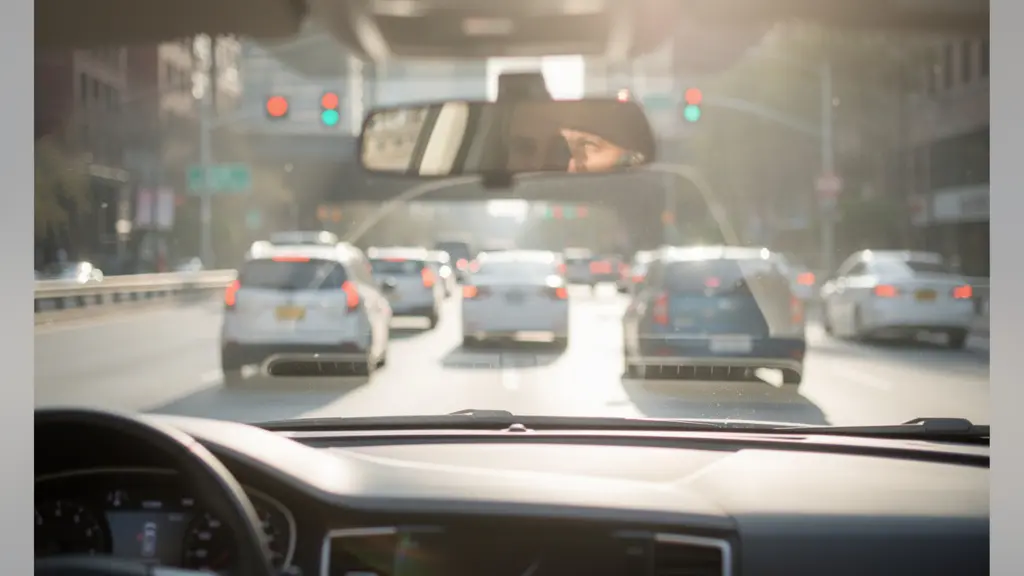
As the image illustrates, this is not a random glance but a structured method of observation. You are actively searching for changes in traffic patterns, potential entry points for other vehicles, and any visual cues that suggest a change in conditions. This proactive scanning is what allows an expert driver to « read » the road and appear to have a sixth sense for danger.
By training your eyes to look further ahead, you are no longer just steering the car; you are managing the unfolding future.
How to React to an Aggressive Driver Without Escalating the Conflict?
Encountering an aggressive driver—one who tailgates, weaves erratically, or gestures angrily—can be one of the most stressful situations on the road. The instinctive human response is often fight or flight: either retaliate with your own aggressive maneuver or become flustered and make poor decisions. A defensive driving expert does neither. The primary goal is to de-escalate and disengage. Your ego has no place in the driver’s seat; your safety is the only priority.
The key is to remove yourself from the aggressive driver’s sphere of influence as calmly and safely as possible. If someone is tailgating you, do not « brake check » them. Instead, maintain your speed and, when safe, move into an adjacent lane to let them pass. Avoid making eye contact or any gestures, as this can be interpreted as a challenge and escalate the situation into a road rage incident. You are not trying to « win » the encounter or teach them a lesson; you are simply choosing to remove a hazard from your immediate environment.
Discourteous behaviors like tailgating, aggressive lane changes, and improper signaling often cascades into road rage. Defensive driving means keeping cool under frustration and setting a positive example through safe – and considerate – operating habits.
– Coreway Driving School NYC, Rules of Defensive Driving Guide
This approach breaks the feedback loop that aggressive drivers often seek. They are looking for a reaction, and by refusing to provide one, you neutralize the situation. If you ever feel genuinely threatened or the other driver’s behavior becomes relentlessly hostile, your next move is to drive to a safe, well-lit, and populated area like a shopping center, or directly to a police or fire station. Do not drive home, as this could lead the aggressor to your personal space. Your car is a tool for transport, not a weapon for confrontation.
Ultimately, the most powerful move you can make is to let them go and focus on your own journey, preserving your safety and peace of mind.
The Deadly Positioning Error Next to a Truck Turning Left
Sharing the road with large commercial trucks requires a specific set of defensive driving skills. Their sheer size and weight create operational limitations that many car drivers fail to appreciate, particularly concerning blind spots. These are not small areas; they are vast zones around the truck where the driver is completely « blind. » According to the National Highway Traffic Safety Administration, nearly 840,000 blind spot accidents occur each year in the United States, resulting in 300 deaths. A fundamental rule of thumb is: if you can’t see the truck driver’s face in their mirrors, they cannot see you.
One of the most common and dangerous mistakes is misjudging a truck’s turning radius. A large truck making a turn—especially a left turn across traffic—often needs to swing wide. A car driver positioned too close on the inside of that turn can easily be sideswiped or crushed. Truck drivers have no visibility in these specific zones during a turn. Lingering in a truck’s blind spot, or « No-Zone, » is one of the highest-risk behaviors a car driver can engage in. It’s crucial to understand where these zones are and to pass through them decisively, never loitering alongside a truck.
The following table, based on an analysis from truck accident lawyers, breaks down the four primary No-Zones, highlighting why the right side is particularly dangerous.
| Blind Spot Location | Distance/Coverage | Danger Level |
|---|---|---|
| Front (No-Zone) | 20 feet in front of the cab | High – Driver sits too high to see close vehicles |
| Rear | Almost 200 feet from the back | Very High – No rearview mirror |
| Left Side | One lane, halfway down trailer | Medium – Driver sits on this side |
| Right Side | Entire length of the trailer | Extremely High – Largest blind spot |
This data reveals that the blind spot on the right side of the truck extends across two lanes and runs the entire length of the trailer. This is why overtaking a truck on the right is exceptionally hazardous. The safest practice is to always give trucks ample space, anticipate their turns, and pass them on the left quickly and decisively, ensuring you are visible in their mirrors before and after your maneuver.
Treating a truck’s blind spots with the same respect you would treat a solid wall is a hallmark of a true defensive driver.
When to Check Your Mirrors: The Sequence 80% of Drivers Forget
Most drivers check their mirrors when they are about to change lanes, but this is a reactive and often incomplete use of a critical safety tool. An advanced driver uses their mirrors as part of a continuous loop of information gathering, not just for a specific maneuver. The goal is to build and maintain a « mental map » of the traffic around you at all times. This is why driving instructors recommend a routine scan of your interior and side mirrors every 5 to 8 seconds. This may sound excessive, but it quickly becomes an unconscious habit that provides constant situational awareness.
Beyond this regular scan, there are specific triggers that should prompt an immediate mirror check. These are moments when the traffic situation is likely to change. By integrating these checks into your driving, you will rarely be surprised by another vehicle. The key is to check your mirrors before you act, not during or after.
The most effective drivers follow a trigger-based protocol for mirror checks. This moves beyond simple habit and into a systematic approach to safety:
- Check BEFORE you brake: This is arguably the most forgotten check. Knowing what is behind you before you slow down is crucial to avoid being rear-ended.
- Check BEFORE changing speed (up or down): This gives you information on whether you have a safe space cushion.
- Check BEFORE cresting a hill or entering a sharp curve: Visibility ahead is limited, so you need to know what’s behind you.
- Check BEFORE and AFTER changing lanes: The « after » check confirms your maneuver was completed safely and updates your mental map.
- Check WHILE stopped in traffic: Watch for approaching vehicles from the rear that may not be stopping in time, giving you a precious moment to take evasive action if possible.
This systematic approach ensures that you are never « driving blind. » Your mirrors are your eyes in the back of your head, and using them proactively is a non-negotiable part of the defensive driving system. It turns them from a simple tool for a single maneuver into a constant source of strategic information.
This habit transforms driving from a series of isolated actions into a fluid and aware process.
How Far Have You Already Traveled Before You Even Touch the Brake Pedal?
When a hazard suddenly appears, most people think of stopping distance only in terms of how long it takes the car to brake. But there is a critical, « invisible » distance the car covers before your foot even makes contact with the brake pedal. This is the total reaction distance, and it’s much longer than you think. For an average, alert driver, the total time to perceive a hazard, recognize it as a threat, and physically move their foot to the brake is about 1.5 seconds. This may not sound like much, but at 60 mph, your car travels 88 feet per second.
This means that during that 1.5-second reaction time, your vehicle travels 132 feet (about 40 meters)—roughly the length of three semi-trailers—before you even begin the process of braking. You have covered this massive distance completely out of control, coasting toward a hazard while your brain and body catch up. This « blind distance » is a sobering reality of human reaction time, and it’s why leaving a large space cushion is not just a good idea but a law of physics. This distance is the bare minimum for a driver who is alert, sober, and not distracted.
The total reaction time can be broken down into three distinct stages:
- Perception Time: The time it takes for your eyes to see the hazard and send a signal to your brain (approx. 0.5 seconds).
- Cognition Time: The time your brain takes to process the signal, identify it as a hazard, and decide on a course of action (approx. 0.5 seconds).
- Reaction Time: The time it takes to physically execute the decision by moving your foot from the accelerator to the brake pedal (approx. 0.5 seconds).
If you are tired, distracted, or under the influence, these times can easily double or triple, extending that blind distance to catastrophic lengths. This is why the 12-15 second visual lead time is so critical; it gives your brain a head start, often allowing you to bypass this entire emergency reaction process in favor of a calm, controlled deceleration.
This knowledge is the ultimate justification for maintaining a large following distance and practicing proactive scanning at all times.
Why Does Your Car Brake by Itself With No Visible Obstacle?
Modern vehicles are increasingly equipped with Advanced Driver Assistance Systems (ADAS), including Automatic Emergency Braking (AEB). These systems use a combination of radar and camera sensors to monitor the road ahead and are designed to automatically apply the brakes if they detect an imminent collision. While these systems are proven lifesavers, many drivers have experienced unnerving « phantom braking » events, where the car brakes sharply for no apparent reason. This is not necessarily a malfunction, but a limitation of the current technology.
AEB sensors are programmed to interpret data and identify threats, but they can be confused by a variety of real-world conditions that mimic a genuine hazard. These false positives can be triggered by a number of environmental factors. Common culprits include:
- Sharp shadows under bridges or overpasses, which the system can misinterpret as a solid object.
- Steel plates or manhole covers on the road, which can create strong radar reflections.
- Steam rising from manholes or exhaust from a vehicle in a cold environment.
- Sharp curves in the road, where the radar may briefly detect a guardrail or a car in an adjacent lane as being directly in its path.
- Adverse weather, like heavy rain or snow, which can interfere with sensor readings.
It’s important for drivers to understand that while these systems are powerful aids, they are not infallible. The driver is, and always will be, the ultimate person in charge of the vehicle. If a phantom braking event occurs, the standard procedure is to press the accelerator pedal firmly. This action is designed to override the AEB system and signals to the car that the driver’s input takes precedence. Always consult your vehicle’s owner’s manual to understand the specific characteristics and override procedures for your car’s ADAS features. Knowing how your car’s « electronic eyes » see the world is a new and essential part of modern defensive driving.
This knowledge allows you to remain the confident commander of your vehicle, using technology as an assistant, not a replacement for your own judgment.
Key Takeaways
- In wet conditions, the 2-second rule is insufficient; a minimum of a 4-second following distance is required to compensate for doubled stopping distances.
- Proactive driving means scanning 12-15 seconds ahead to identify potential hazards, giving you time to react smoothly instead of braking suddenly.
- Trucks have massive blind spots (« No-Zones »), especially on their right side; never linger alongside them and always ensure you are visible in their mirrors.
What Are the New Rules of the Highway Code That Could Get You a Fine?
The rules of the road are not static. Laws and regulations evolve to reflect new technologies, changing traffic patterns, and a greater understanding of road safety. A proactive driver has a responsibility to stay current with these changes, as ignorance is no defense against a fine or, worse, causing an accident. For example, recent updates to the UK’s Highway Code introduced a « hierarchy of road users, » a principle that is gaining traction globally. This formally places the greatest responsibility on those who can do the most harm. In practice, this means drivers of cars and trucks have a higher duty of care to protect vulnerable road users like pedestrians, cyclists, and motorcyclists, especially at junctions.
This shift means that in a potential conflict between a car turning and a cyclist going straight, the onus is now more explicitly on the driver to see and yield to the cyclist. Failing to do so is not just poor practice; it’s an offense. This legal evolution is coupled with a technological one: the rise of « smart enforcement. » Municipalities are increasingly using AI-powered cameras that can automatically detect a wide range of infractions beyond simple speeding. These systems can identify mobile phone use, seatbelt violations, and illegal occupancy of bus or carpool lanes, issuing tickets automatically.
The proliferation of this technology means that the chances of being caught for a momentary lapse in judgment have increased exponentially. It reinforces the need for constant vigilance and adherence to the rules, not just when a police car is in sight. Being a defensive driver in the modern era means understanding both the written and unwritten rules of the road, and recognizing that technology is making the environment less forgiving of mistakes. It is your responsibility to seek out and understand changes to traffic laws in your specific jurisdiction, as they directly impact your legal obligations and financial liabilities.
Making a commitment to continuous learning is the final, essential pillar of a comprehensive defensive driving system. Your journey to becoming a safer, more skilled driver begins with the decision to adopt this proactive mindset today.
Frequently Asked Questions on Modern Vehicle Safety Systems
Why do AEB systems sometimes brake for no apparent reason?
Automatic Emergency Braking sensors can misinterpret non-threatening objects like shadows under bridges, specific road markings, or adverse weather conditions like heavy rain or steam as genuine obstacles, triggering a false braking event.
What’s the difference between radar and camera detection?
Blind spot monitoring and other ADAS systems use a combination of sensors and cameras to monitor the vehicle’s surroundings. Radars are excellent for detecting the distance and speed of objects, while cameras are better at recognizing shapes and context (like lane markings). Some advanced systems fuse this data and may have the ability to automatically apply brakes or adjust steering to avoid collisions.
Can I override automatic braking if it’s a false alarm?
Yes, in almost all vehicles, firmly pressing the accelerator pedal is the designed method to override an unwanted automatic braking event. This signals to the car’s computer that the driver is aware and in control. However, you should always check your specific vehicle’s manual for the exact instructions.