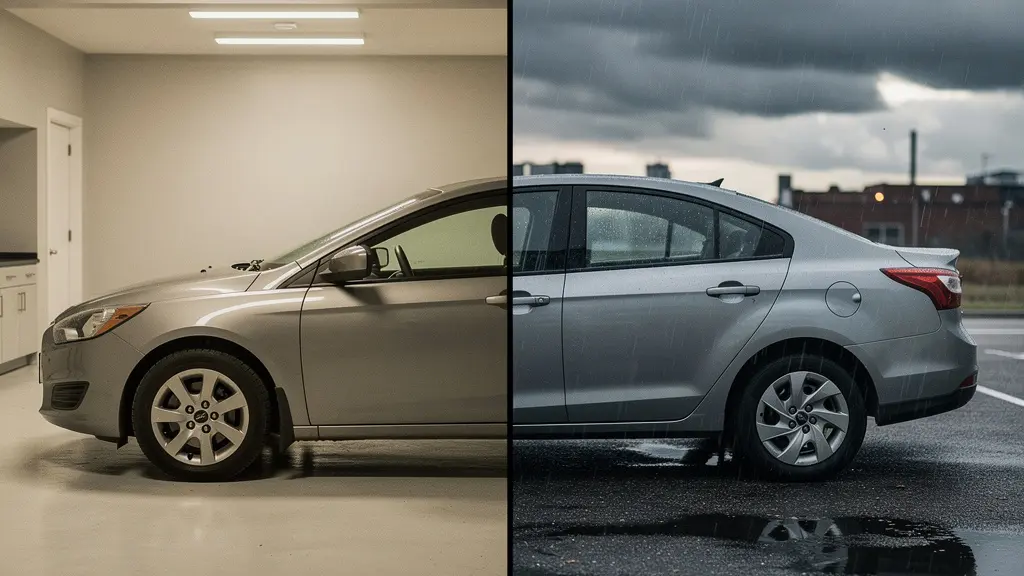
Contrary to popular belief, keeping comprehensive insurance on an older car isn’t a safety net; it’s often a financial trap filled with coverage gaps and hidden costs.
- Small claims for theft or vandalism can trigger premium hikes that cost more than the repair itself over time.
- « Guaranteed » perks like rental car coverage often expire before a theft claim is even settled, leaving you to pay out of pocket.
Recommendation: Instead of paying for a false sense of security, redirect your premium savings into a dedicated « self-insurance » fund to gain true financial control over your vehicle’s risks.
As your car ages past its eighth year, a familiar question arises: is it time to drop comprehensive insurance? The conventional wisdom revolves around a simple calculation: comparing the premium cost to the car’s depreciating value. You might hear about the « 10% rule, » check the Kelley Blue Book value, and weigh the pros and cons. This conversation, however, often misses the most critical point. The decision isn’t just about saving a few hundred dollars a year. It’s about understanding that « full coverage » is often a misleading term, a financial security blanket that’s thinner than you think.
Many owners hold onto comprehensive coverage out of a fear of the unknown: a major hailstorm, a tree falling on the car, or worst of all, theft. What they fail to account for are the numerous « financial dead zones »—scenarios where the policy either doesn’t apply, the deductible makes a claim pointless, or filing a claim creates a long-term financial penalty through increased premiums. This creates a dangerous illusion of protection, where you pay for peace of mind you don’t actually have.
This guide takes a different approach. Instead of just asking *if* you should drop the coverage, we will explore *why* it often makes strategic sense. The real goal is to shift from being a passive premium-payer to an active risk manager. We will dissect the common myths and hidden costs associated with comprehensive policies for older vehicles, revealing the scenarios where your insurance is least likely to help you. By understanding these limitations, you can make an informed choice and structure a financial strategy that provides genuine security, not just the illusion of it.
text
To guide you through this financial decision, we will break down the key scenarios and calculations you need to consider. This structured analysis will help you assess your policy’s true value and decide on the most logical path forward.
Summary: Is Comprehensive Insurance a Waste on an Older Car?
- Franchise élevée et prime basse : le pari est-il gagnant en cas d’accident ?
- Pouvez-vous vraiment conduire la voiture d’un ami avec votre assurance tous risques ?
- Vol de sac ou d’ordinateur : votre assurance auto vous rembourse-t-elle vraiment ?
- Véhicule de courtoisie garanti : pourquoi vous retrouvez-vous à pied après un vol ?
- Rayure de clé sur le parking : déclarer ou payer de sa poche ?
- Le seuil psychologique des 60 000 miles : vendre avant ou après ?
- Quelle certification (Thatcham S5/S7) votre assureur exige-t-il pour couvrir le vol ?
- Comment structurer votre police d’assurance pour ne payer que ce qui est nécessaire ?
Franchise élevée et prime basse : le pari est-il gagnant en cas d’accident ?
The most common advice for owners of older cars is to perform a simple break-even analysis. The general rule of thumb suggests that you should consider dropping comprehensive coverage if the annual premium plus the deductible exceeds 10% of your car’s Actual Cash Value (ACV). For example, if your car is worth $4,000, your annual comprehensive premium is $500, and your deductible is $1,000, the total cost ($1,500) is 37.5% of your car’s value. Financially, paying for a repair that could totalize the car yourself makes more sense.
This calculation is the logical starting point. However, it’s crucial to view this not just as a math problem, but as a strategic bet. By opting for a high deductible to lower your premium, you are betting that you won’t have a major incident. But for an older car, the odds shift. A minor collision or a hailstorm can easily result in a repair bill that exceeds the vehicle’s ACV, leading the insurer to declare it a total loss. In that scenario, your payout is the car’s low value minus your high deductible, a sum that is often shockingly small and insufficient to purchase a replacement vehicle.

As the image above illustrates, this is a decision rooted in calculation. A key analysis from financial experts confirms the tipping point: you should seriously question your coverage if premiums cost more than 10% of your car’s value. The real question then becomes: are you paying for meaningful protection, or are you just prepaying for a minor discount on an inevitable financial loss? For many, the premium money is better directed into a personal savings fund dedicated to automotive emergencies.
Pouvez-vous vraiment conduire la voiture d’un ami avec votre assurance tous risques ?
One of the pervasive myths about auto insurance is that your policy follows you, no matter what car you drive. While your liability coverage often does, comprehensive and collision do not. This creates a significant blind spot when you borrow a friend’s car, especially if they, like you, have an older vehicle and have already dropped their own comprehensive coverage. If you get into an accident and are at fault, or if the car is damaged in a hit-and-run, there is simply no policy to cover the damage to the vehicle you are driving.
This exposes both you and the car’s owner to significant financial risk. As an insurance expert clarifies, the hierarchy of coverage is often misunderstood.
While the car’s insurance is typically primary, if you’ve dropped comprehensive, there is NO primary coverage for damage to your car
– Rachael Brennan, Policygenius Auto Insurance Guide
The consequences extend beyond the immediate repair costs, creating a ripple effect that can damage relationships and finances for years.
The Hidden Liability of Permissive Use
When a friend borrows an 8-year-old car that lacks comprehensive coverage, the owner faces a dual risk. First, their friend’s driving record could impact their future premiums, even if the friend is at fault. Second, there is zero coverage for any damage to the vehicle. In a documented case, a car owner saw their premiums increase by 20% for three years after a friend’s at-fault accident. This amounted to an extra $1,800 in costs over three years, on top of the completely uncovered damage to their car.
This scenario underscores a crucial point: the decision to drop comprehensive coverage has implications beyond just your own vehicle. It requires a new level of awareness and communication when borrowing or lending a car.
Vol de sac ou d’ordinateur : votre assurance auto vous rembourse-t-elle vraiment ?
A common justification for keeping comprehensive insurance is protection against theft. While it does cover the theft of the car itself, it provides almost no meaningful protection for personal items stolen from inside the vehicle. This is one of the most significant « financial dead zones » in a standard auto policy. Your car insurance is designed to cover the car, not its contents. That expensive laptop, camera, or work equipment stolen from your back seat falls under your home or renter’s insurance policy, not your auto policy.
The problem is compounded by deductibles. Both your auto and home insurance policies have them. If a thief breaks your window (a $300 repair) and steals your $1,200 laptop, you face a dilemma. The window repair is likely below your comprehensive deductible, so you’ll pay out of pocket. The laptop is covered by your homeowner’s policy, but if that deductible is $1,000, you’ll only get $200 back. Filing two separate claims is often not worth the hassle or the potential impact on your premiums.
This table illustrates the coverage gap where neither policy provides a real solution. Even worse, filing a claim for a minor theft can have long-term financial consequences. Data shows that filing even small theft claims can increase premiums by 10-20% for up to three years, a concept known as « premium leakage. » This penalty can quickly outweigh the value of the stolen item.
| Item Stolen | Auto Insurance Coverage | Home/Renters Coverage | Typical Gap Amount |
|---|---|---|---|
| $1,200 Laptop | $1,000 deductible applies | $1,000 deductible applies | $1,200 uncovered |
| $800 Camera | Not covered (below deductible) | Not covered (below deductible) | $800 uncovered |
| $2,500 Professional Equipment | $1,000 deductible + premium increase | May exceed sub-limits | $500-1,500 gap |
The takeaway is clear: comprehensive insurance creates a false sense of security regarding your personal belongings. The protection is minimal at best and can be financially punitive at worst.
Véhicule de courtoisie garanti : pourquoi vous retrouvez-vous à pied après un vol ?
Rental reimbursement is an inexpensive add-on that feels like a no-brainer. For a few dollars a month, your insurer promises to provide a courtesy car if yours is in the shop or, in the worst-case scenario, stolen. However, this « guarantee » is another area where the fine print creates a serious financial dead zone, particularly after a vehicle theft. The protection you paid for often runs out just when you need it most.
The core issue is a mismatch in timelines. Most rental reimbursement policies cap your coverage at a set number of days, typically between 14 and 30. While this is usually sufficient for standard repairs, a theft claim is a different beast. The process involves filing a police report, waiting for an initial investigation period (insurers won’t act immediately in case the car is recovered), and then navigating the insurer’s own fraud investigation and settlement process. This entire timeline can easily stretch from 21 to 45 days.

The result is a coverage gap. Your 14-day rental coverage expires, but your claim is still weeks away from being paid out. You are left without a car and without the rental you were promised, forcing you to pay daily rental fees of $40-$60 out of your own pocket. This gap can add up to hundreds of dollars, an unexpected cost at a stressful time.
The Rental Coverage Trap for Stolen Vehicles
The typical theft claim process takes 21-45 days from police report to final settlement. With most rental reimbursement policies capping coverage at 14-30 days, owners of stolen vehicles frequently face a ‘dead zone.’ During this period, rental coverage expires before the insurer completes their investigation and payout, leaving them to cover $40-$60 in daily rental costs out of pocket during the gap.
A smarter approach for an older car owner is to « self-insure » for this risk. By taking the $60-$120 saved annually on the rental rider and placing it in a dedicated high-yield savings account, you can build a flexible transport fund that you control completely, without arbitrary time limits.
Rayure de clé sur le parking : déclarer ou payer de sa poche ?
It’s a frustratingly common scenario: you return to your car to find a deep key scratch down the side. Your first instinct might be to call your insurance company—after all, this is what comprehensive coverage is for. However, for an older car, filing a claim for cosmetic damage like this is often one of the worst financial decisions you can make. It’s a classic example of « premium leakage, » where a short-term payout leads to long-term financial pain.
Let’s break down the math. A body shop might quote you $800 for the repair. If your deductible is $500, you’ll save $300 by filing a claim. That seems reasonable, but it ignores the hidden cost. Insurers view policyholders who file frequent, small claims as higher risk. Even a single « no-fault » claim for vandalism can trigger a premium increase of 10-20% that lasts for three to five years. If your total annual premium is $1,200, a 10% increase is $120 per year, or $360 over three years. Suddenly, your $300 « savings » has turned into a $60 net loss, not to mention the time and hassle of the claims process.
This is because insurers have found that drivers who file multiple small claims are statistically more likely to file larger ones in the future, marking them as a higher risk. For the owner of an aging vehicle, whose value is diminishing, it makes far more sense to treat minor cosmetic damage as a standard running cost. Either live with the scratch or pay for the repair out of pocket from the money you’ve saved by not over-insuring your car.
Your Action Plan: The True Cost Calculator for a Cosmetic Damage Claim
- Get the Quote: Document the full repair estimate from a reputable body shop (e.g., $800 for a key scratch).
- Note Your Deductible: Identify your current comprehensive deductible from your policy documents (e.g., $500).
- Research the Penalty: Research the average premium increase for a vandalism claim with your insurer (a 10-20% increase for 3-5 years is a typical benchmark).
- Calculate the Long-Term Cost: Multiply your current premium by the expected percentage increase and then by the number of years the surcharge will apply (e.g., $1,200 premium x 10% x 3 years = $360).
- Compare and Decide: If the initial repair cost is less than your deductible plus the total premium increases, paying out of pocket is the smarter financial move.
This simple audit transforms the decision from an emotional reaction into a calculated business choice, protecting your long-term financial health.
Le seuil psychologique des 60 000 miles : vendre avant ou après ?
The mileage on your car’s odometer is more than just a number; it’s a critical data point for your insurer that directly influences your premiums. While factors like age and driving record are important, crossing certain mileage thresholds can trigger significant rate adjustments. This is because insurers correlate high mileage with increased wear and tear and a higher probability of both mechanical failure and total-loss accidents. For the strategic owner, these insurance rate hikes can serve as a powerful market signal.
Insurers often re-evaluate risk in large brackets. While there isn’t one universal « magic number, » the range between 50,000 and 70,000 miles is often a critical re-pricing point. This is particularly true for high-mileage drivers, as data shows that driving over 20,000 miles per year can result in premiums up to 36% higher than for low-mileage drivers. When you receive a renewal notice with a sharp, unexplained jump in your comprehensive premium, it’s not arbitrary. It’s a sign that your insurer’s algorithm has flagged your vehicle as having crossed a significant risk threshold.
Using Premium Spikes as a Market Sell Signal
An analysis of insurance renewal patterns reveals that insurers frequently increase comprehensive premiums sharply between 50,000-70,000 miles, reflecting a higher total loss probability. When the owner of a 2017 Honda Accord saw their comprehensive premium jump by 25% at the 65,000-mile mark despite having no claims, it was a clear signal. The insurer’s risk model had determined the car was now a worse bet. This signal coincided precisely with the period when the vehicle’s trade-in value was at its peak, just before the steepest part of its depreciation curve.
Instead of just begrudgingly paying the higher rate or dropping coverage, the savvy owner should interpret this as a message from the market. Your insurer, with its vast datasets, is telling you that your car has entered a new, riskier phase of its life. This may be the optimal moment to sell or trade in the vehicle, maximizing its value before both its resale price and its insurability decline further.
Quelle certification (Thatcham S5/S7) votre assureur exige-t-il pour couvrir le vol ?
While dropping comprehensive coverage is a sound strategy for many older cars, it leaves one major risk on the table: theft. If your car is stolen, you are left with a total loss and no insurance payout. For owners who live in high-theft areas or own models that are popular with thieves, this risk can be too significant to ignore. The strategic solution is not to blindly hold onto an expensive comprehensive policy, but to proactively reduce the risk of theft itself through anti-theft devices.
Insurers actively reward this behavior. Installing certified anti-theft systems can lead to substantial discounts on the comprehensive portion of your premium. These discounts can often be significant enough to make keeping the coverage financially viable, or at the very least, they can pay for the cost of the device over a short period. More importantly, these devices dramatically increase the chances of your car being recovered if it is stolen. For instance, studies show an impressive 85% recovery rate for vehicles with GPS tracking systems.
The key is to choose a device that offers the best return on investment. While a simple steering wheel lock offers a minimal discount, a more advanced engine immobilizer or a Thatcham-certified GPS tracker (like S5 or S7 systems in the UK) can command discounts of up to 20%.
| Device Type | Typical Discount | Installation Cost | Break-even Period |
|---|---|---|---|
| GPS Tracker (e.g., Thatcham S7) | 5-15% annually | $200-500 | 1-2 years |
| Engine Immobilizer (e.g., Thatcham S5) | 10-20% annually | $300-600 | 1.5-3 years |
| Steering Wheel Lock | 2-5% annually | $50-150 | 6-12 months |
| Alarm System | 5-10% annually | $200-400 | 1-2 years |
By investing in one of these systems, you are not just hoping to deter thieves; you are actively managing your risk profile. This allows you to have a more intelligent conversation with your insurer, armed with proof that your vehicle is a lower risk, and thereby negotiate a premium that accurately reflects that reduced risk.
Key Takeaways
- The « 10% rule » is a starting point, but a true assessment must include hidden costs like premium hikes after small claims.
- Comprehensive coverage offers a false sense of security for personal items and has significant « dead zones » in its rental car benefits after a theft.
- Instead of passively paying premiums, actively manage your risk by creating a « self-insurance » fund with the savings and investing in proven anti-theft devices.
Comment structurer votre police d’assurance pour ne payer que ce qui est nécessaire ?
The journey away from comprehensive insurance is not about abandoning protection; it’s about embracing a more efficient and targeted form of risk management. The ultimate goal is to stop paying for a bundled, one-size-fits-all policy full of holes and start building a personalized financial shield. This means unbundling the risks and addressing each one with the most appropriate tool, whether that’s a different type of insurance, a hardware investment, or a dedicated savings fund.
This strategic approach involves several key shifts. First, you accept that for an older car, cosmetic damage is a running cost, not an insurable event. Second, you recognize that your homeowner’s or renter’s policy is the correct tool for protecting personal belongings, not your auto policy. Third, you mitigate the catastrophic risk of theft by investing in a GPS tracker, which reduces both the risk and the premium. Finally, and most importantly, you take the money saved on the comprehensive premium and rental rider and channel it into a high-yield savings account. This becomes your Self-Insurance Fund.
This fund is your true security blanket. It’s flexible, it’s under your control, it earns interest, and it can be used for any eventuality—a major repair, a rental car, or a down payment on your next vehicle—without deductibles or the threat of premium hikes. It represents a fundamental shift from dependency to empowerment.
The Self-Insurance Fund Success Strategy
A driver with a 2016 Toyota Camry valued at $6,000 was saving $900 annually by dropping comprehensive coverage. By placing these savings into a high-yield account earning 4.5% APY, they accumulated $6,890 in just 7 years—a sum that exceeded their car’s value while providing complete financial flexibility. This « self-insurance fund » approach is particularly effective for drivers who can also leverage other financial tools, like a 0% APR credit card, as a short-term bridge for emergencies while the fund is growing.
Ultimately, the decision rests on a clear-eyed assessment of value. By moving beyond the simplistic premium vs. car value calculation and embracing a holistic risk management strategy, you can structure a plan that provides genuine financial resilience for the years to come. The next logical step is to perform your own break-even analysis and start building your dedicated fund.