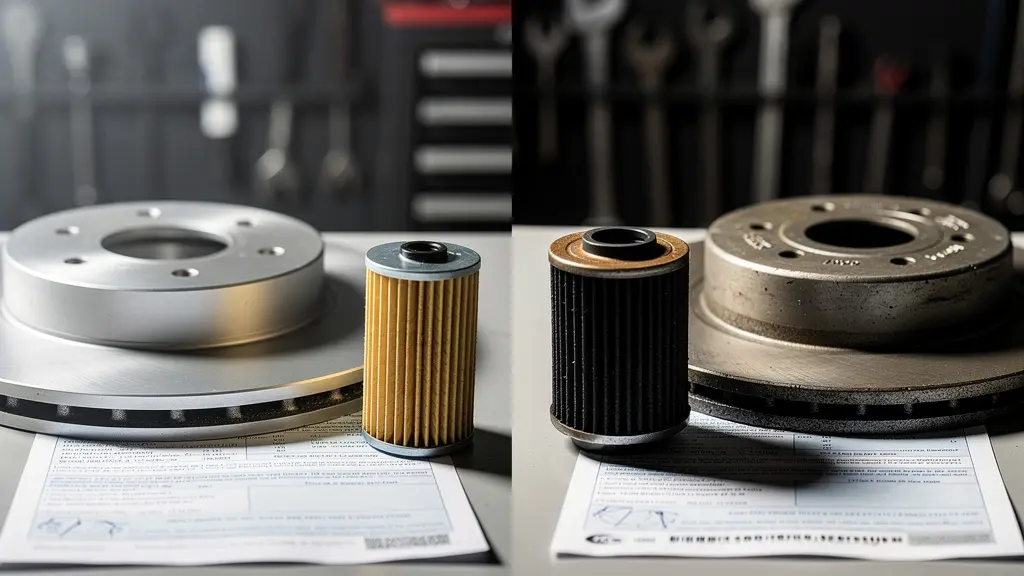
The true cost of a cheap, non-compliant car part isn’t its price tag—it’s the risk of a voided insurance policy and a denied warranty claim when you need it most.
- Legitimate, certified aftermarket parts are legally protected and will not void your warranty; dangerous counterfeits and non-compliant parts will.
- Insurers can deny a claim not for the modification itself, but for the « material non-disclosure »—your failure to declare a part that changes the vehicle’s risk profile.
Recommendation: Prioritise parts with clear certification (e.g., DOT, CAPA) over unverified online bargains, and always document your repairs and declare performance-altering modifications to your insurer.
The temptation is undeniable. A quick search online reveals a critical car part for a fraction of the dealership’s price. For any cost-conscious car owner, it seems like a smart, savvy move to save money on repairs. The common advice often falls into two camps: the overly cautious, who insist on only using expensive manufacturer-branded parts, and the bargain hunters, who believe a part is a part, no matter the source. This simplistic view overlooks the complex reality of the automotive parts market, which includes everything from high-quality components to dangerous fakes.
But what if the real issue isn’t about choosing between the dealer and the internet? What if the key to saving money without compromising safety or your insurance coverage lies elsewhere? The true dividing line isn’t between « original » and « aftermarket, » but between « compliant » and « non-compliant. » Understanding this distinction is the single most important factor in protecting your vehicle, your finances, and your safety. A non-compliant part doesn’t just risk mechanical failure; it silently alters your vehicle’s risk profile, potentially giving your insurer grounds to deny a claim entirely.
This article will guide you through that critical distinction. We won’t just tell you what to avoid; we will equip you with the knowledge to identify dangerous counterfeits, understand your legal rights regarding warranty, and recognise which modifications truly put your insurance policy at risk. By moving beyond brand names and focusing on certification and compliance, you can confidently maintain your vehicle, save money, and ensure you remain fully covered.
For those who prefer a condensed format, the following video breaks down some of the most common misconceptions about using aftermarket parts and their impact on your vehicle’s coverage.
To navigate this complex topic, we have structured this guide to address the most pressing questions and concerns, from identifying fake parts to understanding the fine print of your insurance policy. Explore the sections below to become a more informed and protected car owner.
Contents: Understanding the Risks of Non-Compliant Car Parts
- How to spot a fake oil filter that could destroy your engine?
- Original part vs. OEM: is there a real quality difference?
- £20 brake discs: the saving that adds 10m to your stopping distance
- Retrofit LED bulbs: why are 90% of kits sold are illegal on the road?
- Can the manufacturer void your warranty for using a third-party battery?
- Why paying dealership labor rates is no longer mandatory for your service book?
- Rims, stickers, or remapping: what truly voids your policy?
- When should you replace your brake discs to ensure a safe stop?
How to spot a fake oil filter that could destroy your engine?
A counterfeit oil filter is one of the most insidious non-compliant parts you can install. It looks identical to the genuine article on the outside, but internally it’s a ticking time bomb for your engine. As industry experts have reported a surge in counterfeit filters, the risk to unsuspecting consumers has never been higher. These fakes use inferior filter media that fails to trap harmful contaminants, poor-quality adhesives that can dissolve into your oil, and weak anti-drain-back valves that cause catastrophic dry starts.
The savings of a few pounds are quickly erased by the thousands required for an engine rebuild. The danger lies in their deceptive appearance. However, there are subtle but crucial differences you can look for before installation. A genuine filter feels substantial in your hand, while a fake is often noticeably lighter due to cheaper, less dense materials. The external printing on a fake might have slight font or colour inaccuracies, and the internal components, if visible, will show the true lack of quality.
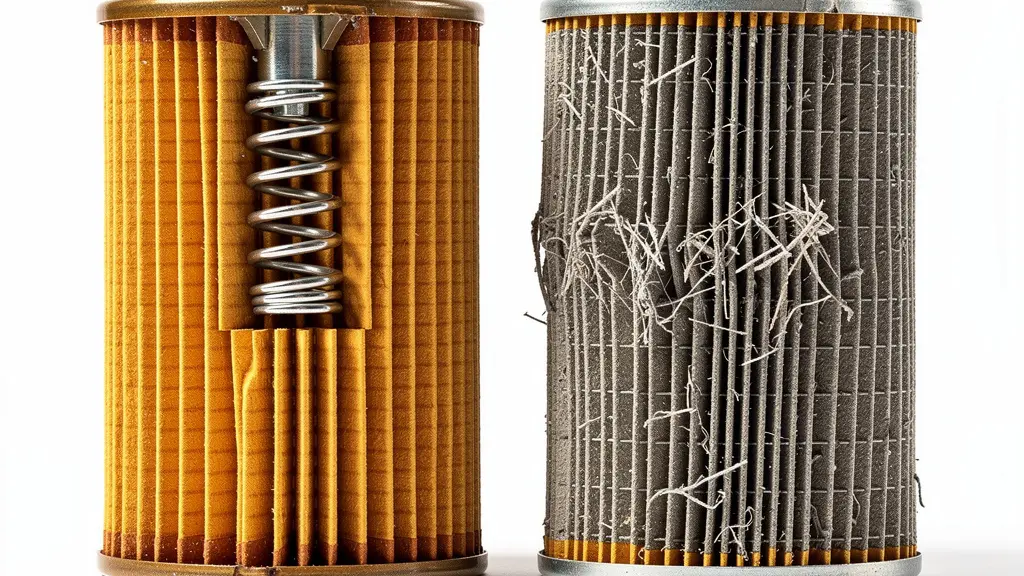
As the cutaway image above illustrates, the differences are stark. A genuine filter has densely packed, uniform pleats for maximum filtration surface area. A counterfeit uses sparse, irregular paper that allows damaging particles to circulate freely. To avoid this risk, always buy from reputable, authorised dealers rather than anonymous online marketplaces. Pay close attention to the packaging, build quality, and weight. If a deal seems too good to be true, it almost certainly is.
Original part vs. OEM: is there a real quality difference?
This is a central question for any car owner looking to save money on repairs. The answer requires a clear understanding of the terminology. An « Original Equipment » (OE) or « Genuine » part is the component sold in a car manufacturer’s branded box. An « Original Equipment Manufacturer » (OEM) part, however, is often the very same component, made on the same assembly line by the same company, but sold in that company’s own packaging without the car brand’s logo. The physical part is identical.
Quality aftermarket parts take this a step further. These are components made by companies that may or may not supply the original manufacturer, but they are designed to meet or exceed the original specifications. In the United States, your right to use these parts is protected by law. The Magnuson-Moss Warranty Act prevents manufacturers from voiding your vehicle’s warranty simply because you used an aftermarket part. The burden of proof is on them to show that the aftermarket part directly caused the failure you’re claiming.
As one automotive industry analysis states, the distinction is often more about branding than substance. According to an Auto Insurance Industry Report, « Parts labeled as OEM are physically identical to the original manufacturer’s part, minus the logo, proving the ‘quality difference’ is often just branding. » To ensure quality, look for parts certified by organisations like the Certified Automotive Parts Association (CAPA), which independently tests and verifies that aftermarket parts are functionally equivalent to the original.
The following table, based on information from consumer automotive guides, breaks down the key legal and financial differences between these part categories. This analysis of warranty protections highlights the security that certified aftermarket parts can offer.
| Aspect | OEM Parts | Quality Aftermarket |
|---|---|---|
| Warranty Protection | Full coverage | Protected under Magnuson-Moss Act |
| Insurance Coverage | Always covered | Covered if declared |
| Cost Difference | Baseline | 30-50% less expensive |
| Certification Required | Factory certified | CAPA certification recommended |
£20 brake discs: the saving that adds 10m to your stopping distance
Brake systems are the most critical safety feature of your vehicle, and this is where the « compliant vs. non-compliant » distinction becomes a matter of life and death. A set of brake discs advertised for a price like £20, while tempting, is a significant red flag. While this example uses UK pricing, the principle is universal: you cannot manufacture a safety-critical component that meets strict engineering tolerances for such a low cost without cutting dangerous corners.
The performance of a brake disc is determined by its metallurgy—the specific blend of iron, carbon, and other elements used in its casting. High-quality discs use a high-carbon-content iron, which provides excellent thermal stability. This means they can absorb and dissipate the immense heat generated during heavy braking without warping or losing their frictional properties. In contrast, ultra-cheap discs are often made from low-grade, porous iron with inconsistent casting.
Under pressure, this cheap metal behaves dangerously. It cannot manage heat effectively, leading to two critical failures. First, it can cause « brake fade, » where the disc overheats and the friction coefficient drops, making the pedal feel soft and dramatically increasing your stopping distance. Second, the rapid heating and cooling cycles can cause the disc to warp or develop hard spots, leading to severe vibration and uneven braking. That initial saving of £50 or £100 could directly translate to an extra 10 metres of stopping distance in an emergency—the difference between a near-miss and a serious collision.
Retrofit LED bulbs: why are 90% of kits sold are illegal on the road?
Upgrading to LED headlights seems like a straightforward way to improve night-time visibility and modernise a vehicle’s look. However, the vast majority of « plug-and-play » retrofit LED bulb kits sold online are not legal for road use and are dangerously non-compliant. The issue isn’t the LED technology itself, but how it’s implemented. A headlight’s reflector and lens housing are precisely engineered for a specific type of light source—typically a halogen filament positioned at an exact point.
A retrofit LED bulb has multiple light-emitting diodes arranged on a circuit board, which can never perfectly replicate the 360-degree light pattern of a single halogen filament. This mismatch creates uncontrolled light scatter and severe glare, blinding oncoming drivers and pedestrians. It might make the road immediately in front of you seem brighter, but it ruins your long-distance vision and creates a significant public safety hazard. Because of this, using a simple LED bulb in a housing designed for a halogen bulb is illegal in most jurisdictions. In fact, a 2024 study by the Insurance Institute for Highway Safety found that 43% of aftermarket LED kits tested failed to meet basic beam pattern requirements for road use.

As the comparison shows, a legal, compliant beam pattern has a sharp horizontal « cutoff » line that directs light onto the road and away from the eyes of other drivers. An illegal retrofit kit produces a scattered, blotchy pattern with intense glare. The only legal way to upgrade to LED is to replace the entire headlight assembly with a unit that is DOT (Department of Transportation) or ECE (Economic Commission for Europe) certified as a complete LED system. If you are in an accident and your vehicle is found to have non-compliant lighting, your insurer could argue it was a contributing factor and deny your claim.
Can the manufacturer void your warranty for using a third-party battery?
This is a common fear, but one that is largely unfounded thanks to consumer protection laws like the Magnuson-Moss Warranty Act in the US. The core principle, as outlined by the Federal Trade Commission, is that a manufacturer cannot void your warranty simply because you used a third-party part. This applies to batteries, oil filters, tyres, and other routine replacement items. The manufacturer must prove that the specific aftermarket part you installed was the direct cause of the failure for which you are seeking warranty coverage.
However, this protection is not a blank check. The nuance lies in ensuring the third-party part is a compliant and direct equivalent to the original. This is especially true in modern vehicles with complex electrical systems. Many new cars feature an Intelligent Battery Sensor (IBS) that monitors the battery’s health and adjusts the alternator’s charging strategy. If you replace the battery, the new one must be « registered » with the vehicle’s Engine Control Unit (ECU) so the system knows its specifications (e.g., type, capacity, age).
Case Study: The Unregistered Aftermarket Battery
A case involving a modern BMW highlighted this exact issue. The owner replaced the original battery with a non-OEM battery but failed to have it registered with the car’s ECU. The vehicle’s charging system, still operating on the parameters of the old battery, overcharged the new one, leading to electrical faults. According to a report on performance upgrades and warranty coverage, the manufacturer rightfully denied the warranty claim for the damaged electrical components, arguing that the failure was caused not by the battery being « aftermarket, » but by the improper installation and failure to follow the required service procedure. The part itself was fine; its integration into the system was non-compliant.
Therefore, you are free to use a third-party battery, but you must ensure it meets the manufacturer’s specifications for type (AGM, EFB), size, and capacity, and that you follow the correct installation and registration procedures for your specific vehicle.
Why paying dealership labor rates is no longer mandatory for your service book?
For decades, it was common belief that you had to have your car serviced at an authorised dealership to keep your warranty intact. This myth allowed dealerships to command premium labor rates, leaving owners feeling trapped. However, consumer protection laws give you the freedom to have your vehicle serviced by any qualified independent repair shop without affecting your warranty coverage.
The key is documentation. The responsibility is on you to prove that the servicing was performed according to the manufacturer’s recommended schedule and specifications. You are not paying the dealership for the service itself, but for the automatic and seamless record-keeping that comes with it. A good independent shop can provide the same level of service, but you must be diligent in managing the paperwork.
To protect your warranty, you must ensure the independent shop does the following: uses fluids and parts that meet the OEM specifications (they don’t have to be OEM-branded), provides detailed receipts that list the parts used and services performed, and, for modern vehicles, has the equipment to update your car’s digital service record. Keeping a meticulous file with all service invoices is your ultimate protection if a warranty claim is ever questioned. This diligence empowers you to choose a trusted local mechanic over a costly dealership, so long as they are competent and provide proper documentation.
Key Takeaways
- The critical distinction for safety and insurance is not « OEM vs. Aftermarket, » but « Compliant vs. Non-Compliant. »
- Your warranty cannot be voided simply for using certified aftermarket parts, but the manufacturer can deny a claim if that part is proven to have caused the failure.
- Failing to declare performance-altering modifications to your insurer (material non-disclosure) is more likely to void your policy than the modification itself.
Rims, stickers, or remapping: what truly voids your policy?
Many owners love to personalise their vehicles, but fear that any modification—from simple stickers to a full engine remap—will automatically invalidate their insurance. The truth is more nuanced and hinges on a legal concept called « duty of good faith » or « material non-disclosure. » An insurance policy is a contract based on a calculated risk profile. Any modification that materially changes that risk must be declared to the insurer.
Cosmetic changes like stickers or standard alloy wheels that are within the manufacturer’s specified size range typically do not alter the risk profile and don’t need to be declared. However, modifications that affect performance or handling absolutely do. This includes:
- Engine Remapping (Tuning): Increasing horsepower and torque changes the performance risk.
- Suspension Changes: Lowering or stiffening the suspension alters handling characteristics.
- Non-Standard Wheels/Tyres: Fitting oversized wheels can affect braking, stability, and speedometer accuracy.
- Exhaust System Changes: Aftermarket exhausts that alter performance or noise levels are a material change.
As insurance law experts point out, the policy isn’t voided by the part itself. It’s voided by your failure to tell the insurer about it. If you have an accident and the investigation reveals an undeclared performance modification, the insurer can argue that you breached your contract by misrepresenting the vehicle they agreed to cover. They can then refuse the claim, leaving you liable for all costs.
Case Study: Claim Denied for an Undeclared Exhaust
A powerful real-world example involved a driver whose claim was denied after an accident. According to a report on a case with Desjardins Insurance, the owner had fitted an aftermarket exhaust system but failed to declare it. Even though the vehicle had passed its safety inspection, the insurer classified the undeclared part as a material non-disclosure. They argued it altered the car’s risk profile and that they would have charged a higher premium or refused coverage had they known. Consequently, the claim was denied, and the owner was held financially responsible for the accident.
When should you replace your brake discs to ensure a safe stop?
Knowing when to replace your brake discs is not just about following a mileage guideline; it’s about active, visual inspection. While every disc has a « minimum thickness » measurement stamped on it, this single metric doesn’t tell the whole story. A disc can be above its minimum thickness and still be dangerously unsafe. Your life depends on identifying the warning signs of a compromised braking system before it’s too late.
Overheating is the primary enemy of brake discs. Excessive heat can cause « hard spots » or « bluing » on the disc surface, which are areas where the metal’s crystalline structure has changed. These spots are less effective at generating friction, leading to uneven braking and vibration. Even more dangerous are heat cracks, which often appear as small, spiderweb-like fissures on the surface. While minor crazing can be normal, larger cracks indicate the disc’s structural integrity is compromised and it could fail catastrophically under heavy braking.
Furthermore, environmental factors play a huge role. As automotive maintenance studies indicate, discs in wet or salty climates can suffer from severe corrosion that makes them unsafe long before they wear down to their minimum thickness. Rust can flake off, taking friction material with it and creating an uneven, unreliable braking surface. Therefore, a comprehensive inspection is about more than just a measurement; it’s a holistic assessment of the disc’s condition.
Action Plan: Auditing Your Brake Discs for Safety
- Points of Contact: Identify all key inspection areas. This includes the inner and outer friction surfaces, the outer edge (where the minimum thickness is often stamped), and the central hub for signs of corrosion.
- Data Collection: Inventory all visible signs of wear and damage. Look for deep scoring (grooves), a prominent « lip » on the outer edge, blue or dark heat spots, and any visible cracks.
- Coherence Check: Use a digital caliper to measure the actual friction surface thickness. Compare this measurement to the « MIN THK » value stamped on the disc hub. If the measurement is at or below this value, replacement is mandatory.
- Qualitative Assessment: Scrutinize the disc for critical warning signs that override the thickness measurement. Any visible cracks or significant, dark blue areas of overheating mean the disc is unsafe, regardless of its thickness.
- Integration Plan: If replacement is necessary, formulate a plan. This must include replacing brake pads at the same time as the discs and ensuring you purchase compliant, certified parts for your specific vehicle model.
To ensure your vehicle remains safe, your warranty protected, and your insurance coverage intact, the next step is to apply this critical framework of compliance to every part you purchase and every service you commission. Smart vehicle ownership is not about finding the absolute lowest price; it’s about understanding and managing risk to make informed, responsible decisions.