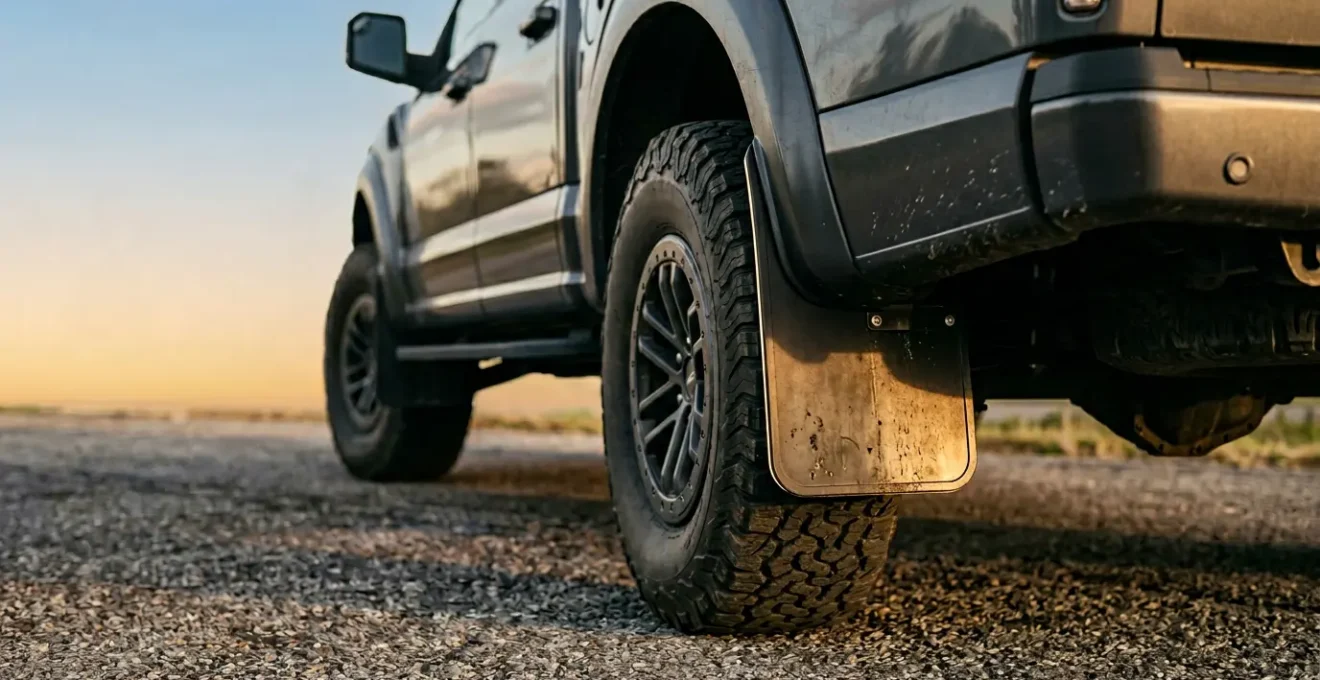
Beyond the debate on style, mud flaps are a calculated investment in preserving your vehicle’s structural integrity, with the highest return on investment among all paint protection methods.
- They act as the first line of defense against mechanical abrasion and chemical corrosion on your car’s most vulnerable lower panels.
- Proper installation is non-negotiable to prevent creating rust, while flexible materials are essential to avoid damage from impacts.
Recommendation: For any driver on rural or motorway routes, mud flaps are not a question of aesthetics but a pragmatic choice to reduce long-term ownership costs and maintain resale value.
Take a close look at any car that frequently travels on motorways or rural roads. You’ll inevitably see it: a sandblasted effect along the rocker panels and behind the wheel arches, peppered with tiny chips and stubborn black dots of tar. This is the visible evidence of a constant battle between your car’s paint and the road itself. For years, the common solution—mud flaps—has been caught in a debate: are they a practical necessity or a hopelessly dated accessory? Many dismiss them based on aesthetics alone, associating them with older vehicles or heavy-duty trucks.
But what if this entire debate misses the point? From a body shop perspective, where we see the long-term consequences of daily driving, the question isn’t about style. It’s about a cost-of-ownership calculus. The real issue is the relentless attack of two forces: mechanical abrasion from gravel and debris, and chemical corrosion from tar and road salt. Viewing mud flaps through this lens transforms them from a questionable accessory into a form of low-cost bodywork insurance. This guide will break down their function not as a fashion statement, but as a critical component in a proactive vehicle protection strategy, examining everything from correct installation to their surprising financial benefits.
To fully understand the practical implications and strategic value of this accessory, this article breaks down every critical aspect. The following sections will guide you through the technical, financial, and safety considerations that turn mud flaps into a smart investment for the savvy driver.
Summary: Are mud flaps a tacky accessory or an indispensable investment?
- How to install mud flaps without creating future rust spots?
- How much do you save on tar remover products thanks to mud flaps?
- Road Courtesy: Why do mud flaps reduce spray for those following you?
- Why do rigid mud flaps break on the first high curb?
- Color-matched mud flaps: tacky or stylish for your sports car?
- Why is road salt the #1 enemy of your underbody?
- ‘Bikini’ partial kit: Is protecting just the bumper and hood enough?
- Is PPF (Paint Protection Film) worth its price for a non-sports car?
How to Install Mud Flaps Without Creating Future Rust Spots?
The single biggest mistake a car owner can make is turning a preventative measure into a source of damage. An improperly installed mud flap, especially one that requires drilling, can create the perfect entry point for moisture, guaranteeing future rust. When you drill a hole into a body panel, you break the factory’s protective E-coat, primer, and paint layers. Without immediate and proper sealing, that raw metal edge will begin to corrode from the inside out, hidden behind the very accessory meant to protect it. This isn’t just a cosmetic issue; it’s a threat to the panel’s structural integrity.
The professional approach is about creating a completely sealed system. This involves meticulously preparing the drilled holes, using hardware that prevents corrosion between dissimilar metals, and creating a final waterproof barrier. For modern vehicles, especially those with aluminum bodies like many new trucks, this is even more critical to prevent galvanic corrosion. Following a precise, multi-step process ensures your mud flaps protect your car without introducing a new, more insidious problem.
Your Action Plan: 5 Pro-Level Steps for Rust-Free Mud Flap Installation
- Use a center punch to mark drill points precisely, preventing bit-walk that could enlarge holes and create moisture entry points.
- Apply touch-up paint or zinc-rich primer inside each fresh hole immediately after drilling, before inserting any hardware.
- Use nylon or plastic washers between metal screws and aluminum body panels to prevent galvanic corrosion on modern vehicles like the Ford F-150.
- Finish each screw installation with a small dab of silicone sealant around the screw head to create a waterproof barrier.
- For no-drill installations, use automotive-grade 3M VHB tape combined with custom-fit clips for secure mounting without penetrating the body.
How Much Do You Save on Tar Remover Products Thanks to Mud Flaps?
The savings from mud flaps are often miscalculated. Most people think about the cost of a few bottles of tar and bug remover per year, which seems negligible. However, this overlooks the real cost, which is the cumulative damage to your vehicle’s clear coat. Every time you use a harsh chemical solvent or abrasive clay bar to remove bonded contaminants, you are minutely eroding the protective clear coat layer. Over years, this repeated chemical and mechanical cleaning thins the paint’s defenses, making it more susceptible to fading, oxidation, and eventual failure. The cost isn’t the £15 bottle of remover; it’s the potential £500+ cost of a professional machine polish to restore the finish, or even a £1000+ respray of the rocker panels down the line.
Mud flaps drastically reduce the amount of tar, asphalt, and chemical grime that gets thrown onto your lower body panels. This means you’ll spend less time and money on aggressive cleaning products, and more importantly, you’ll preserve the longevity and thickness of your factory clear coat. The true financial benefit is measured not in bottles of degreaser saved, but in the deferred cost of long-term paint correction and repair.
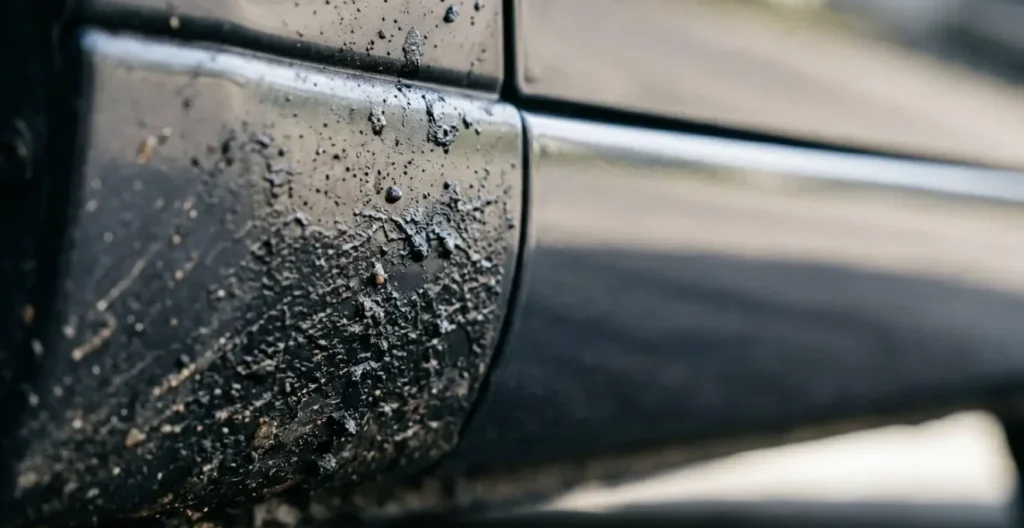
As this image illustrates, the accumulation of road debris is aggressive and destructive. By physically blocking a majority of this spray, mud flaps keep your paint cleaner and reduce the need for damaging cleaning procedures. This is a clear example of how a small initial investment pays dividends by preserving the most expensive and visible part of your car: its paint job.
Road Courtesy: Why Do Mud Flaps Reduce Spray for Those Following You?
While protecting your own vehicle is a primary motivator, the role of mud flaps in road safety is a significant and often legally mandated benefit, especially for commercial vehicles. At high speeds on wet roads, a vehicle’s tires act like powerful pumps, atomizing and displacing huge volumes of water, dirt, and debris into a dense, vision-obscuring cloud. This « spray » can completely blind a following driver, dramatically increasing the risk of an accident. In fact, visibility-related accidents account for up to 23% of traffic incidents in rainy conditions.
Mud flaps work as a simple but effective aerodynamic barrier. They interrupt the trajectory of the high-velocity spray coming off the top and back of the tire, redirecting it downwards towards the road surface instead of into the windshield of the car behind you. The effectiveness of this is not left to chance; stringent European standards require that anti-spray flaps drain at least 70% of this splashing water and dirt. By controlling this dangerous spray, you are not just being courteous; you are actively contributing to a safer driving environment for everyone, reducing the chances of a costly and dangerous collision caused by a moment of temporary blindness.
Why Do Rigid Mud Flaps Break on the First High Curb?
The failure of cheap, rigid mud flaps is a predictable lesson in basic physics. When a stiff, inflexible plastic flap strikes an object—like a high curb, a speed bump, or a block of ice—it cannot dissipate the impact energy. Instead, it transfers that force directly to its weakest point. Often, this results in the flap itself shattering. Worse, the force can be transferred to the mounting points on your vehicle’s bodywork, potentially cracking the fender liner, bending the metal bracket, or even pulling the screws out of the sheet metal, causing far more damage than the flap was worth.
This is why quality mud flaps, particularly in the performance and off-road communities, are made from flexible materials like polyurethane or a specialized rubber blend. These materials are designed to bend and deform upon impact, absorbing the energy and then returning to their original shape. Some advanced designs, like those from Rally Armor, even incorporate an engineered failure point in their hardware. The yielding brackets are designed to move and flex with the flap, preventing catastrophic failure of either the flap or the car’s body. The choice is simple: a rigid flap creates a liability, while a flexible flap provides resilient protection.
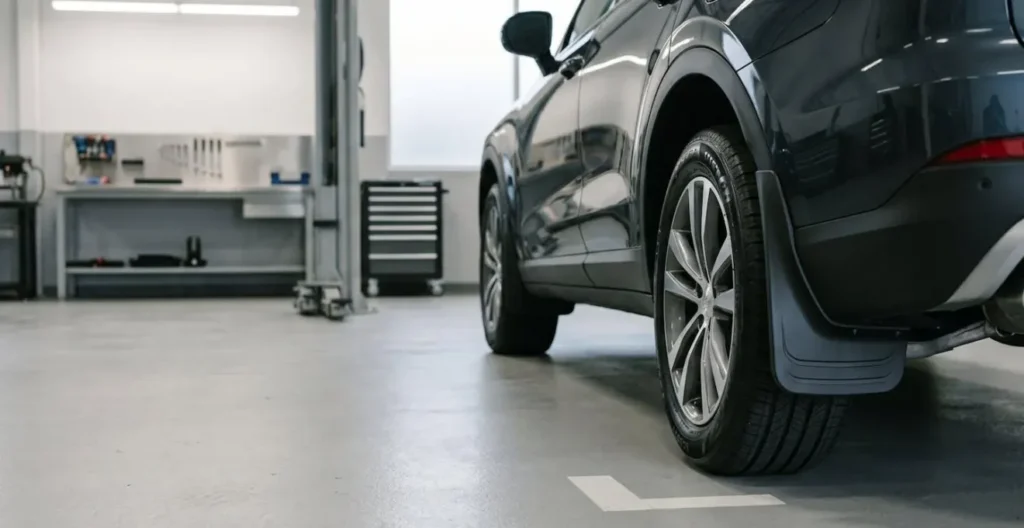
The visual difference is clear. A flexible material can contort to navigate obstacles without damage, ensuring the protection remains effective without becoming a source of new problems. This flexibility is not a bug; it’s the most critical feature of a well-designed mud flap.
Color-Matched Mud Flaps: Tacky or Stylish for Your Sports Car?
The aesthetic debate around mud flaps is where subjectivity reigns, but even here, there are established « rules » within different automotive subcultures. The question of « tacky or stylish » depends entirely on the vehicle’s overall theme and the owner’s intent. A bright red mud flap on a stock silver sedan might look out of place, but on a 90s-era Japanese tuner car, it’s a period-correct nod to a specific style. Similarly, a gloss black flap might disappear on a dark car, while a color-matched one on a luxury vehicle aims for a seamless, factory-finish look.
From a pragmatic standpoint, the goal is often for the flap to be as unobtrusive as possible. A simple, matte black finish tends to blend into the shadows of the wheel well, putting the focus on the car’s lines rather than the accessory. However, in certain contexts—like rally builds or retro-inspired projects—the mud flap can become a deliberate style accent, much like a spoiler or a set of wheels. The key is understanding the language of the style you’re aiming for. The following table breaks down common approaches to help you decide which aesthetic path aligns with your vehicle.
This decision is less about a universal right or wrong and more about aligning with a specific aesthetic goal, as detailed in an analysis from sources like car culture publication CarThrottle. The table below summarizes these distinct approaches.
| Style Category | Typical Mud Flap Choice | Vehicle Example | Aesthetic Goal |
|---|---|---|---|
| Rally-Spec | Matte black with contrasting logo | Subaru WRX | Performance-oriented, disappears into shadow |
| OEM+ (Subtle Enhancement) | Carbon fiber or subtle texture | Porsche | Premium materials, refined appearance |
| VIP Style | Perfectly color-matched gloss | Lexus | Seamless integration, luxurious finish |
| Retro-Tuner | Bold contrasting color | 90s Japanese cars (Honda, Nissan) | Eye-catching accent, nostalgic styling |
Why Is Road Salt the #1 Enemy of Your Underbody?
Road salt is the most aggressive and pervasive agent of chemical corrosion your vehicle will ever face. It’s far more destructive than simple rainwater. When dissolved in water, salt (sodium chloride) creates an electrolyte solution that dramatically accelerates the electrochemical process of rusting. It doesn’t just cause surface rust; it seeps into seams, spot welds, and hidden cavities in your car’s underbody, chassis, and suspension components. This is where the real, structural damage occurs, often out of sight until it becomes a major safety and financial issue.
In countries with harsh winters, the impact is severe. For example, UK MOT testing data shows approximately 18% of vehicle failures involve corrosion-related issues, with this rate being much higher in regions that use a lot of road salt. The salt-brine mixture kicked up by your tires coats everything, from brake lines to fuel tanks to electrical connectors, promoting decay and premature failure. The effect is so pronounced that studies have found vehicles in high salt-usage areas can have lifespans 2-3 years shorter than identical cars in salt-free regions. Mud flaps create a physical barrier, significantly reducing the amount of this corrosive spray that reaches the most vulnerable parts of your car’s lower body and undercarriage, making them a crucial piece of winter armor.
‘Bikini’ Partial Kit: Is Protecting Just the Bumper and Hood Enough?
Partial Paint Protection Film (PPF) kits, often called « bikini cuts » or « track packs, » are a popular and cost-effective way to protect a vehicle’s most forward-facing surfaces. By covering the front bumper, a portion of the hood, and the mirror caps, they provide excellent defense against stone chips and bug impacts from vehicles you are following. It’s a smart strategy for preventing the most common type of road rash. However, it is an incomplete solution because it only addresses one direction of threat: direct frontal impacts.
This strategy leaves the entire lower half of your car—the rocker panels, the area behind the wheels, and the lower doors—completely exposed to the mechanical abrasion from your own tires. As your wheels turn, they are constantly sandblasting these areas with gravel, sand, and debris. This is a different type of damage that a front-end PPF kit does nothing to prevent. The most effective strategy, therefore, is a complementary one.
Case Study: Complementary Protection on a C7 Corvette
A 2014 Corvette owner, facing damage from sticky performance tires, implemented a smart, dual-protection strategy. They combined a front-end « bikini » PPF kit to handle forward-facing debris with a set of aftermarket mud flaps to control the aggressive lateral spray from the tires. This combination effectively protected over 80% of the vehicle’s most common impact zones at a fraction of the cost of a full-body PPF wrap, demonstrating a perfect synergy between the two protection methods.
Key Takeaways
- Mud flaps are not an aesthetic choice but a financial one, offering the highest return on investment for preventing lower body damage.
- Installation is critical: improper drilling creates rust points, defeating the purpose of the accessory. Always seal drilled holes.
- Material matters: flexible polyurethane or rubber absorbs impacts, while rigid plastic transfers force to your car’s body, causing damage.
- They are a vital safety feature, reducing dangerous road spray for following vehicles and improving visibility in wet conditions.
Is PPF (Paint Protection Film) Worth Its Price for a Non-Sports Car?
Paint Protection Film (PPF) offers the ultimate defense against stone chips, scratches, and environmental contaminants. Its self-healing properties can make minor abrasions disappear, keeping the paint beneath it in pristine, factory-new condition. However, this premium protection comes at a premium price. With PPF costs ranging from $900 for a partial front-end to over $7,000 for a full-vehicle wrap, the question for the owner of a non-sports car is one of return on investment.
The financial justification for PPF is primarily linked to preserving resale value. A vehicle’s value is significantly impacted by the condition of its original paint. Market analysis consistently shows that vehicles with original factory paint can sell for 5% to 15% more than those with repainted panels, as a respray is often a red flag for a potential prior accident. For a high-value or collectible car, PPF can easily pay for itself at trade-in. For a daily-driven sedan or SUV, the calculus is more nuanced. While full PPF might be overkill, a combination of a partial front kit and a set of mud flaps often represents the most logical and cost-effective approach. The following table puts these choices into perspective, highlighting where mud flaps deliver unparalleled value.
This table provides a clear cost-benefit analysis of the most common vehicle protection methods.
| Protection Method | Approximate Cost | Primary Protection Zone | Protection Type | Cost per Protected Zone |
|---|---|---|---|---|
| Mud Flaps | ~$150 | Lower body sides, rocker panels | Physical debris barrier | Highest value (lowest cost/high impact) |
| Ceramic Coating | ~$800 | All exterior surfaces | Chemical/UV protection, no impact resistance | Medium value |
| Front PPF (Partial) | ~$1,500 | Hood, bumper, fenders | Impact + chemical protection | Good value for high-risk areas |
| Full PPF | $5,000-$8,000 | Entire vehicle exterior | Complete impact + chemical protection | Premium investment |
The data is clear: for protecting the high-impact lower body sides from the specific damage caused by tire spray, no other method offers the same bang-for-your-buck as a simple set of mud flaps.
Ultimately, the choice comes down to a pragmatic assessment of your driving habits and your long-term goals for the vehicle. The next time you wash your car, take a moment to inspect the rocker panels and the area behind the wheels. The damage you see accumulating there is the most compelling argument for making this small, smart investment in your vehicle’s future health and value.